

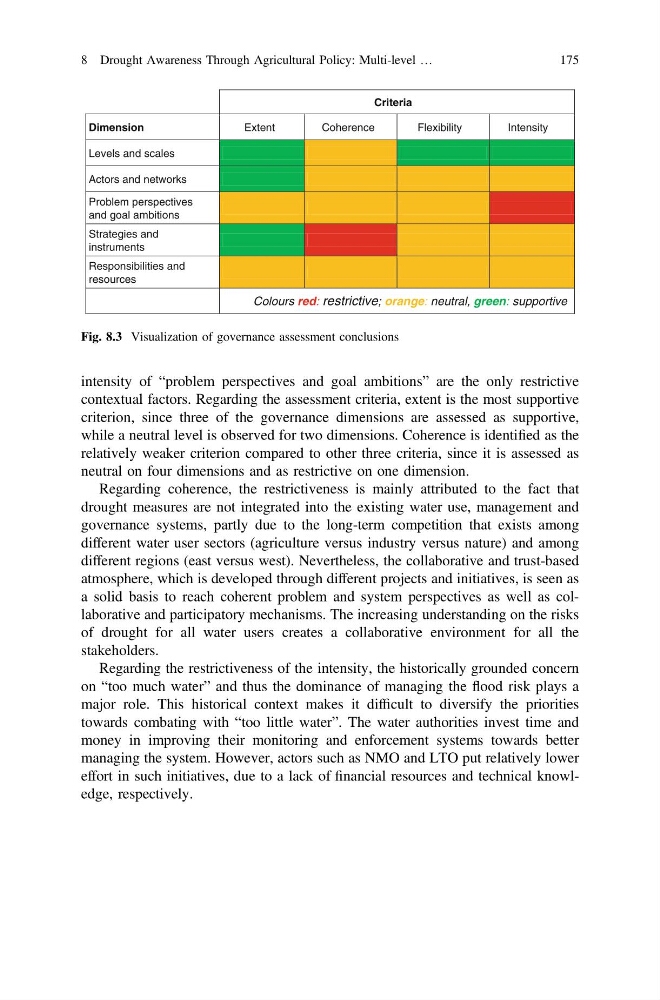
intensity of “problem perspectives and goal ambitions” are the only restrictive
contextual factors. Regarding the assessment criteria, extent is the most supportive
criterion, since three of the governance dimensions are assessed as supportive,
while a neutral level is observed for two dimensions. Coherence is identified as the
relatively weaker criterion compared to other three criteria, since it is assessed as
neutral on four dimensions and as restrictive on one dimension.
Regarding coherence, the restrictiveness is mainly attributed to the fact that
drought measures are not integrated into the existing water use, management and
governance systems, partly due to the long-term competition that exists among
different water user sectors (agriculture versus industry versus nature) and among
different regions (east versus west). Nevertheless, the collaborative and trust-based
atmosphere, which is developed through different projects and initiatives, is seen as
a solid basis to reach coherent problem and system perspectives as well as collaborative and participatory mechanisms. The increasing understanding on the risks
of drought for all water users creates a collaborative environment for all the
stakeholders.
Regarding the restrictiveness of the intensity, the historically grounded concern
on “too much water” and thus the dominance of managing the flood risk plays a
major role. This historical context makes it difficult to diversify the priorities
towards combating with “too little water”. The water authorities invest time and
money in improving their monitoring and enforcement systems towards better
managing the system. However, actors such as NMO and LTO put relatively lower
effort in such initiatives, due to a lack of financial resources and technical knowledge, respectively.
Criteria
Dimension
Extent
Coherence
Flexibility
Intensity
Levels and scales
Actors and networks
Problem perspectives
and goal ambitions
Strategies and
instruments
Responsibilities and
resources
Colours red: restrictive; orange: neutral, green: supportive
Fig. 8.3 Visualization of governance assessment conclusions
8 Drought Awareness Through Agricultural Policy: Multi-level …
175
contextual factors. Regarding the assessment criteria, extent is the most supportive
criterion, since three of the governance dimensions are assessed as supportive,
while a neutral level is observed for two dimensions. Coherence is identified as the
relatively weaker criterion compared to other three criteria, since it is assessed as
neutral on four dimensions and as restrictive on one dimension.
Regarding coherence, the restrictiveness is mainly attributed to the fact that
drought measures are not integrated into the existing water use, management and
governance systems, partly due to the long-term competition that exists among
different water user sectors (agriculture versus industry versus nature) and among
different regions (east versus west). Nevertheless, the collaborative and trust-based
atmosphere, which is developed through different projects and initiatives, is seen as
a solid basis to reach coherent problem and system perspectives as well as collaborative and participatory mechanisms. The increasing understanding on the risks
of drought for all water users creates a collaborative environment for all the
stakeholders.
Regarding the restrictiveness of the intensity, the historically grounded concern
on “too much water” and thus the dominance of managing the flood risk plays a
major role. This historical context makes it difficult to diversify the priorities
towards combating with “too little water”. The water authorities invest time and
money in improving their monitoring and enforcement systems towards better
managing the system. However, actors such as NMO and LTO put relatively lower
effort in such initiatives, due to a lack of financial resources and technical knowledge, respectively.
Criteria
Dimension
Extent
Coherence
Flexibility
Intensity
Levels and scales
Actors and networks
Problem perspectives
and goal ambitions
Strategies and
instruments
Responsibilities and
resources
Colours red: restrictive; orange: neutral, green: supportive
Fig. 8.3 Visualization of governance assessment conclusions
8 Drought Awareness Through Agricultural Policy: Multi-level …
175