

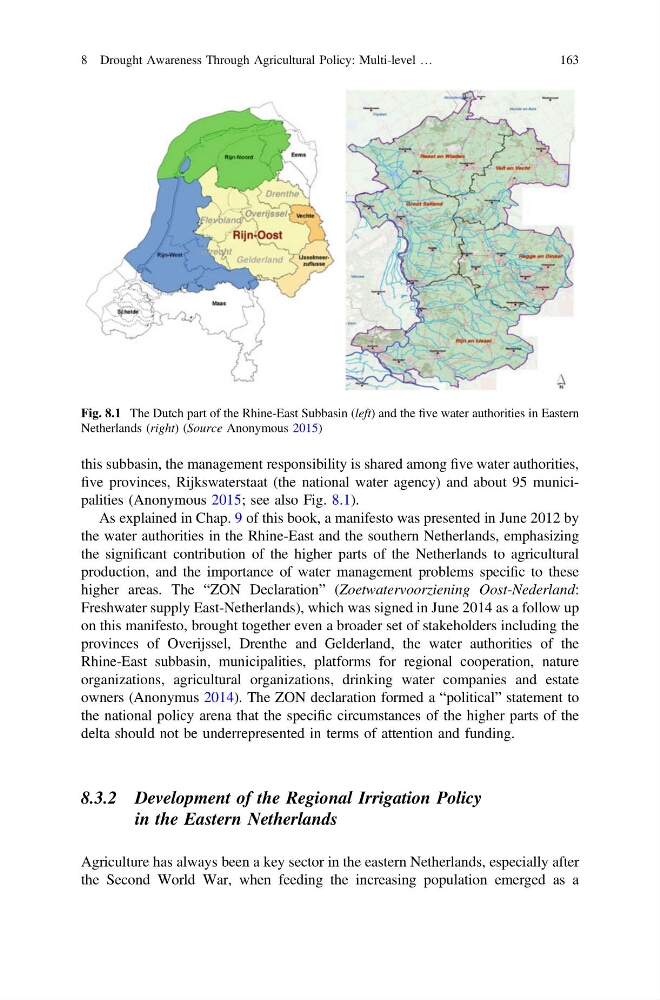
this subbasin, the management responsibility is shared among five water authorities,
five provinces, Rijkswaterstaat (the national water agency) and about 95 municipalities (Anonymous 2015; see also Fig. 8.1).
As explained in Chap. 9 of this book, a manifesto was presented in June 2012 by
the water authorities in the Rhine-East and the southern Netherlands, emphasizing
the significant contribution of the higher parts of the Netherlands to agricultural
production, and the importance of water management problems specific to these
higher areas. The “ZON Declaration” (Zoetwatervoorziening Oost-Nederland:
Freshwater supply East-Netherlands), which was signed in June 2014 as a follow up
on this manifesto, brought together even a broader set of stakeholders including the
provinces of Overijssel, Drenthe and Gelderland, the water authorities of the
Rhine-East subbasin, municipalities, platforms for regional cooperation, nature
organizations, agricultural organizations, drinking water companies and estate
owners (Anonymus 2014). The ZON declaration formed a “political” statement to
the national policy arena that the specific circumstances of the higher parts of the
delta should not be underrepresented in terms of attention and funding.
8.3.2 Development of the Regional Irrigation Policy
in the Eastern Netherlands
Agriculture has always been a key sector in the eastern Netherlands, especially after
the Second World War, when feeding the increasing population emerged as a
Fig. 8.1 The Dutch part of the Rhine-East Subbasin (left) and the five water authorities in Eastern
Netherlands (right) (Source Anonymous 2015)
8 Drought Awareness Through Agricultural Policy: Multi-level …
163
five provinces, Rijkswaterstaat (the national water agency) and about 95 municipalities (Anonymous 2015; see also Fig. 8.1).
As explained in Chap. 9 of this book, a manifesto was presented in June 2012 by
the water authorities in the Rhine-East and the southern Netherlands, emphasizing
the significant contribution of the higher parts of the Netherlands to agricultural
production, and the importance of water management problems specific to these
higher areas. The “ZON Declaration” (Zoetwatervoorziening Oost-Nederland:
Freshwater supply East-Netherlands), which was signed in June 2014 as a follow up
on this manifesto, brought together even a broader set of stakeholders including the
provinces of Overijssel, Drenthe and Gelderland, the water authorities of the
Rhine-East subbasin, municipalities, platforms for regional cooperation, nature
organizations, agricultural organizations, drinking water companies and estate
owners (Anonymus 2014). The ZON declaration formed a “political” statement to
the national policy arena that the specific circumstances of the higher parts of the
delta should not be underrepresented in terms of attention and funding.
8.3.2 Development of the Regional Irrigation Policy
in the Eastern Netherlands
Agriculture has always been a key sector in the eastern Netherlands, especially after
the Second World War, when feeding the increasing population emerged as a
Fig. 8.1 The Dutch part of the Rhine-East Subbasin (left) and the five water authorities in Eastern
Netherlands (right) (Source Anonymous 2015)
8 Drought Awareness Through Agricultural Policy: Multi-level …
163