

7.5 Improving Drought Governance in Flanders:
Conclusions and Recommendations
This section presents conclusions and a series of possible recommendations to
improve, from a drought perspective, the water governance context in Flanders.
7.5.1 Overall Conclusions
The Flanders region researched in this chapter shows a limited awareness for the
drought problem. By far, the most recognized problem in the region is flooding.
The first actions are taken by VMM and some stakeholders, such as individual
farmers, as far as agricultural droughts have been more frequent within the last
decade. Thus, the VMM approach is mainly based on a scientific technocratic
approach which produces modelling results to assess drought risks following the
specificities of possible droughts (hydrological versus agricultural droughts or water
scarcity). The estimated results are taken as basis for setting the policy agenda and
development of activities. As described, Flanders takes forward a very scientific and
centralized approach. The stakeholder involvement is already improving but is still
limited. Measures are proposed and developed by VMM, stakeholders such as
farmers, have difficulties to influence suitable solutions. Attention and regulations
Governance Criteria
Governance
Dimensions
Extent
Coherence
Flexibility
Intensity
Levels & scales
Actors & networks
Problem perceptions
& goal ambitions
Strategies &
i
nstruments
Responsibilities &
resources
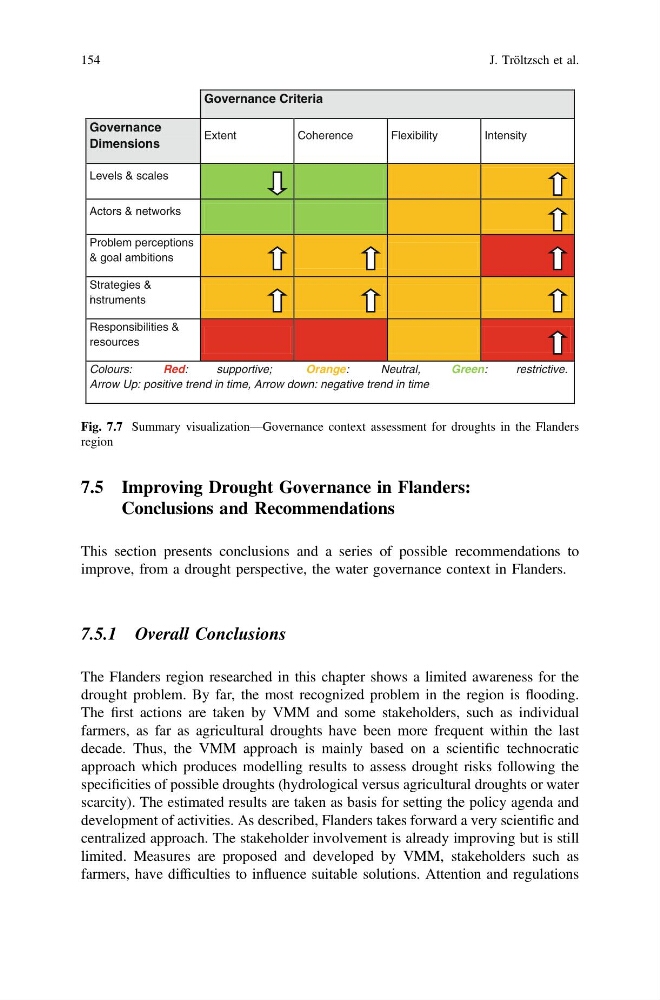
Colours:
Red:
supportive;
Orange:
Neutral,
Green:
restrictive.
Arrow Up: positive trend in time, Arrow down: negative trend in time
Fig. 7.7 Summary visualization—Governance context assessment for droughts in the Flanders
region
154
J. Tröltzsch et al.
Conclusions and Recommendations
This section presents conclusions and a series of possible recommendations to
improve, from a drought perspective, the water governance context in Flanders.
7.5.1 Overall Conclusions
The Flanders region researched in this chapter shows a limited awareness for the
drought problem. By far, the most recognized problem in the region is flooding.
The first actions are taken by VMM and some stakeholders, such as individual
farmers, as far as agricultural droughts have been more frequent within the last
decade. Thus, the VMM approach is mainly based on a scientific technocratic
approach which produces modelling results to assess drought risks following the
specificities of possible droughts (hydrological versus agricultural droughts or water
scarcity). The estimated results are taken as basis for setting the policy agenda and
development of activities. As described, Flanders takes forward a very scientific and
centralized approach. The stakeholder involvement is already improving but is still
limited. Measures are proposed and developed by VMM, stakeholders such as
farmers, have difficulties to influence suitable solutions. Attention and regulations
Governance Criteria
Governance
Dimensions
Extent
Coherence
Flexibility
Intensity
Levels & scales
Actors & networks
Problem perceptions
& goal ambitions
Strategies &
i
nstruments
Responsibilities &
resources
Colours:
Red:
supportive;
Orange:
Neutral,
Green:
restrictive.
Arrow Up: positive trend in time, Arrow down: negative trend in time
Fig. 7.7 Summary visualization—Governance context assessment for droughts in the Flanders
region
154
J. Tröltzsch et al.