

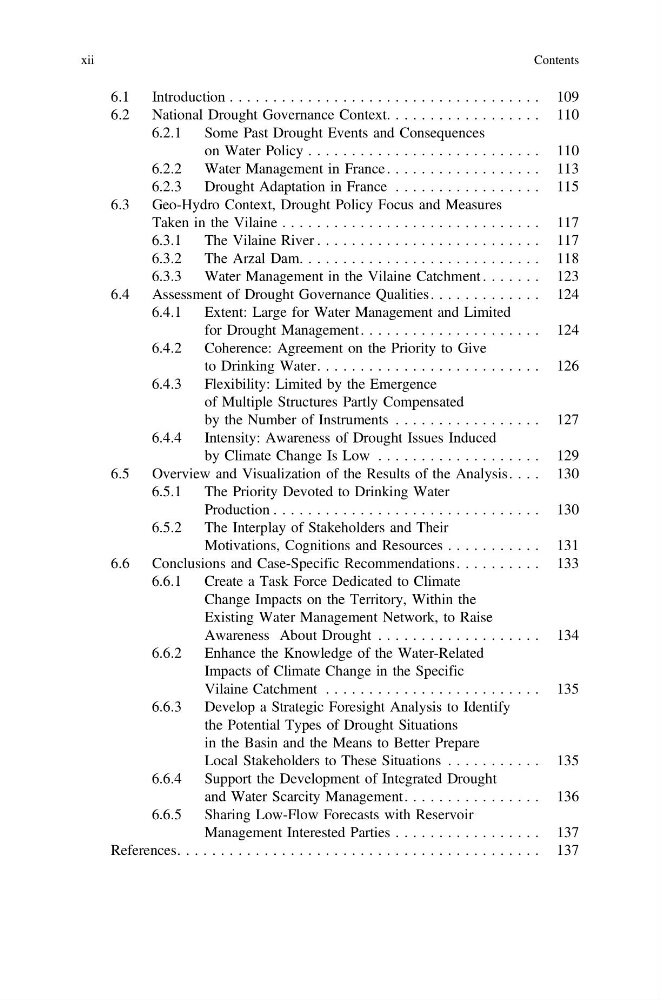
6.1 Introduction . . . . . . . . . . . . . . . . . . . . . . . . . . . . . . . . . . . . 109
6.2 National Drought Governance Context. . . . . . . . . . . . . . . . . . 110
6.2.1
Some Past Drought Events and Consequences
on Water Policy . . . . . . . . . . . . . . . . . . . . . . . . . . . 110
6.2.2
Water Management in France . . . . . . . . . . . . . . . . . . 113
6.2.3
Drought Adaptation in France . . . . . . . . . . . . . . . . . 115
6.3 Geo-Hydro Context, Drought Policy Focus and Measures
Taken in the Vilaine . . . . . . . . . . . . . . . . . . . . . . . . . . . . . . 117
6.3.1
The Vilaine River . . . . . . . . . . . . . . . . . . . . . . . . . . 117
6.3.2
The Arzal Dam. . . . . . . . . . . . . . . . . . . . . . . . . . . . 118
6.3.3
Water Management in the Vilaine Catchment . . . . . . . 123
6.4 Assessment of Drought Governance Qualities. . . . . . . . . . . . . 124
6.4.1
Extent: Large for Water Management and Limited
for Drought Management . . . . . . . . . . . . . . . . . . . . . 124
6.4.2
Coherence: Agreement on the Priority to Give
to Drinking Water. . . . . . . . . . . . . . . . . . . . . . . . . . 126
6.4.3
Flexibility: Limited by the Emergence
of Multiple Structures Partly Compensated
by the Number of Instruments . . . . . . . . . . . . . . . . . 127
6.4.4
Intensity: Awareness of Drought Issues Induced
by Climate Change Is Low . . . . . . . . . . . . . . . . . . . 129
6.5 Overview and Visualization of the Results of the Analysis. . . . 130
6.5.1
The Priority Devoted to Drinking Water
Production . . . . . . . . . . . . . . . . . . . . . . . . . . . . . . . 130
6.5.2
The Interplay of Stakeholders and Their
Motivations, Cognitions and Resources . . . . . . . . . . . 131
6.6 Conclusions and Case-Specific Recommendations . . . . . . . . . . 133
6.6.1
Create a Task Force Dedicated to Climate
Change Impacts on the Territory, Within the
Existing Water Management Network, to Raise
Awareness About Drought . . . . . . . . . . . . . . . . . . . 134
6.6.2
Enhance the Knowledge of the Water-Related
Impacts of Climate Change in the Specific
Vilaine Catchment . . . . . . . . . . . . . . . . . . . . . . . . . 135
6.6.3
Develop a Strategic Foresight Analysis to Identify
the Potential Types of Drought Situations
in the Basin and the Means to Better Prepare
Local Stakeholders to These Situations . . . . . . . . . . . 135
6.6.4
Support the Development of Integrated Drought
and Water Scarcity Management. . . . . . . . . . . . . . . . 136
6.6.5
Sharing Low-Flow Forecasts with Reservoir
Management Interested Parties . . . . . . . . . . . . . . . . . 137
References. . . . . . . . . . . . . . . . . . . . . . . . . . . . . . . . . . . . . . . . . . 137
xii
Contents
6.2 National Drought Governance Context. . . . . . . . . . . . . . . . . . 110
6.2.1
Some Past Drought Events and Consequences
on Water Policy . . . . . . . . . . . . . . . . . . . . . . . . . . . 110
6.2.2
Water Management in France . . . . . . . . . . . . . . . . . . 113
6.2.3
Drought Adaptation in France . . . . . . . . . . . . . . . . . 115
6.3 Geo-Hydro Context, Drought Policy Focus and Measures
Taken in the Vilaine . . . . . . . . . . . . . . . . . . . . . . . . . . . . . . 117
6.3.1
The Vilaine River . . . . . . . . . . . . . . . . . . . . . . . . . . 117
6.3.2
The Arzal Dam. . . . . . . . . . . . . . . . . . . . . . . . . . . . 118
6.3.3
Water Management in the Vilaine Catchment . . . . . . . 123
6.4 Assessment of Drought Governance Qualities. . . . . . . . . . . . . 124
6.4.1
Extent: Large for Water Management and Limited
for Drought Management . . . . . . . . . . . . . . . . . . . . . 124
6.4.2
Coherence: Agreement on the Priority to Give
to Drinking Water. . . . . . . . . . . . . . . . . . . . . . . . . . 126
6.4.3
Flexibility: Limited by the Emergence
of Multiple Structures Partly Compensated
by the Number of Instruments . . . . . . . . . . . . . . . . . 127
6.4.4
Intensity: Awareness of Drought Issues Induced
by Climate Change Is Low . . . . . . . . . . . . . . . . . . . 129
6.5 Overview and Visualization of the Results of the Analysis. . . . 130
6.5.1
The Priority Devoted to Drinking Water
Production . . . . . . . . . . . . . . . . . . . . . . . . . . . . . . . 130
6.5.2
The Interplay of Stakeholders and Their
Motivations, Cognitions and Resources . . . . . . . . . . . 131
6.6 Conclusions and Case-Specific Recommendations . . . . . . . . . . 133
6.6.1
Create a Task Force Dedicated to Climate
Change Impacts on the Territory, Within the
Existing Water Management Network, to Raise
Awareness About Drought . . . . . . . . . . . . . . . . . . . 134
6.6.2
Enhance the Knowledge of the Water-Related
Impacts of Climate Change in the Specific
Vilaine Catchment . . . . . . . . . . . . . . . . . . . . . . . . . 135
6.6.3
Develop a Strategic Foresight Analysis to Identify
the Potential Types of Drought Situations
in the Basin and the Means to Better Prepare
Local Stakeholders to These Situations . . . . . . . . . . . 135
6.6.4
Support the Development of Integrated Drought
and Water Scarcity Management. . . . . . . . . . . . . . . . 136
6.6.5
Sharing Low-Flow Forecasts with Reservoir
Management Interested Parties . . . . . . . . . . . . . . . . . 137
References. . . . . . . . . . . . . . . . . . . . . . . . . . . . . . . . . . . . . . . . . . 137
xii
Contents