

43
integrated assessments are needed in order to comprehensively capture the impact of
such projects on different societal and ecological sectors and levels. An according
“evaluation framework” that covers the main systems and processes involved and that
assesses the outcomes of implemented projects is presented here and will be refl ected
by the course of action in the case studies (Parts III and IV of this volume).
The concept has been inspired by the analytical framework designed for socialecological systems by Ostrom and Cox ( 2010 ). Based upon this fundamental work,
primary classes of entities have been defi ned, which are embedded in a social,
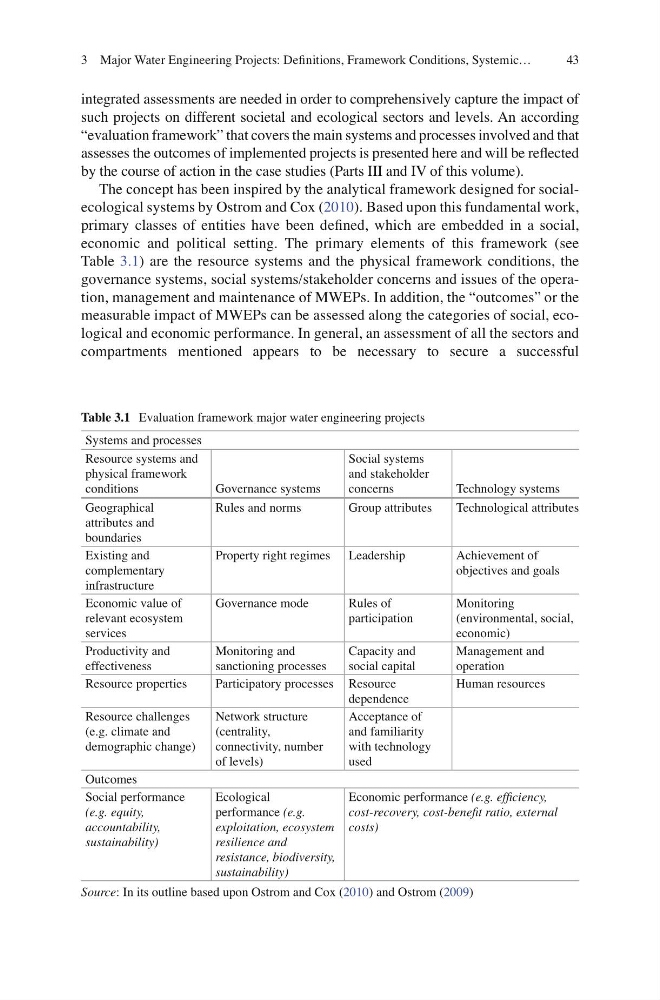
economic and political setting. The primary elements of this framework (see
Table 3.1 ) are the resource systems and the physical framework conditions, the
governance systems, social systems/stakeholder concerns and issues of the operation, management and maintenance of MWEPs. In addition, the “outcomes” or the
measurable impact of MWEPs can be assessed along the categories of social, ecological and economic performance. In general, an assessment of all the sectors and
compartments mentioned appears to be necessary to secure a successful
Table 3.1 Evaluation framework major water engineering projects
Systems and processes
Resource systems and
physical framework
conditions
Governance systems
Social systems
and stakeholder
concerns
Technology systems
Geographical
attributes and
boundaries
Rules and norms
Group attributes
Technological attributes
Existing and
complementary
infrastructure
Property right regimes Leadership
Achievement of
objectives and goals
Economic value of
relevant ecosystem
services
Governance mode
Rules of
participation
Monitoring
(environmental, social,
economic)
Productivity and
effectiveness
Monitoring and
sanctioning processes
Capacity and
social capital
Management and
operation
Resource properties
Participatory processes Resource
dependence
Human resources
Resource challenges
(e.g. climate and
demographic change)
Network structure
(centrality,
connectivity, number
of levels)
Acceptance of
and familiarity
with technology
used
Outcomes
Social performance
(e.g. equity,
accountability,
sustainability)
Ecological
performance (e.g.
exploitation, ecosystem
resilience and
resistance, biodiversity,
sustainability)
Economic performance (e.g. effi ciency,
cost-recovery, cost-benefi t ratio, external
costs)
Source : In its outline based upon Ostrom and Cox ( 2010 ) and Ostrom ( 2009 )
3 Major Water Engineering Projects: Defi nitions, Framework Conditions, Systemic…
integrated assessments are needed in order to comprehensively capture the impact of
such projects on different societal and ecological sectors and levels. An according
“evaluation framework” that covers the main systems and processes involved and that
assesses the outcomes of implemented projects is presented here and will be refl ected
by the course of action in the case studies (Parts III and IV of this volume).
The concept has been inspired by the analytical framework designed for socialecological systems by Ostrom and Cox ( 2010 ). Based upon this fundamental work,
primary classes of entities have been defi ned, which are embedded in a social,
economic and political setting. The primary elements of this framework (see
Table 3.1 ) are the resource systems and the physical framework conditions, the
governance systems, social systems/stakeholder concerns and issues of the operation, management and maintenance of MWEPs. In addition, the “outcomes” or the
measurable impact of MWEPs can be assessed along the categories of social, ecological and economic performance. In general, an assessment of all the sectors and
compartments mentioned appears to be necessary to secure a successful
Table 3.1 Evaluation framework major water engineering projects
Systems and processes
Resource systems and
physical framework
conditions
Governance systems
Social systems
and stakeholder
concerns
Technology systems
Geographical
attributes and
boundaries
Rules and norms
Group attributes
Technological attributes
Existing and
complementary
infrastructure
Property right regimes Leadership
Achievement of
objectives and goals
Economic value of
relevant ecosystem
services
Governance mode
Rules of
participation
Monitoring
(environmental, social,
economic)
Productivity and
effectiveness
Monitoring and
sanctioning processes
Capacity and
social capital
Management and
operation
Resource properties
Participatory processes Resource
dependence
Human resources
Resource challenges
(e.g. climate and
demographic change)
Network structure
(centrality,
connectivity, number
of levels)
Acceptance of
and familiarity
with technology
used
Outcomes
Social performance
(e.g. equity,
accountability,
sustainability)
Ecological
performance (e.g.
exploitation, ecosystem
resilience and
resistance, biodiversity,
sustainability)
Economic performance (e.g. effi ciency,
cost-recovery, cost-benefi t ratio, external
costs)
Source : In its outline based upon Ostrom and Cox ( 2010 ) and Ostrom ( 2009 )
3 Major Water Engineering Projects: Defi nitions, Framework Conditions, Systemic…