

40
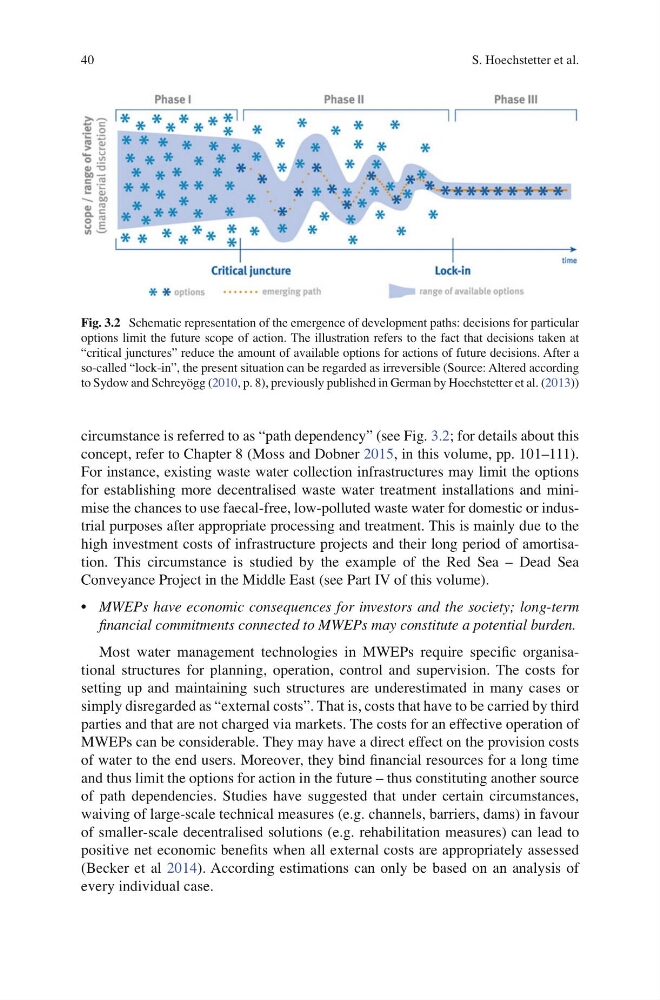
circumstance is referred to as “path dependency” (see Fig. 3.2 ; for details about this
concept, refer to Chapter 8 (Moss and Dobner 2015 , in this volume, pp. 101–111).
For instance, existing waste water collection infrastructures may limit the options
for establishing more decentralised waste water treatment installations and minimise the chances to use faecal-free, low-polluted waste water for domestic or industrial purposes after appropriate processing and treatment. This is mainly due to the
high investment costs of infrastructure projects and their long period of amortisation. This circumstance is studied by the example of the Red Sea – Dead Sea
Conveyance Project in the Middle East (see Part IV of this volume).
• MWEPs have economic consequences for investors and the society; long-term
fi nancial commitments connected to MWEPs may constitute a potential burden.
Most water management technologies in MWEPs require specifi c organisational structures for planning, operation, control and supervision. The costs for
setting up and maintaining such structures are underestimated in many cases or
simply disregarded as “external costs”. That is, costs that have to be carried by third
parties and that are not charged via markets. The costs for an effective operation of
MWEPs can be considerable. They may have a direct effect on the provision costs
of water to the end users. Moreover, they bind fi nancial resources for a long time
and thus limit the options for action in the future – thus constituting another source
of path dependencies. Studies have suggested that under certain circumstances,
waiving of large- scale technical measures (e.g. channels, barriers, dams) in favour
of smaller-scale decentralised solutions (e.g. rehabilitation measures) can lead to
positive net economic benefi ts when all external costs are appropriately assessed
(Becker et al 2014 ). According estimations can only be based on an analysis of
every individual case.
Fig. 3.2 Schematic representation of the emergence of development paths: decisions for particular
options limit the future scope of action. The illustration refers to the fact that decisions taken at
“critical junctures” reduce the amount of available options for actions of future decisions. After a
so-called “lock-in”, the present situation can be regarded as irreversible (Source: Altered according
to Sydow and Schreyögg ( 2010 , p. 8), previously published in German by Hoechstetter et al. ( 2013 ))
S. Hoechstetter et al.
circumstance is referred to as “path dependency” (see Fig. 3.2 ; for details about this
concept, refer to Chapter 8 (Moss and Dobner 2015 , in this volume, pp. 101–111).
For instance, existing waste water collection infrastructures may limit the options
for establishing more decentralised waste water treatment installations and minimise the chances to use faecal-free, low-polluted waste water for domestic or industrial purposes after appropriate processing and treatment. This is mainly due to the
high investment costs of infrastructure projects and their long period of amortisation. This circumstance is studied by the example of the Red Sea – Dead Sea
Conveyance Project in the Middle East (see Part IV of this volume).
• MWEPs have economic consequences for investors and the society; long-term
fi nancial commitments connected to MWEPs may constitute a potential burden.
Most water management technologies in MWEPs require specifi c organisational structures for planning, operation, control and supervision. The costs for
setting up and maintaining such structures are underestimated in many cases or
simply disregarded as “external costs”. That is, costs that have to be carried by third
parties and that are not charged via markets. The costs for an effective operation of
MWEPs can be considerable. They may have a direct effect on the provision costs
of water to the end users. Moreover, they bind fi nancial resources for a long time
and thus limit the options for action in the future – thus constituting another source
of path dependencies. Studies have suggested that under certain circumstances,
waiving of large- scale technical measures (e.g. channels, barriers, dams) in favour
of smaller-scale decentralised solutions (e.g. rehabilitation measures) can lead to
positive net economic benefi ts when all external costs are appropriately assessed
(Becker et al 2014 ). According estimations can only be based on an analysis of
every individual case.
Fig. 3.2 Schematic representation of the emergence of development paths: decisions for particular
options limit the future scope of action. The illustration refers to the fact that decisions taken at
“critical junctures” reduce the amount of available options for actions of future decisions. After a
so-called “lock-in”, the present situation can be regarded as irreversible (Source: Altered according
to Sydow and Schreyögg ( 2010 , p. 8), previously published in German by Hoechstetter et al. ( 2013 ))
S. Hoechstetter et al.