

36
On the other hand, reservoirs comprise a number of economic and ecological
drawbacks. For example, by their nature they tend to be situated in remote areas far
away from the economic centres, resulting in considerable transport expenditures
for infrastructure and pumping. They are likely to exhibit negative effects on the
global climate: Methane emissions – a driver of climate change – from large reservoirs can be signifi cant (Lima et al. 2007 ; Barros et al. 2011 ). These emissions are
due to the rotting of organic matter (e.g. from the vegetation and the soils fl ooded
during the fi lling phase of the reservoirs) in anaerobic conditions. Furthermore, on
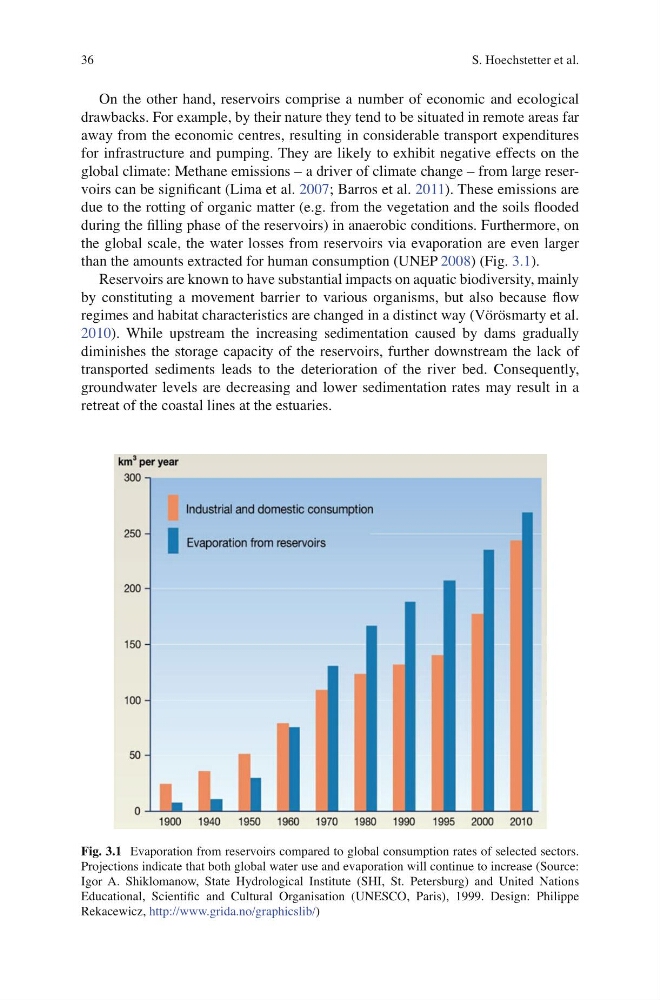
the global scale, the water losses from reservoirs via evaporation are even larger
than the amounts extracted for human consumption (UNEP 2008 ) (Fig. 3.1 ).
Reservoirs are known to have substantial impacts on aquatic biodiversity, mainly
by constituting a movement barrier to various organisms, but also because fl ow
regimes and habitat characteristics are changed in a distinct way (Vörösmarty et al.
2010 ). While upstream the increasing sedimentation caused by dams gradually
diminishes the storage capacity of the reservoirs, further downstream the lack of
transported sediments leads to the deterioration of the river bed. Consequently,
groundwater levels are decreasing and lower sedimentation rates may result in a
retreat of the coastal lines at the estuaries.
Fig. 3.1 Evaporation from reservoirs compared to global consumption rates of selected sectors.
Projections indicate that both global water use and evaporation will continue to increase (Source:
Igor A. Shiklomanow, State Hydrological Institute (SHI, St. Petersburg) and United Nations
Educational, Scientifi c and Cultural Organisation (UNESCO, Paris), 1999. Design: Philippe
Rekacewicz, http://www.grida.no/graphicslib/ )
S. Hoechstetter et al.
On the other hand, reservoirs comprise a number of economic and ecological
drawbacks. For example, by their nature they tend to be situated in remote areas far
away from the economic centres, resulting in considerable transport expenditures
for infrastructure and pumping. They are likely to exhibit negative effects on the
global climate: Methane emissions – a driver of climate change – from large reservoirs can be signifi cant (Lima et al. 2007 ; Barros et al. 2011 ). These emissions are
due to the rotting of organic matter (e.g. from the vegetation and the soils fl ooded
during the fi lling phase of the reservoirs) in anaerobic conditions. Furthermore, on
the global scale, the water losses from reservoirs via evaporation are even larger
than the amounts extracted for human consumption (UNEP 2008 ) (Fig. 3.1 ).
Reservoirs are known to have substantial impacts on aquatic biodiversity, mainly
by constituting a movement barrier to various organisms, but also because fl ow
regimes and habitat characteristics are changed in a distinct way (Vörösmarty et al.
2010 ). While upstream the increasing sedimentation caused by dams gradually
diminishes the storage capacity of the reservoirs, further downstream the lack of
transported sediments leads to the deterioration of the river bed. Consequently,
groundwater levels are decreasing and lower sedimentation rates may result in a
retreat of the coastal lines at the estuaries.
Fig. 3.1 Evaporation from reservoirs compared to global consumption rates of selected sectors.
Projections indicate that both global water use and evaporation will continue to increase (Source:
Igor A. Shiklomanow, State Hydrological Institute (SHI, St. Petersburg) and United Nations
Educational, Scientifi c and Cultural Organisation (UNESCO, Paris), 1999. Design: Philippe
Rekacewicz, http://www.grida.no/graphicslib/ )
S. Hoechstetter et al.