

285
the various stakeholders within each country. Such asymmetrical relations may
considerably hinder the development of transboundary initiatives and agreements.
Indeed, one of the fundamental principles of international water law, the equitable
utilisation of resources, is frequently violated.
Lim ( 2014 ) postulates the identifi cation of multi-resource linkages in the
negotiation of international water agreements as a means to increase the number
of potential win-win solutions. This so-called “shared benefi t model” promotes
the identifi cation of benefi ts of transboundary cooperation that accrue across sectors (e.g. the water sector, agricultural sector, trade sector).
To optimise the management of MWEPs in a transboundary context, it is necessary to improve the coordination and cooperation among riparian states. Important
guidelines on how to improve coordination and cooperation in transboundary water
management can be found in the so-called “Berlin Rules” developed by the
International Law Association (International Law Association 2004 ). The authors
of these rules set out criteria for determining an equitable and reasonable use of
water and also for the consideration of the physical and geographical characteristics
of the watercourse. While the acceptance of these rules might not be binding for
riparian states when bargaining about MWEPs’ benefi ts and cost sharing, international donors, who are in many cases involved in MWEPs, could place more emphasis on the implementation of the Berlin Rules.
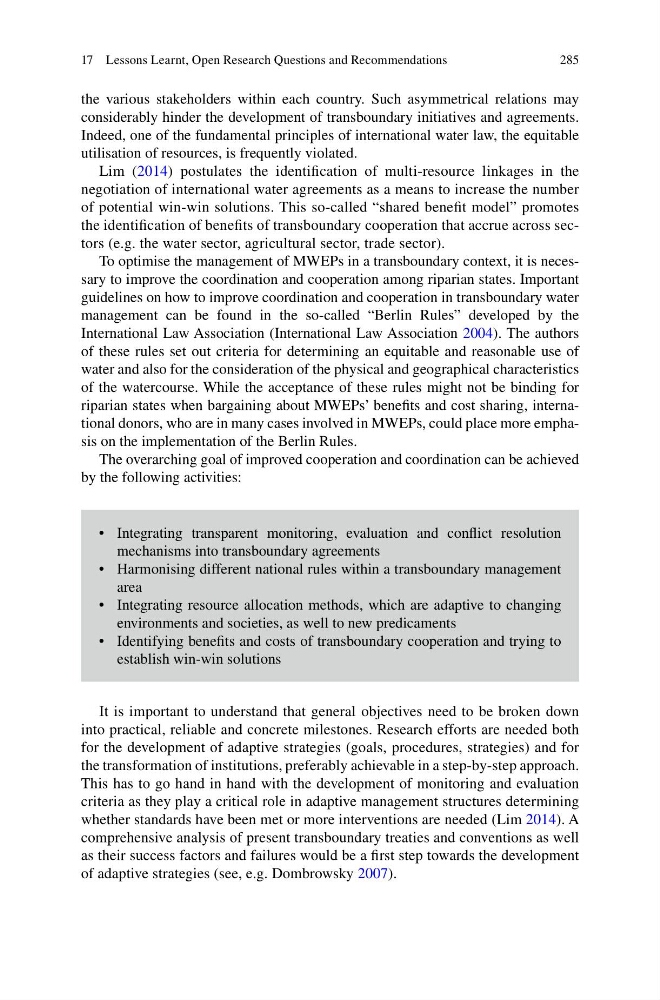
The overarching goal of improved cooperation and coordination can be achieved
by the following activities:
It is important to understand that general objectives need to be broken down
into practical, reliable and concrete milestones. Research efforts are needed both
for the development of adaptive strategies (goals, procedures, strategies) and for
the transformation of institutions, preferably achievable in a step-by-step approach.
This has to go hand in hand with the development of monitoring and evaluation
criteria as they play a critical role in adaptive management structures determining
whether standards have been met or more interventions are needed (Lim 2014 ). A
comprehensive analysis of present transboundary treaties and conventions as well
as their success factors and failures would be a fi rst step towards the development
of adaptive strategies (see, e.g. Dombrowsky 2007 ).
• Integrating transparent monitoring, evaluation and confl ict resolution
mechanisms into transboundary agreements
• Harmonising different national rules within a transboundary management
area
• Integrating resource allocation methods, which are adaptive to changing
environments and societies, as well to new predicaments
• Identifying benefi ts and costs of transboundary cooperation and trying to
establish win-win solutions
17 Lessons Learnt, Open Research Questions and Recommendations
the various stakeholders within each country. Such asymmetrical relations may
considerably hinder the development of transboundary initiatives and agreements.
Indeed, one of the fundamental principles of international water law, the equitable
utilisation of resources, is frequently violated.
Lim ( 2014 ) postulates the identifi cation of multi-resource linkages in the
negotiation of international water agreements as a means to increase the number
of potential win-win solutions. This so-called “shared benefi t model” promotes
the identifi cation of benefi ts of transboundary cooperation that accrue across sectors (e.g. the water sector, agricultural sector, trade sector).
To optimise the management of MWEPs in a transboundary context, it is necessary to improve the coordination and cooperation among riparian states. Important
guidelines on how to improve coordination and cooperation in transboundary water
management can be found in the so-called “Berlin Rules” developed by the
International Law Association (International Law Association 2004 ). The authors
of these rules set out criteria for determining an equitable and reasonable use of
water and also for the consideration of the physical and geographical characteristics
of the watercourse. While the acceptance of these rules might not be binding for
riparian states when bargaining about MWEPs’ benefi ts and cost sharing, international donors, who are in many cases involved in MWEPs, could place more emphasis on the implementation of the Berlin Rules.
The overarching goal of improved cooperation and coordination can be achieved
by the following activities:
It is important to understand that general objectives need to be broken down
into practical, reliable and concrete milestones. Research efforts are needed both
for the development of adaptive strategies (goals, procedures, strategies) and for
the transformation of institutions, preferably achievable in a step-by-step approach.
This has to go hand in hand with the development of monitoring and evaluation
criteria as they play a critical role in adaptive management structures determining
whether standards have been met or more interventions are needed (Lim 2014 ). A
comprehensive analysis of present transboundary treaties and conventions as well
as their success factors and failures would be a fi rst step towards the development
of adaptive strategies (see, e.g. Dombrowsky 2007 ).
• Integrating transparent monitoring, evaluation and confl ict resolution
mechanisms into transboundary agreements
• Harmonising different national rules within a transboundary management
area
• Integrating resource allocation methods, which are adaptive to changing
environments and societies, as well to new predicaments
• Identifying benefi ts and costs of transboundary cooperation and trying to
establish win-win solutions
17 Lessons Learnt, Open Research Questions and Recommendations