

174
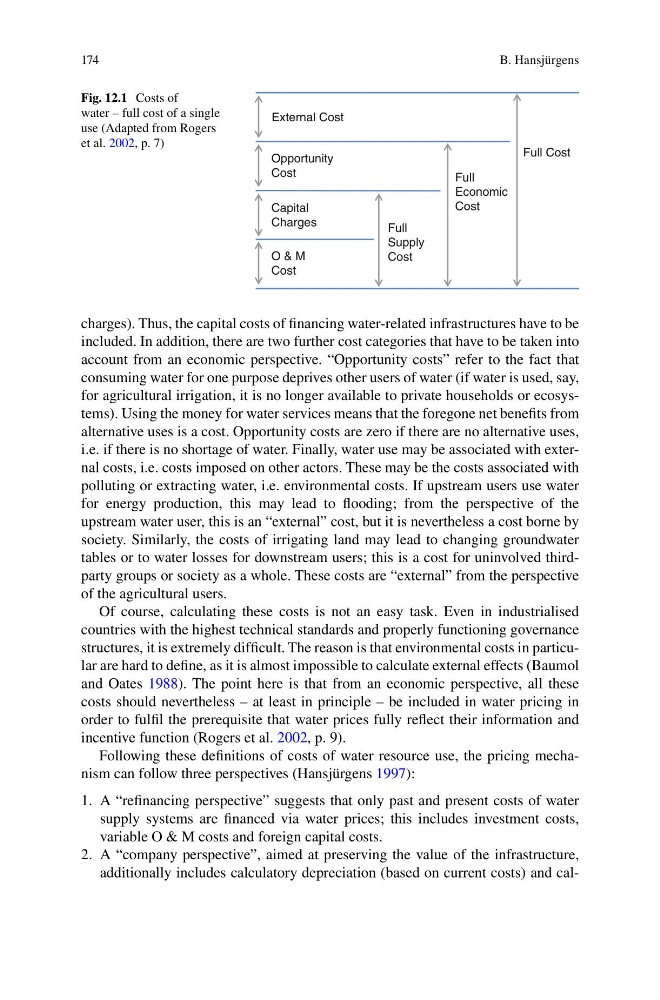
charges). Thus, the capital costs of fi nancing water-related infrastructures have to be
included. In addition, there are two further cost categories that have to be taken into
account from an economic perspective. “Opportunity costs” refer to the fact that
consuming water for one purpose deprives other users of water (if water is used, say,
for agricultural irrigation, it is no longer available to private households or ecosystems). Using the money for water services means that the foregone net benefi ts from
alternative uses is a cost. Opportunity costs are zero if there are no alternative uses,
i.e. if there is no shortage of water. Finally, water use may be associated with external costs, i.e. costs imposed on other actors. These may be the costs associated with
polluting or extracting water, i.e. environmental costs. If upstream users use water
for energy production, this may lead to fl ooding; from the perspective of the
upstream water user, this is an “external” cost, but it is nevertheless a cost borne by
society. Similarly, the costs of irrigating land may lead to changing groundwater
tables or to water losses for downstream users; this is a cost for uninvolved thirdparty groups or society as a whole. These costs are “external” from the perspective
of the agricultural users.
Of course, calculating these costs is not an easy task. Even in industrialised
countries with the highest technical standards and properly functioning governance
structures, it is extremely diffi cult. The reason is that environmental costs in particular are hard to defi ne, as it is almost impossible to calculate external effects (Baumol
and Oates 1988 ). The point here is that from an economic perspective, all these
costs should nevertheless – at least in principle – be included in water pricing in
order to fulfi l the prerequisite that water prices fully refl ect their information and
incentive function (Rogers et al. 2002 , p. 9).
Following these defi nitions of costs of water resource use, the pricing mechanism can follow three perspectives (Hansjürgens 1997 ):
1. A “refi nancing perspective” suggests that only past and present costs of water
supply systems are fi nanced via water prices; this includes investment costs,
variable O & M costs and foreign capital costs.
2. A “company perspective”, aimed at preserving the value of the infrastructure,
additionally includes calculatory depreciation (based on current costs) and calOpportunity
Cost
Capital
Charges
O & M
Cost
Full
Supply
Cost
Full
Economic
Cost
Full Cost
External Cost
Fig. 12.1 Costs of
water – full cost of a single
use (Adapted from Rogers
et al. 2002 , p. 7)
B. Hansjürgens
charges). Thus, the capital costs of fi nancing water-related infrastructures have to be
included. In addition, there are two further cost categories that have to be taken into
account from an economic perspective. “Opportunity costs” refer to the fact that
consuming water for one purpose deprives other users of water (if water is used, say,
for agricultural irrigation, it is no longer available to private households or ecosystems). Using the money for water services means that the foregone net benefi ts from
alternative uses is a cost. Opportunity costs are zero if there are no alternative uses,
i.e. if there is no shortage of water. Finally, water use may be associated with external costs, i.e. costs imposed on other actors. These may be the costs associated with
polluting or extracting water, i.e. environmental costs. If upstream users use water
for energy production, this may lead to fl ooding; from the perspective of the
upstream water user, this is an “external” cost, but it is nevertheless a cost borne by
society. Similarly, the costs of irrigating land may lead to changing groundwater
tables or to water losses for downstream users; this is a cost for uninvolved thirdparty groups or society as a whole. These costs are “external” from the perspective
of the agricultural users.
Of course, calculating these costs is not an easy task. Even in industrialised
countries with the highest technical standards and properly functioning governance
structures, it is extremely diffi cult. The reason is that environmental costs in particular are hard to defi ne, as it is almost impossible to calculate external effects (Baumol
and Oates 1988 ). The point here is that from an economic perspective, all these
costs should nevertheless – at least in principle – be included in water pricing in
order to fulfi l the prerequisite that water prices fully refl ect their information and
incentive function (Rogers et al. 2002 , p. 9).
Following these defi nitions of costs of water resource use, the pricing mechanism can follow three perspectives (Hansjürgens 1997 ):
1. A “refi nancing perspective” suggests that only past and present costs of water
supply systems are fi nanced via water prices; this includes investment costs,
variable O & M costs and foreign capital costs.
2. A “company perspective”, aimed at preserving the value of the infrastructure,
additionally includes calculatory depreciation (based on current costs) and calOpportunity
Cost
Capital
Charges
O & M
Cost
Full
Supply
Cost
Full
Economic
Cost
Full Cost
External Cost
Fig. 12.1 Costs of
water – full cost of a single
use (Adapted from Rogers
et al. 2002 , p. 7)
B. Hansjürgens