

164
sense, the educational programmes on offer are struggling to fi nd their way between
a Soviet tradition reliant on huge amounts of technical data generated by large teams
of specialised scientists on the one hand and modern requirements for different
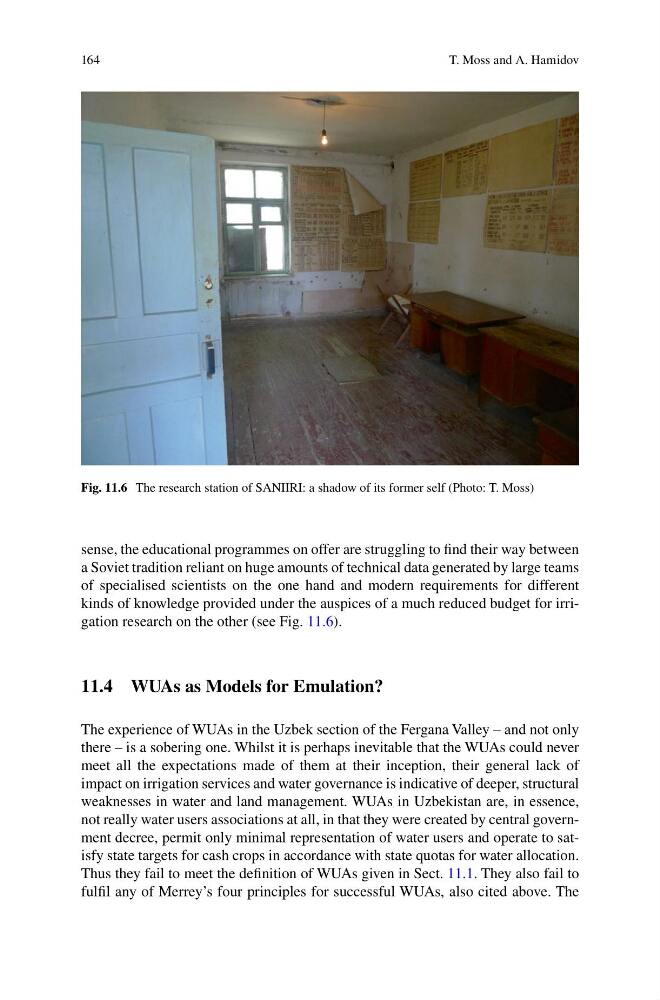
kinds of knowledge provided under the auspices of a much reduced budget for irrigation research on the other (see Fig. 11.6 ).
11.4 WUAs as Models for Emulation?
The experience of WUAs in the Uzbek section of the Fergana Valley – and not only
there – is a sobering one. Whilst it is perhaps inevitable that the WUAs could never
meet all the expectations made of them at their inception, their general lack of
impact on irrigation services and water governance is indicative of deeper, structural
weaknesses in water and land management. WUAs in Uzbekistan are, in essence,
not really water users associations at all, in that they were created by central government decree, permit only minimal representation of water users and operate to satisfy state targets for cash crops in accordance with state quotas for water allocation.
Thus they fail to meet the defi nition of WUAs given in Sect. 11.1 . They also fail to
fulfi l any of Merrey’s four principles for successful WUAs, also cited above. The
Fig. 11.6 The research station of SANIIRI: a shadow of its former self (Photo: T. Moss)
T. Moss and A. Hamidov
sense, the educational programmes on offer are struggling to fi nd their way between
a Soviet tradition reliant on huge amounts of technical data generated by large teams
of specialised scientists on the one hand and modern requirements for different
kinds of knowledge provided under the auspices of a much reduced budget for irrigation research on the other (see Fig. 11.6 ).
11.4 WUAs as Models for Emulation?
The experience of WUAs in the Uzbek section of the Fergana Valley – and not only
there – is a sobering one. Whilst it is perhaps inevitable that the WUAs could never
meet all the expectations made of them at their inception, their general lack of
impact on irrigation services and water governance is indicative of deeper, structural
weaknesses in water and land management. WUAs in Uzbekistan are, in essence,
not really water users associations at all, in that they were created by central government decree, permit only minimal representation of water users and operate to satisfy state targets for cash crops in accordance with state quotas for water allocation.
Thus they fail to meet the defi nition of WUAs given in Sect. 11.1 . They also fail to
fulfi l any of Merrey’s four principles for successful WUAs, also cited above. The
Fig. 11.6 The research station of SANIIRI: a shadow of its former self (Photo: T. Moss)
T. Moss and A. Hamidov