

134
level (GWL)). After independence, this rotation was radically changed and nowadays includes 2:1 or 2:3 (2 years winter wheat and 1–3 years cotton). The cotton in
Uzbekistan is cultivated in the fi rst half of April and harvested in September (last
harvest in November); winter wheat is broadcast seeded in late September (most
cases in October) and harvested from mid-June till mid-July. In the remaining
period, following the winter wheat harvest, secondary crops such as rice, maize,
sorghum, sunfl ower or vegetables are sown from July to November.
According to Dukhovny et al. ( 2012 ), agriculture in FV contributes between
20.8 % (Fergana province) to 58 % (Sogd province) to the gross regional product.
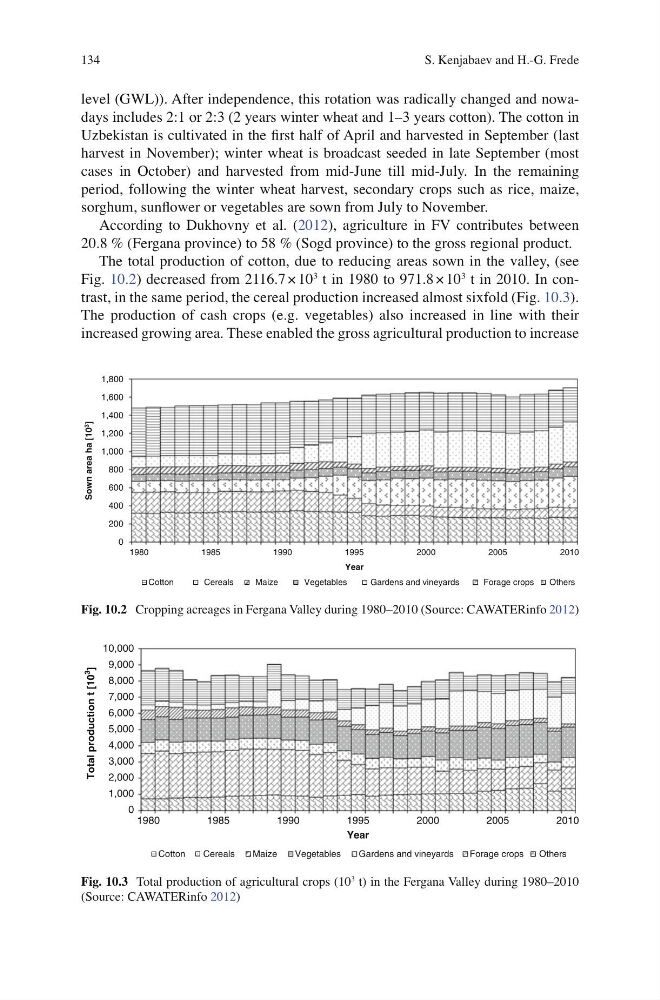
The total production of cotton, due to reducing areas sown in the valley, (see
Fig. 10.2 ) decreased from 2116.7 × 10
3 t in 1980 to 971.8 × 10
3 t in 2010. In contrast, in the same period, the cereal production increased almost sixfold (Fig. 10.3 ).
The production of cash crops (e.g. vegetables) also increased in line with their
increased growing area. These enabled the gross agricultural production to increase
0
200
400
600
800
1,000
1,200
1,400
1,600
1,800
1980
1985
1990
1995
2000
2005
2010
Sown area ha [10 3
]
Year
Cotton
Cereals
Maize
Vegetables
Gardens and vineyards
Forage crops
Others
Fig. 10.2 Cropping acreages in Fergana Valley during 1980–2010 (Source: CAWATERinfo 2012 )
0
1,000
2,000
3,000
4,000
5,000
6,000
7,000
8,000
9,000
10,000
1980
1985
1990
1995
2000
2005
2010
Total production t [10
3
]
Year
Cotton
Cereals
Maize
Vegetables
Gardens and vineyards
Forage crops
Others
Fig. 10.3 Total production of agricultural crops (10
3 t) in the Fergana Valley during 1980–2010
(Source: CAWATERinfo 2012 )
S. Kenjabaev and H.-G. Frede
level (GWL)). After independence, this rotation was radically changed and nowadays includes 2:1 or 2:3 (2 years winter wheat and 1–3 years cotton). The cotton in
Uzbekistan is cultivated in the fi rst half of April and harvested in September (last
harvest in November); winter wheat is broadcast seeded in late September (most
cases in October) and harvested from mid-June till mid-July. In the remaining
period, following the winter wheat harvest, secondary crops such as rice, maize,
sorghum, sunfl ower or vegetables are sown from July to November.
According to Dukhovny et al. ( 2012 ), agriculture in FV contributes between
20.8 % (Fergana province) to 58 % (Sogd province) to the gross regional product.
The total production of cotton, due to reducing areas sown in the valley, (see
Fig. 10.2 ) decreased from 2116.7 × 10
3 t in 1980 to 971.8 × 10
3 t in 2010. In contrast, in the same period, the cereal production increased almost sixfold (Fig. 10.3 ).
The production of cash crops (e.g. vegetables) also increased in line with their
increased growing area. These enabled the gross agricultural production to increase
0
200
400
600
800
1,000
1,200
1,400
1,600
1,800
1980
1985
1990
1995
2000
2005
2010
Sown area ha [10 3
]
Year
Cotton
Cereals
Maize
Vegetables
Gardens and vineyards
Forage crops
Others
Fig. 10.2 Cropping acreages in Fergana Valley during 1980–2010 (Source: CAWATERinfo 2012 )
0
1,000
2,000
3,000
4,000
5,000
6,000
7,000
8,000
9,000
10,000
1980
1985
1990
1995
2000
2005
2010
Total production t [10
3
]
Year
Cotton
Cereals
Maize
Vegetables
Gardens and vineyards
Forage crops
Others
Fig. 10.3 Total production of agricultural crops (10
3 t) in the Fergana Valley during 1980–2010
(Source: CAWATERinfo 2012 )
S. Kenjabaev and H.-G. Frede