

123
Following independence, Fergana’s water management system faced similar
challenges. The irrigation network was implemented at a time when no boundaries
affected the decision-making of concerned engineers and politicians. The meshed
system of canals and reservoirs had emerged from a genetic expansion of irrigation
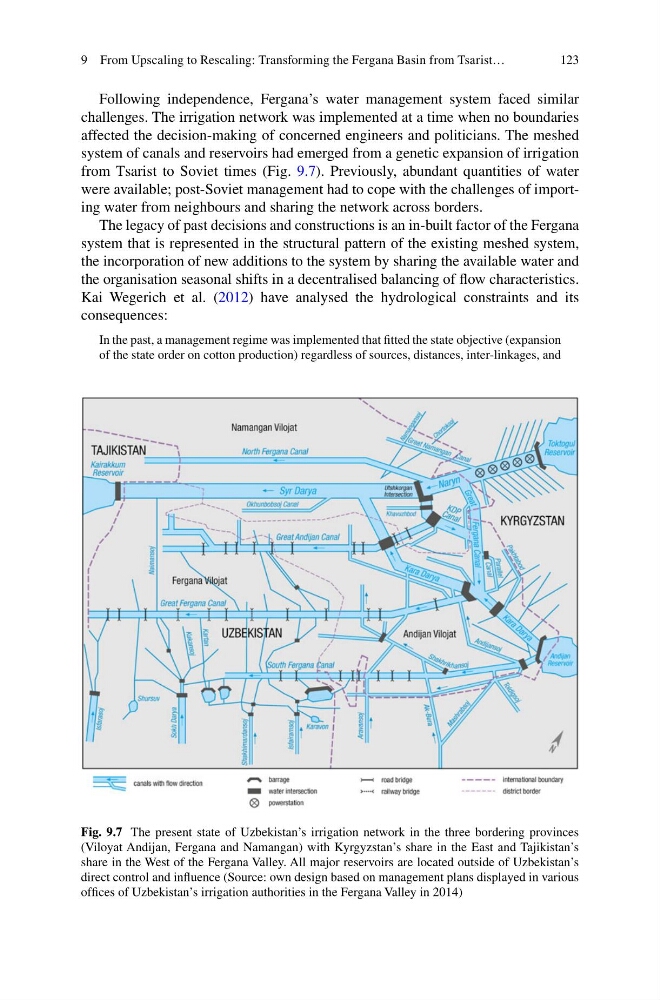
from Tsarist to Soviet times (Fig. 9.7 ). Previously, abundant quantities of water
were available; post-Soviet management had to cope with the challenges of importing water from neighbours and sharing the network across borders.
The legacy of past decisions and constructions is an in-built factor of the Fergana
system that is represented in the structural pattern of the existing meshed system,
the incorporation of new additions to the system by sharing the available water and
the organisation seasonal shifts in a decentralised balancing of fl ow characteristics.
Kai Wegerich et al. ( 2012 ) have analysed the hydrological constraints and its
consequences:
In the past, a management regime was implemented that fi tted the state objective ( expansion
of the state order on cotton production) regardless of sources, distances, inter-linkages, and
Fig. 9.7 The present state of Uzbekistan’s irrigation network in the three bordering provinces
(Viloyat Andijan, Fergana and Namangan) with Kyrgyzstan’s share in the East and Tajikistan’s
share in the West of the Fergana Valley. All major reservoirs are located outside of Uzbekistan’s
direct control and infl uence (Source: own design based on management plans displayed in various
offi ces of Uzbekistan’s irrigation authorities in the Fergana Valley in 2014)
9 From Upscaling to Rescaling: Transforming the Fergana Basin from Tsarist…
Following independence, Fergana’s water management system faced similar
challenges. The irrigation network was implemented at a time when no boundaries
affected the decision-making of concerned engineers and politicians. The meshed
system of canals and reservoirs had emerged from a genetic expansion of irrigation
from Tsarist to Soviet times (Fig. 9.7 ). Previously, abundant quantities of water
were available; post-Soviet management had to cope with the challenges of importing water from neighbours and sharing the network across borders.
The legacy of past decisions and constructions is an in-built factor of the Fergana
system that is represented in the structural pattern of the existing meshed system,
the incorporation of new additions to the system by sharing the available water and
the organisation seasonal shifts in a decentralised balancing of fl ow characteristics.
Kai Wegerich et al. ( 2012 ) have analysed the hydrological constraints and its
consequences:
In the past, a management regime was implemented that fi tted the state objective ( expansion
of the state order on cotton production) regardless of sources, distances, inter-linkages, and
Fig. 9.7 The present state of Uzbekistan’s irrigation network in the three bordering provinces
(Viloyat Andijan, Fergana and Namangan) with Kyrgyzstan’s share in the East and Tajikistan’s
share in the West of the Fergana Valley. All major reservoirs are located outside of Uzbekistan’s
direct control and infl uence (Source: own design based on management plans displayed in various
offi ces of Uzbekistan’s irrigation authorities in the Fergana Valley in 2014)
9 From Upscaling to Rescaling: Transforming the Fergana Basin from Tsarist…