

115
system and the socio-economic environment have experienced several
transformations. The present-day challenge of adjusting the irrigation network’s
functioning to new borders, confl icts among neighbours and global relations needs
further refl ection when taking Neil Brenner’s statement into context emphasising
the interrelationship of these processes characterised as “[…] the deterritorialisation
of social relations on a global scale [that] hinges intrinsically upon their simultaneous reterritorialisation on sub-global scales within relatively fi xed and immobile
confi gurations of territorial organisation” (Brenner 1999 , p. 62). We will trace and
link the effects of globalisation and modernisation to path-dependent developments
in the Fergana Valley with its creation of a complex network of interconnected rivers
and main canals. We will look at the existing system as a historico-genetic product
faced with contemporary challenges differing signifi cantly from the frame conditions and traits they initiated. And based upon the following overview of salient
features that frame the modes of operation of this MWEP, we will highlight three
aspects to assess the challenges Uzbekistan is confronted with in Fergana. First, the
often neglected Tsarist strategy of modernisation, its emphasis on cotton cultivation
and its transition and translation into the Soviet cotton-based growth model for
“white gold” in the Fergana Valley; second, the challenges of spatial rescaling
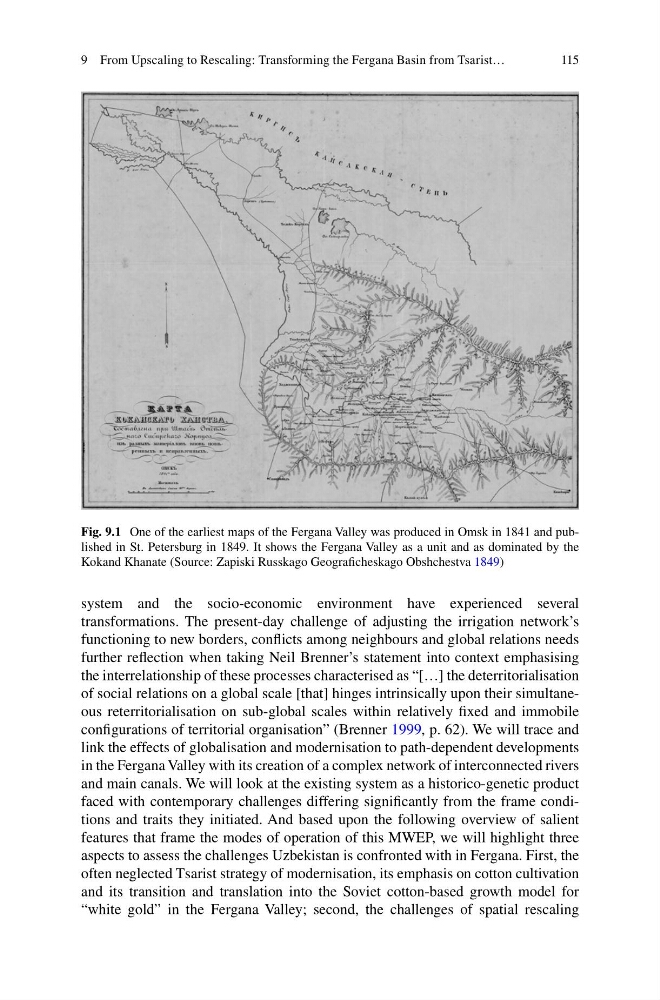
Fig. 9.1 One of the earliest maps of the Fergana Valley was produced in Omsk in 1841 and published in St. Petersburg in 1849. It shows the Fergana Valley as a unit and as dominated by the
Kokand Khanate (Source: Zapiski Russkago Geografi cheskago Obshchestva 1849 )
9 From Upscaling to Rescaling: Transforming the Fergana Basin from Tsarist…
system and the socio-economic environment have experienced several
transformations. The present-day challenge of adjusting the irrigation network’s
functioning to new borders, confl icts among neighbours and global relations needs
further refl ection when taking Neil Brenner’s statement into context emphasising
the interrelationship of these processes characterised as “[…] the deterritorialisation
of social relations on a global scale [that] hinges intrinsically upon their simultaneous reterritorialisation on sub-global scales within relatively fi xed and immobile
confi gurations of territorial organisation” (Brenner 1999 , p. 62). We will trace and
link the effects of globalisation and modernisation to path-dependent developments
in the Fergana Valley with its creation of a complex network of interconnected rivers
and main canals. We will look at the existing system as a historico-genetic product
faced with contemporary challenges differing signifi cantly from the frame conditions and traits they initiated. And based upon the following overview of salient
features that frame the modes of operation of this MWEP, we will highlight three
aspects to assess the challenges Uzbekistan is confronted with in Fergana. First, the
often neglected Tsarist strategy of modernisation, its emphasis on cotton cultivation
and its transition and translation into the Soviet cotton-based growth model for
“white gold” in the Fergana Valley; second, the challenges of spatial rescaling
Fig. 9.1 One of the earliest maps of the Fergana Valley was produced in Omsk in 1841 and published in St. Petersburg in 1849. It shows the Fergana Valley as a unit and as dominated by the
Kokand Khanate (Source: Zapiski Russkago Geografi cheskago Obshchestva 1849 )
9 From Upscaling to Rescaling: Transforming the Fergana Basin from Tsarist…