

93
became evident. While the geopolitical setting of Central Asia has changed, the
“old elites” still have considerable infl uence on the institutions of the water management sector.
The water balance, which was already fragile during the Soviet regime, has completely lost its equilibrium (Eschment 2011 ). Agreements that were supposed to
regulate the management of water between the different states have not been
respected and must be considered as failures (ICWC 2002 ). A line of division runs
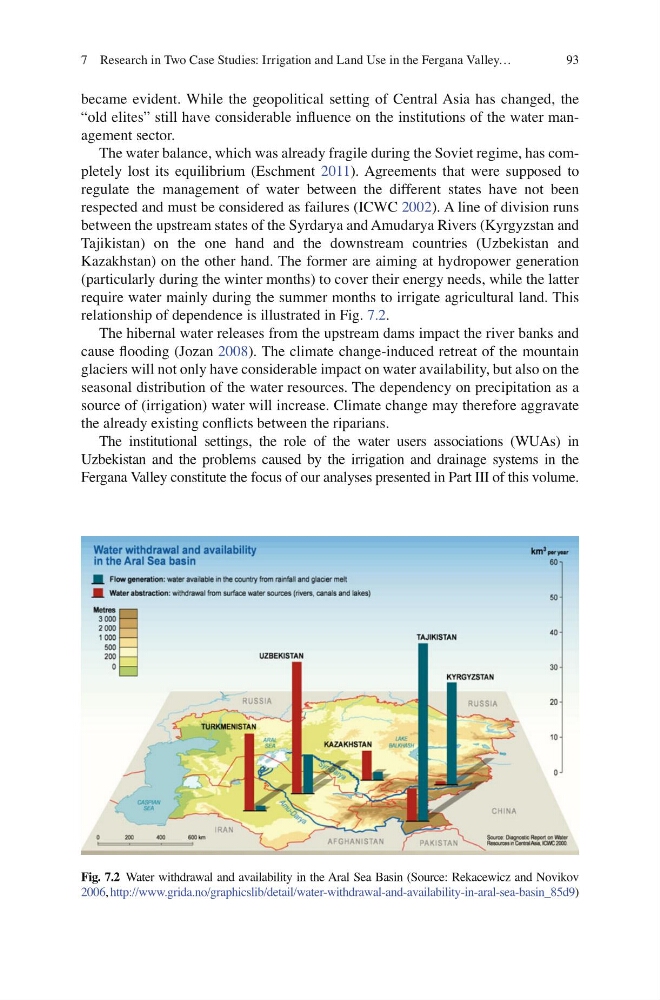
between the upstream states of the Syrdarya and Amudarya Rivers (Kyrgyzstan and
Tajikistan) on the one hand and the downstream countries (Uzbekistan and
Kazakhstan) on the other hand. The former are aiming at hydropower generation
(particularly during the winter months) to cover their energy needs, while the latter
require water mainly during the summer months to irrigate agricultural land. This
relationship of dependence is illustrated in Fig. 7.2 .
The hibernal water releases from the upstream dams impact the river banks and
cause fl ooding (Jozan 2008 ). The climate change-induced retreat of the mountain
glaciers will not only have considerable impact on water availability, but also on the
seasonal distribution of the water resources. The dependency on precipitation as a
source of (irrigation) water will increase. Climate change may therefore aggravate
the already existing confl icts between the riparians.
The institutional settings, the role of the water users associations (WUAs) in
Uzbekistan and the problems caused by the irrigation and drainage systems in the
Fergana Valley constitute the focus of our analyses presented in Part III of this volume.
Fig. 7.2 Water withdrawal and availability in the Aral Sea Basin (Source: Rekacewicz and Novikov
2006 , http://www.grida.no/graphicslib/detail/water-withdrawal-and-availability-in-aral-sea-basin_85d9 )
7 Research in Two Case Studies: Irrigation and Land Use in the Fergana Valley…
became evident. While the geopolitical setting of Central Asia has changed, the
“old elites” still have considerable infl uence on the institutions of the water management sector.
The water balance, which was already fragile during the Soviet regime, has completely lost its equilibrium (Eschment 2011 ). Agreements that were supposed to
regulate the management of water between the different states have not been
respected and must be considered as failures (ICWC 2002 ). A line of division runs
between the upstream states of the Syrdarya and Amudarya Rivers (Kyrgyzstan and
Tajikistan) on the one hand and the downstream countries (Uzbekistan and
Kazakhstan) on the other hand. The former are aiming at hydropower generation
(particularly during the winter months) to cover their energy needs, while the latter
require water mainly during the summer months to irrigate agricultural land. This
relationship of dependence is illustrated in Fig. 7.2 .
The hibernal water releases from the upstream dams impact the river banks and
cause fl ooding (Jozan 2008 ). The climate change-induced retreat of the mountain
glaciers will not only have considerable impact on water availability, but also on the
seasonal distribution of the water resources. The dependency on precipitation as a
source of (irrigation) water will increase. Climate change may therefore aggravate
the already existing confl icts between the riparians.
The institutional settings, the role of the water users associations (WUAs) in
Uzbekistan and the problems caused by the irrigation and drainage systems in the
Fergana Valley constitute the focus of our analyses presented in Part III of this volume.
Fig. 7.2 Water withdrawal and availability in the Aral Sea Basin (Source: Rekacewicz and Novikov
2006 , http://www.grida.no/graphicslib/detail/water-withdrawal-and-availability-in-aral-sea-basin_85d9 )
7 Research in Two Case Studies: Irrigation and Land Use in the Fergana Valley…