

natural uranium, and reduction of the heat load of the HLW packages to be stored in
geological disposal, leading to its efficient use.
Transmutation of high-level radioactive elements with a long half-life present in
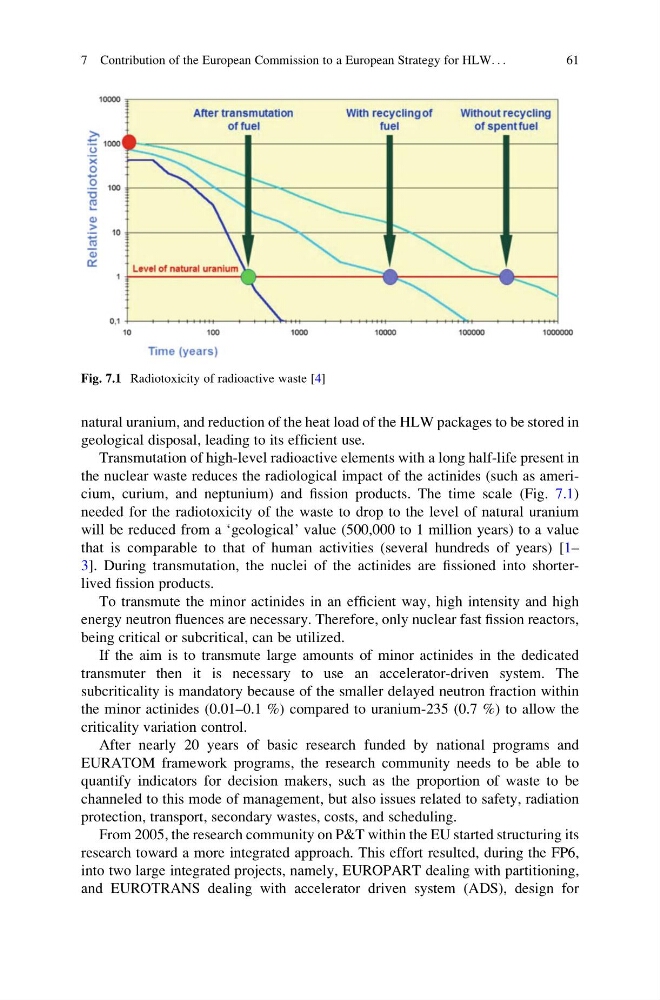
the nuclear waste reduces the radiological impact of the actinides (such as americium, curium, and neptunium) and fission products. The time scale (Fig. 7.1)
needed for the radiotoxicity of the waste to drop to the level of natural uranium
will be reduced from a ‘geological’ value (500,000 to 1 million years) to a value
that is comparable to that of human activities (several hundreds of years) [1–
3]. During transmutation, the nuclei of the actinides are fissioned into shorterlived fission products.
To transmute the minor actinides in an efficient way, high intensity and high
energy neutron fluences are necessary. Therefore, only nuclear fast fission reactors,
being critical or subcritical, can be utilized.
If the aim is to transmute large amounts of minor actinides in the dedicated
transmuter then it is necessary to use an accelerator-driven system. The
subcriticality is mandatory because of the smaller delayed neutron fraction within
the minor actinides (0.01–0.1 %) compared to uranium-235 (0.7 %) to allow the
criticality variation control.
After nearly 20 years of basic research funded by national programs and
EURATOM framework programs, the research community needs to be able to
quantify indicators for decision makers, such as the proportion of waste to be
channeled to this mode of management, but also issues related to safety, radiation
protection, transport, secondary wastes, costs, and scheduling.
From 2005, the research community on P&T within the EU started structuring its
research toward a more integrated approach. This effort resulted, during the FP6,
into two large integrated projects, namely, EUROPART dealing with partitioning,
and EUROTRANS dealing with accelerator driven system (ADS), design for
Fig. 7.1 Radiotoxicity of radioactive waste [4]
7 Contribution of the European Commission to a European Strategy for HLW. . .
61
geological disposal, leading to its efficient use.
Transmutation of high-level radioactive elements with a long half-life present in
the nuclear waste reduces the radiological impact of the actinides (such as americium, curium, and neptunium) and fission products. The time scale (Fig. 7.1)
needed for the radiotoxicity of the waste to drop to the level of natural uranium
will be reduced from a ‘geological’ value (500,000 to 1 million years) to a value
that is comparable to that of human activities (several hundreds of years) [1–
3]. During transmutation, the nuclei of the actinides are fissioned into shorterlived fission products.
To transmute the minor actinides in an efficient way, high intensity and high
energy neutron fluences are necessary. Therefore, only nuclear fast fission reactors,
being critical or subcritical, can be utilized.
If the aim is to transmute large amounts of minor actinides in the dedicated
transmuter then it is necessary to use an accelerator-driven system. The
subcriticality is mandatory because of the smaller delayed neutron fraction within
the minor actinides (0.01–0.1 %) compared to uranium-235 (0.7 %) to allow the
criticality variation control.
After nearly 20 years of basic research funded by national programs and
EURATOM framework programs, the research community needs to be able to
quantify indicators for decision makers, such as the proportion of waste to be
channeled to this mode of management, but also issues related to safety, radiation
protection, transport, secondary wastes, costs, and scheduling.
From 2005, the research community on P&T within the EU started structuring its
research toward a more integrated approach. This effort resulted, during the FP6,
into two large integrated projects, namely, EUROPART dealing with partitioning,
and EUROTRANS dealing with accelerator driven system (ADS), design for
Fig. 7.1 Radiotoxicity of radioactive waste [4]
7 Contribution of the European Commission to a European Strategy for HLW. . .
61