

found to be much smaller than the data reported by Zeisel [6]. As seen in Table 5.2,
the cross section of
238 Np is obtained for the first time. Thus, the joint research
activities of the Japan Atomic Energy Agency (JAEA) and universities have
measured the cross sections for important LLFPs and MAs by the activation
method.
5.4 Measurement Activities at J-PARC/MLF/ANNRI
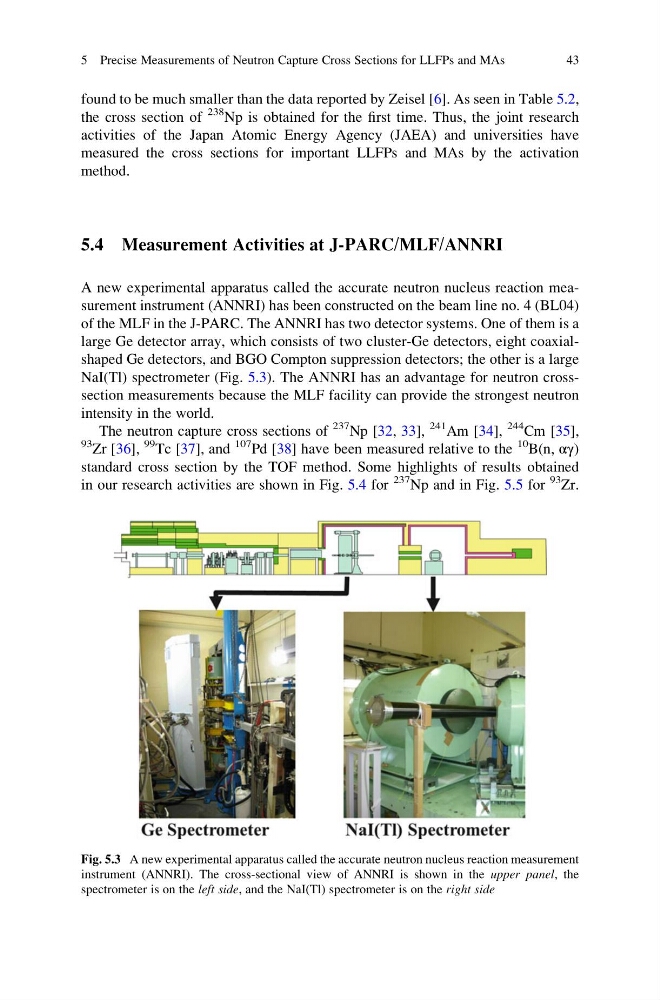
A new experimental apparatus called the accurate neutron nucleus reaction measurement instrument (ANNRI) has been constructed on the beam line no. 4 (BL04)
of the MLF in the J-PARC. The ANNRI has two detector systems. One of them is a
large Ge detector array, which consists of two cluster-Ge detectors, eight coaxialshaped Ge detectors, and BGO Compton suppression detectors; the other is a large
NaI(Tl) spectrometer (Fig. 5.3). The ANNRI has an advantage for neutron crosssection measurements because the MLF facility can provide the strongest neutron
intensity in the world.
The neutron capture cross sections of
237 Np [32, 33],
241 Am [34],
244 Cm [35],
93 Zr [36],
99 Tc [37], and
107 Pd [38] have been measured relative to the
10 B(n, αγ)
standard cross section by the TOF method. Some highlights of results obtained
in our research activities are shown in Fig. 5.4 for
237 Np and in Fig. 5.5 for
93 Zr.
Fig. 5.3 A new experimental apparatus called the accurate neutron nucleus reaction measurement
instrument (ANNRI). The cross-sectional view of ANNRI is shown in the upper panel, the
spectrometer is on the left side, and the NaI(Tl) spectrometer is on the right side
5 Precise Measurements of Neutron Capture Cross Sections for LLFPs and MAs
43
the cross section of
238 Np is obtained for the first time. Thus, the joint research
activities of the Japan Atomic Energy Agency (JAEA) and universities have
measured the cross sections for important LLFPs and MAs by the activation
method.
5.4 Measurement Activities at J-PARC/MLF/ANNRI
A new experimental apparatus called the accurate neutron nucleus reaction measurement instrument (ANNRI) has been constructed on the beam line no. 4 (BL04)
of the MLF in the J-PARC. The ANNRI has two detector systems. One of them is a
large Ge detector array, which consists of two cluster-Ge detectors, eight coaxialshaped Ge detectors, and BGO Compton suppression detectors; the other is a large
NaI(Tl) spectrometer (Fig. 5.3). The ANNRI has an advantage for neutron crosssection measurements because the MLF facility can provide the strongest neutron
intensity in the world.
The neutron capture cross sections of
237 Np [32, 33],
241 Am [34],
244 Cm [35],
93 Zr [36],
99 Tc [37], and
107 Pd [38] have been measured relative to the
10 B(n, αγ)
standard cross section by the TOF method. Some highlights of results obtained
in our research activities are shown in Fig. 5.4 for
237 Np and in Fig. 5.5 for
93 Zr.
Fig. 5.3 A new experimental apparatus called the accurate neutron nucleus reaction measurement
instrument (ANNRI). The cross-sectional view of ANNRI is shown in the upper panel, the
spectrometer is on the left side, and the NaI(Tl) spectrometer is on the right side
5 Precise Measurements of Neutron Capture Cross Sections for LLFPs and MAs
43