

extract was poured into a 50-ml glass beaker, Cs tracer and/or soluble metal salt was
added to it (when necessary), and then solution pH was adjusted to values shown in
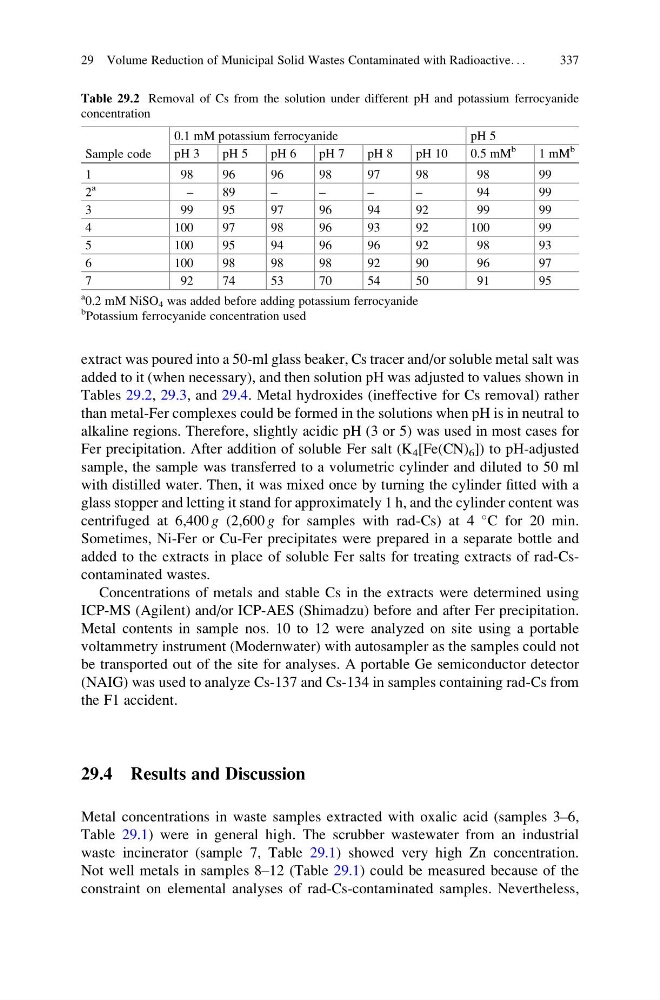
Tables 29.2, 29.3, and 29.4. Metal hydroxides (ineffective for Cs removal) rather
than metal-Fer complexes could be formed in the solutions when pH is in neutral to
alkaline regions. Therefore, slightly acidic pH (3 or 5) was used in most cases for
Fer precipitation. After addition of soluble Fer salt (K 4 [Fe(CN) 6 ]) to pH-adjusted
sample, the sample was transferred to a volumetric cylinder and diluted to 50 ml
with distilled water. Then, it was mixed once by turning the cylinder fitted with a
glass stopper and letting it stand for approximately 1 h, and the cylinder content was
centrifuged at 6,400 g (2,600 g for samples with rad-Cs) at 4
C for 20 min.
Sometimes, Ni-Fer or Cu-Fer precipitates were prepared in a separate bottle and
added to the extracts in place of soluble Fer salts for treating extracts of rad-Cscontaminated wastes.
Concentrations of metals and stable Cs in the extracts were determined using
ICP-MS (Agilent) and/or ICP-AES (Shimadzu) before and after Fer precipitation.
Metal contents in sample nos. 10 to 12 were analyzed on site using a portable
voltammetry instrument (Modernwater) with autosampler as the samples could not
be transported out of the site for analyses. A portable Ge semiconductor detector
(NAIG) was used to analyze Cs-137 and Cs-134 in samples containing rad-Cs from
the F1 accident.
29.4 Results and Discussion
Metal concentrations in waste samples extracted with oxalic acid (samples 3–6,
Table 29.1) were in general high. The scrubber wastewater from an industrial
waste incinerator (sample 7, Table 29.1) showed very high Zn concentration.
Not well metals in samples 8–12 (Table 29.1) could be measured because of the
constraint on elemental analyses of rad-Cs-contaminated samples. Nevertheless,
Table 29.2 Removal of Cs from the solution under different pH and potassium ferrocyanide
concentration
Sample code
0.1 mM potassium ferrocyanide
pH 5
pH 3
pH 5
pH 6
pH 7
pH 8
pH 10
0.5 mM
b
1 mM
b
1
9 8
9 6
9 6
9 8
9 7
9 8
9 8
9 9
2
a
–
89
–
–
–
–
94
99
3
9 9
9 5
9 7
9 6
9 4
9 2
9 9
9 9
4
100
97
98
96
93
92
100
99
5
100
95
94
96
96
92
98
93
6
100
98
98
98
92
90
96
97
7
9 2
7 4
5 3
7 0
5 4
5 0
9 1
9 5
a
0.2 mM NiSO 4 was added before adding potassium ferrocyanide
b
Potassium ferrocyanide concentration used
29 Volume Reduction of Municipal Solid Wastes Contaminated with Radioactive. . .
337
added to it (when necessary), and then solution pH was adjusted to values shown in
Tables 29.2, 29.3, and 29.4. Metal hydroxides (ineffective for Cs removal) rather
than metal-Fer complexes could be formed in the solutions when pH is in neutral to
alkaline regions. Therefore, slightly acidic pH (3 or 5) was used in most cases for
Fer precipitation. After addition of soluble Fer salt (K 4 [Fe(CN) 6 ]) to pH-adjusted
sample, the sample was transferred to a volumetric cylinder and diluted to 50 ml
with distilled water. Then, it was mixed once by turning the cylinder fitted with a
glass stopper and letting it stand for approximately 1 h, and the cylinder content was
centrifuged at 6,400 g (2,600 g for samples with rad-Cs) at 4
C for 20 min.
Sometimes, Ni-Fer or Cu-Fer precipitates were prepared in a separate bottle and
added to the extracts in place of soluble Fer salts for treating extracts of rad-Cscontaminated wastes.
Concentrations of metals and stable Cs in the extracts were determined using
ICP-MS (Agilent) and/or ICP-AES (Shimadzu) before and after Fer precipitation.
Metal contents in sample nos. 10 to 12 were analyzed on site using a portable
voltammetry instrument (Modernwater) with autosampler as the samples could not
be transported out of the site for analyses. A portable Ge semiconductor detector
(NAIG) was used to analyze Cs-137 and Cs-134 in samples containing rad-Cs from
the F1 accident.
29.4 Results and Discussion
Metal concentrations in waste samples extracted with oxalic acid (samples 3–6,
Table 29.1) were in general high. The scrubber wastewater from an industrial
waste incinerator (sample 7, Table 29.1) showed very high Zn concentration.
Not well metals in samples 8–12 (Table 29.1) could be measured because of the
constraint on elemental analyses of rad-Cs-contaminated samples. Nevertheless,
Table 29.2 Removal of Cs from the solution under different pH and potassium ferrocyanide
concentration
Sample code
0.1 mM potassium ferrocyanide
pH 5
pH 3
pH 5
pH 6
pH 7
pH 8
pH 10
0.5 mM
b
1 mM
b
1
9 8
9 6
9 6
9 8
9 7
9 8
9 8
9 9
2
a
–
89
–
–
–
–
94
99
3
9 9
9 5
9 7
9 6
9 4
9 2
9 9
9 9
4
100
97
98
96
93
92
100
99
5
100
95
94
96
96
92
98
93
6
100
98
98
98
92
90
96
97
7
9 2
7 4
5 3
7 0
5 4
5 0
9 1
9 5
a
0.2 mM NiSO 4 was added before adding potassium ferrocyanide
b
Potassium ferrocyanide concentration used
29 Volume Reduction of Municipal Solid Wastes Contaminated with Radioactive. . .
337