

were between 10
4 and10
6 [4]. Apparently, the use of the Fer coprecipitation
technique for rad-Cs removal from waste extract is appropriate to maximize
waste volume reduction.
On the other hand, there are concerns on the outcome of using Fer, especially
regarding the radiological risk of generating concentrated waste regarding rad-Cs
and the chemical hazard from Fer compounds.
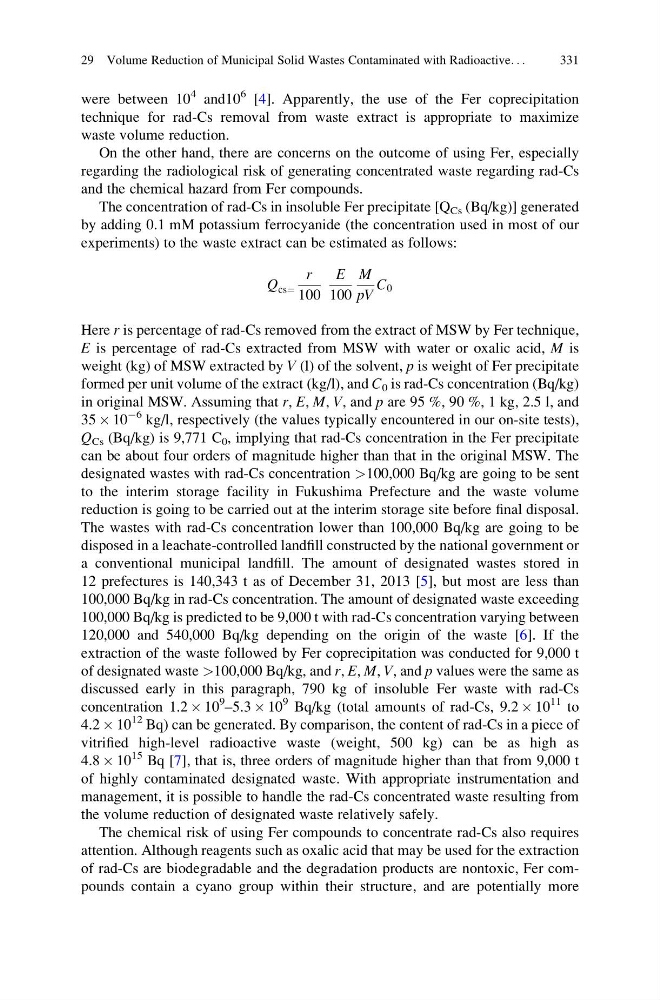
The concentration of rad-Cs in insoluble Fer precipitate [Q Cs (Bq/kg)] generated
by adding 0.1 mM potassium ferrocyanide (the concentration used in most of our
experiments) to the waste extract can be estimated as follows:
Q cs¼
r
100
E
100
M
pV
C 0
Here r is percentage of rad-Cs removed from the extract of MSW by Fer technique,
E is percentage of rad-Cs extracted from MSW with water or oxalic acid, M is
weight (kg) of MSW extracted by V (l) of the solvent, p is weight of Fer precipitate
formed per unit volume of the extract (kg/l), and C 0 is rad-Cs concentration (Bq/kg)
in original MSW. Assuming that r, E, M, V, and p are 95 %, 90 %, 1 kg, 2.5 l, and
35 Â 10
À6 kg/l, respectively (the values typically encountered in our on-site tests),
Q Cs (Bq/kg) is 9,771 C 0 , implying that rad-Cs concentration in the Fer precipitate
can be about four orders of magnitude higher than that in the original MSW. The
designated wastes with rad-Cs concentration >100,000 Bq/kg are going to be sent
to the interim storage facility in Fukushima Prefecture and the waste volume
reduction is going to be carried out at the interim storage site before final disposal.
The wastes with rad-Cs concentration lower than 100,000 Bq/kg are going to be
disposed in a leachate-controlled landfill constructed by the national government or
a conventional municipal landfill. The amount of designated wastes stored in
12 prefectures is 140,343 t as of December 31, 2013 [5], but most are less than
100,000 Bq/kg in rad-Cs concentration. The amount of designated waste exceeding
100,000 Bq/kg is predicted to be 9,000 t with rad-Cs concentration varying between
120,000 and 540,000 Bq/kg depending on the origin of the waste [6]. If the
extraction of the waste followed by Fer coprecipitation was conducted for 9,000 t
of designated waste >100,000 Bq/kg, and r, E, M, V, and p values were the same as
discussed early in this paragraph, 790 kg of insoluble Fer waste with rad-Cs
concentration 1.2 Â 10
9 –5.3 Â 10
9 Bq/kg (total amounts of rad-Cs, 9.2 Â 10
11 to
4.2 Â 10
12 Bq) can be generated. By comparison, the content of rad-Cs in a piece of
vitrified high-level radioactive waste (weight, 500 kg) can be as high as
4.8 Â 10
15 Bq [7], that is, three orders of magnitude higher than that from 9,000 t
of highly contaminated designated waste. With appropriate instrumentation and
management, it is possible to handle the rad-Cs concentrated waste resulting from
the volume reduction of designated waste relatively safely.
The chemical risk of using Fer compounds to concentrate rad-Cs also requires
attention. Although reagents such as oxalic acid that may be used for the extraction
of rad-Cs are biodegradable and the degradation products are nontoxic, Fer compounds contain a cyano group within their structure, and are potentially more
29 Volume Reduction of Municipal Solid Wastes Contaminated with Radioactive. . .
331
4 and10
6 [4]. Apparently, the use of the Fer coprecipitation
technique for rad-Cs removal from waste extract is appropriate to maximize
waste volume reduction.
On the other hand, there are concerns on the outcome of using Fer, especially
regarding the radiological risk of generating concentrated waste regarding rad-Cs
and the chemical hazard from Fer compounds.
The concentration of rad-Cs in insoluble Fer precipitate [Q Cs (Bq/kg)] generated
by adding 0.1 mM potassium ferrocyanide (the concentration used in most of our
experiments) to the waste extract can be estimated as follows:
Q cs¼
r
100
E
100
M
pV
C 0
Here r is percentage of rad-Cs removed from the extract of MSW by Fer technique,
E is percentage of rad-Cs extracted from MSW with water or oxalic acid, M is
weight (kg) of MSW extracted by V (l) of the solvent, p is weight of Fer precipitate
formed per unit volume of the extract (kg/l), and C 0 is rad-Cs concentration (Bq/kg)
in original MSW. Assuming that r, E, M, V, and p are 95 %, 90 %, 1 kg, 2.5 l, and
35 Â 10
À6 kg/l, respectively (the values typically encountered in our on-site tests),
Q Cs (Bq/kg) is 9,771 C 0 , implying that rad-Cs concentration in the Fer precipitate
can be about four orders of magnitude higher than that in the original MSW. The
designated wastes with rad-Cs concentration >100,000 Bq/kg are going to be sent
to the interim storage facility in Fukushima Prefecture and the waste volume
reduction is going to be carried out at the interim storage site before final disposal.
The wastes with rad-Cs concentration lower than 100,000 Bq/kg are going to be
disposed in a leachate-controlled landfill constructed by the national government or
a conventional municipal landfill. The amount of designated wastes stored in
12 prefectures is 140,343 t as of December 31, 2013 [5], but most are less than
100,000 Bq/kg in rad-Cs concentration. The amount of designated waste exceeding
100,000 Bq/kg is predicted to be 9,000 t with rad-Cs concentration varying between
120,000 and 540,000 Bq/kg depending on the origin of the waste [6]. If the
extraction of the waste followed by Fer coprecipitation was conducted for 9,000 t
of designated waste >100,000 Bq/kg, and r, E, M, V, and p values were the same as
discussed early in this paragraph, 790 kg of insoluble Fer waste with rad-Cs
concentration 1.2 Â 10
9 –5.3 Â 10
9 Bq/kg (total amounts of rad-Cs, 9.2 Â 10
11 to
4.2 Â 10
12 Bq) can be generated. By comparison, the content of rad-Cs in a piece of
vitrified high-level radioactive waste (weight, 500 kg) can be as high as
4.8 Â 10
15 Bq [7], that is, three orders of magnitude higher than that from 9,000 t
of highly contaminated designated waste. With appropriate instrumentation and
management, it is possible to handle the rad-Cs concentrated waste resulting from
the volume reduction of designated waste relatively safely.
The chemical risk of using Fer compounds to concentrate rad-Cs also requires
attention. Although reagents such as oxalic acid that may be used for the extraction
of rad-Cs are biodegradable and the degradation products are nontoxic, Fer compounds contain a cyano group within their structure, and are potentially more
29 Volume Reduction of Municipal Solid Wastes Contaminated with Radioactive. . .
331