

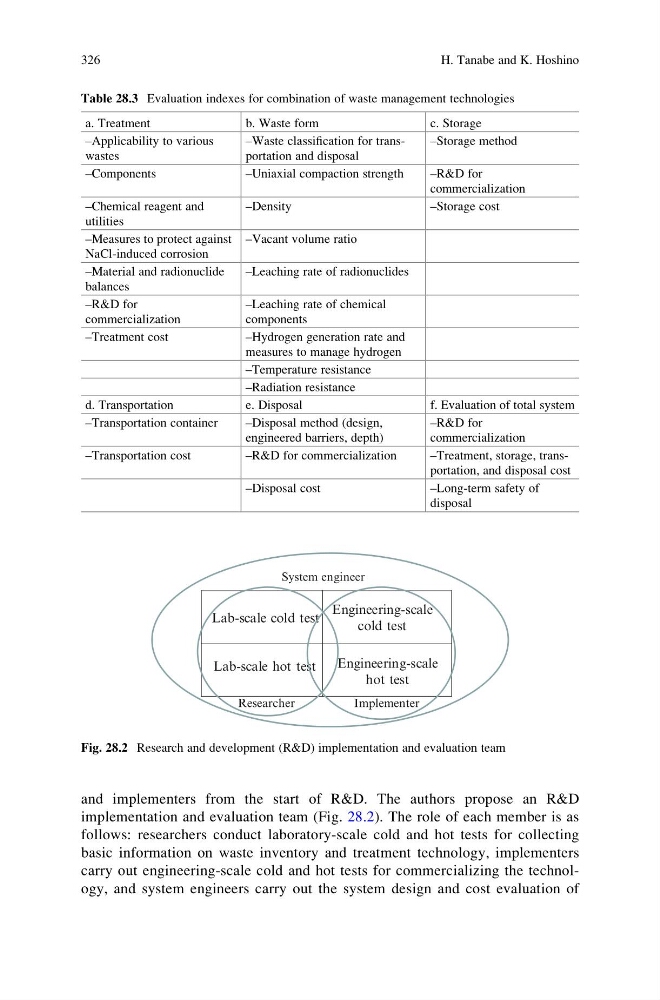
and implementers from the start of R&D. The authors propose an R&D
implementation and evaluation team (Fig. 28.2). The role of each member is as
follows: researchers conduct laboratory-scale cold and hot tests for collecting
basic information on waste inventory and treatment technology, implementers
carry out engineering-scale cold and hot tests for commercializing the technology, and system engineers carry out the system design and cost evaluation of
Table 28.3 Evaluation indexes for combination of waste management technologies
a. Treatment
b. Waste form
c. Storage
–Applicability to various
wastes
–Waste classification for transportation and disposal
–Storage method
–Components
–Uniaxial compaction strength
–R&D for
commercialization
–Chemical reagent and
utilities
–Density
–Storage cost
–Measures to protect against
NaCl-induced corrosion
–Vacant volume ratio
–Material and radionuclide
balances
–Leaching rate of radionuclides
–R&D for
commercialization
–Leaching rate of chemical
components
–Treatment cost
–Hydrogen generation rate and
measures to manage hydrogen
–Temperature resistance
–Radiation resistance
d. Transportation
e. Disposal
f. Evaluation of total system
–Transportation container
–Disposal method (design,
engineered barriers, depth)
–R&D for
commercialization
–Transportation cost
–R&D for commercialization
–Treatment, storage, transportation, and disposal cost
–Disposal cost
–Long-term safety of
disposal
Lab-scale cold test
Engineering-scale
cold test
Lab-scale hot test
Engineering-scale
hot test
Researcher
Implementer
System engineer
Fig. 28.2 Research and development (R&D) implementation and evaluation team
326
H. Tanabe and K. Hoshino
implementation and evaluation team (Fig. 28.2). The role of each member is as
follows: researchers conduct laboratory-scale cold and hot tests for collecting
basic information on waste inventory and treatment technology, implementers
carry out engineering-scale cold and hot tests for commercializing the technology, and system engineers carry out the system design and cost evaluation of
Table 28.3 Evaluation indexes for combination of waste management technologies
a. Treatment
b. Waste form
c. Storage
–Applicability to various
wastes
–Waste classification for transportation and disposal
–Storage method
–Components
–Uniaxial compaction strength
–R&D for
commercialization
–Chemical reagent and
utilities
–Density
–Storage cost
–Measures to protect against
NaCl-induced corrosion
–Vacant volume ratio
–Material and radionuclide
balances
–Leaching rate of radionuclides
–R&D for
commercialization
–Leaching rate of chemical
components
–Treatment cost
–Hydrogen generation rate and
measures to manage hydrogen
–Temperature resistance
–Radiation resistance
d. Transportation
e. Disposal
f. Evaluation of total system
–Transportation container
–Disposal method (design,
engineered barriers, depth)
–R&D for
commercialization
–Transportation cost
–R&D for commercialization
–Treatment, storage, transportation, and disposal cost
–Disposal cost
–Long-term safety of
disposal
Lab-scale cold test
Engineering-scale
cold test
Lab-scale hot test
Engineering-scale
hot test
Researcher
Implementer
System engineer
Fig. 28.2 Research and development (R&D) implementation and evaluation team
326
H. Tanabe and K. Hoshino