

28.1 Introduction
A significant volume of highly contaminated water was generated from the accidents
at the Fukushima Daiichi Nuclear Power Units. Several methods have been applied
to decontaminate the water. After decontamination treatments using several systems
developed by AREVA, Kurion, and Toshiba, various kinds of sludge and spent
adsorbents were generated as secondary wastes. These wastes are now tentatively
stored at the site, but further treatment shall be applied to produce appropriate waste
forms for interim storage and final disposal in a repository. Management of these
wastes is believed to take several decades. The authors examined how to manage
these wastes in consideration of the large volume of waste, the variety of waste
types, and the long period to carry out the treatment and disposal in a safe and
efficient manner. The issues identified are discussed in the following sections.
28.2 Requirements for an Inventory List and Online
Waste Management System
A fundamental issue is to establish a raw waste inventory list with information on
various characteristics, including chemical and physical form and radionuclide
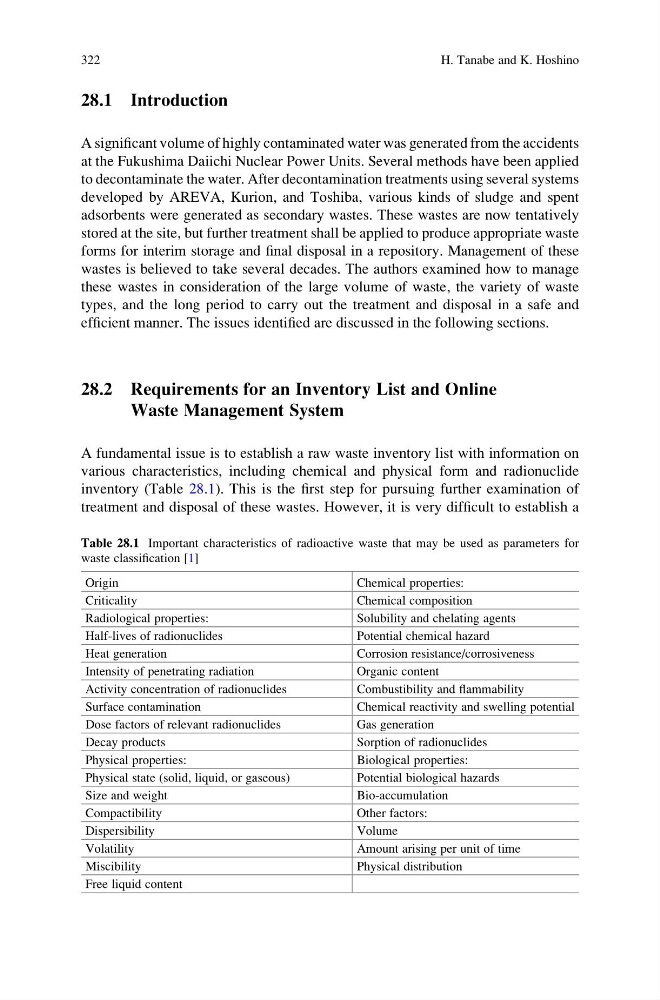
inventory (Table 28.1). This is the first step for pursuing further examination of
treatment and disposal of these wastes. However, it is very difficult to establish a
Table 28.1 Important characteristics of radioactive waste that may be used as parameters for
waste classification [1]
Origin
Chemical properties:
Criticality
Chemical composition
Radiological properties:
Solubility and chelating agents
Half-lives of radionuclides
Potential chemical hazard
Heat generation
Corrosion resistance/corrosiveness
Intensity of penetrating radiation
Organic content
Activity concentration of radionuclides
Combustibility and flammability
Surface contamination
Chemical reactivity and swelling potential
Dose factors of relevant radionuclides
Gas generation
Decay products
Sorption of radionuclides
Physical properties:
Biological properties:
Physical state (solid, liquid, or gaseous)
Potential biological hazards
Size and weight
Bio-accumulation
Compactibility
Other factors:
Dispersibility
Volume
Volatility
Amount arising per unit of time
Miscibility
Physical distribution
Free liquid content
322
H. Tanabe and K. Hoshino
A significant volume of highly contaminated water was generated from the accidents
at the Fukushima Daiichi Nuclear Power Units. Several methods have been applied
to decontaminate the water. After decontamination treatments using several systems
developed by AREVA, Kurion, and Toshiba, various kinds of sludge and spent
adsorbents were generated as secondary wastes. These wastes are now tentatively
stored at the site, but further treatment shall be applied to produce appropriate waste
forms for interim storage and final disposal in a repository. Management of these
wastes is believed to take several decades. The authors examined how to manage
these wastes in consideration of the large volume of waste, the variety of waste
types, and the long period to carry out the treatment and disposal in a safe and
efficient manner. The issues identified are discussed in the following sections.
28.2 Requirements for an Inventory List and Online
Waste Management System
A fundamental issue is to establish a raw waste inventory list with information on
various characteristics, including chemical and physical form and radionuclide
inventory (Table 28.1). This is the first step for pursuing further examination of
treatment and disposal of these wastes. However, it is very difficult to establish a
Table 28.1 Important characteristics of radioactive waste that may be used as parameters for
waste classification [1]
Origin
Chemical properties:
Criticality
Chemical composition
Radiological properties:
Solubility and chelating agents
Half-lives of radionuclides
Potential chemical hazard
Heat generation
Corrosion resistance/corrosiveness
Intensity of penetrating radiation
Organic content
Activity concentration of radionuclides
Combustibility and flammability
Surface contamination
Chemical reactivity and swelling potential
Dose factors of relevant radionuclides
Gas generation
Decay products
Sorption of radionuclides
Physical properties:
Biological properties:
Physical state (solid, liquid, or gaseous)
Potential biological hazards
Size and weight
Bio-accumulation
Compactibility
Other factors:
Dispersibility
Volume
Volatility
Amount arising per unit of time
Miscibility
Physical distribution
Free liquid content
322
H. Tanabe and K. Hoshino