

the guest speakers and their demonstrations of a cloud chamber (a simple device
that allows the decay of radioactive materials to be observed) and other experiments, students gradually learned more about the science involved, leading them to
become more proactive in thinking about issues for themselves.
25.4 Results of the Questionnaire Survey
The results of the “Fundamental literacy for members of society” questionnaire are
summarized in this section. Responses were obtained from a total of 42 students
(Enshu I): responses from 10 of the 12 students registered for the course; Introduction to Debate (first semester): 26 of the 27 students; Introduction to Debate (second
semester): 6 of the 8 students. The composition of the classes was as follows: Enshu
1: third- and fourth-year female students; Introduction to Debate (first semester)
and Introduction to Debate (second semester): second- and third-year female and
male students. Because the sample was small, no comparison of data based on
gender and year of study was made; instead, the results of the group as a whole is
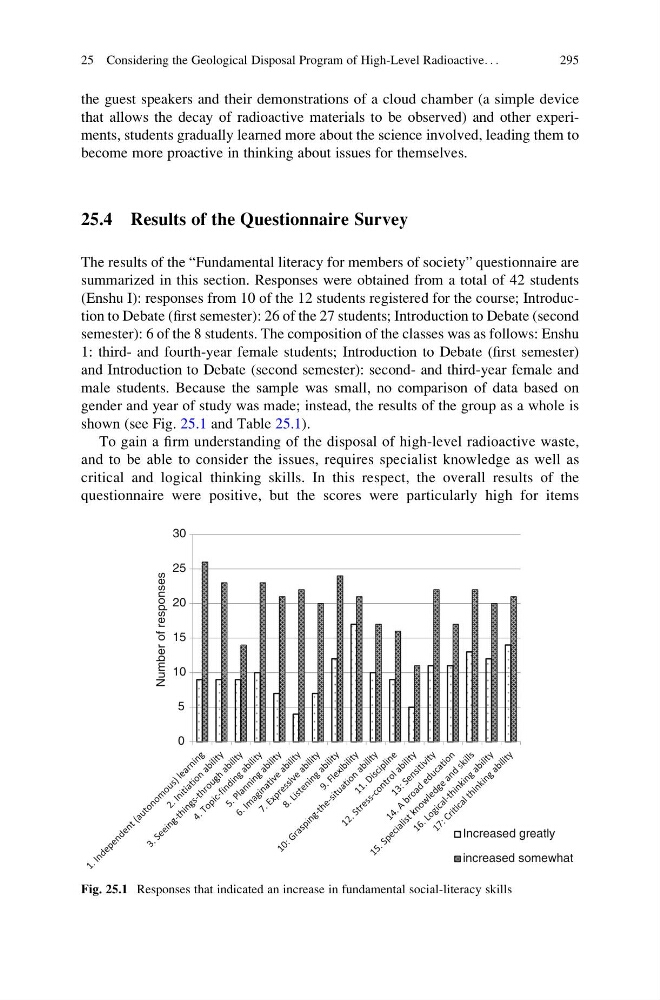
shown (see Fig. 25.1 and Table 25.1).
To gain a firm understanding of the disposal of high-level radioactive waste,
and to be able to consider the issues, requires specialist knowledge as well as
critical and logical thinking skills. In this respect, the overall results of the
questionnaire were positive, but the scores were particularly high for items
0
5
10
15
20
Number of responses
25
30
Increased greatly
increased somewhat
Fig. 25.1 Responses that indicated an increase in fundamental social-literacy skills
25 Considering the Geological Disposal Program of High-Level Radioactive. . .
295
that allows the decay of radioactive materials to be observed) and other experiments, students gradually learned more about the science involved, leading them to
become more proactive in thinking about issues for themselves.
25.4 Results of the Questionnaire Survey
The results of the “Fundamental literacy for members of society” questionnaire are
summarized in this section. Responses were obtained from a total of 42 students
(Enshu I): responses from 10 of the 12 students registered for the course; Introduction to Debate (first semester): 26 of the 27 students; Introduction to Debate (second
semester): 6 of the 8 students. The composition of the classes was as follows: Enshu
1: third- and fourth-year female students; Introduction to Debate (first semester)
and Introduction to Debate (second semester): second- and third-year female and
male students. Because the sample was small, no comparison of data based on
gender and year of study was made; instead, the results of the group as a whole is
shown (see Fig. 25.1 and Table 25.1).
To gain a firm understanding of the disposal of high-level radioactive waste,
and to be able to consider the issues, requires specialist knowledge as well as
critical and logical thinking skills. In this respect, the overall results of the
questionnaire were positive, but the scores were particularly high for items
0
5
10
15
20
Number of responses
25
30
Increased greatly
increased somewhat
Fig. 25.1 Responses that indicated an increase in fundamental social-literacy skills
25 Considering the Geological Disposal Program of High-Level Radioactive. . .
295