

steel. Boron originating from the control rods cannot be expected necessarily to
coexist with the fuel debris. It is also possible that the fuel debris in CVs has been
generated through the molten core–concrete interaction (MCCI). It must be considered that the fuel debris is not uniform and will be found at various locations.
The fuel debris is being cooled with nonborated water although it is highly
preferable to add neutron poison and to maintain enough concentration in the water
to secure the subcritical condition such as was performed after the TMI-2 accident.
Boration is not realistic at present because of the coolant water leakage from CVs
and underground water inflow to the coolant water circulation. Boron will be
injected only in the event of re-criticality [7].
21.3 Criticality Characteristics of Fuel Debris
The criticality safety handbook shows the minimum critical masses of homogeneous uranium-water mixtures, 36 and 53 kg, respectively for the
235 U/U enrichments of 5 and 4 wt%. Mass control limits that can avoid criticality are also given
for heterogeneous UO 2 -water composites, that is, 28 kg for the 5 wt% enrichment.
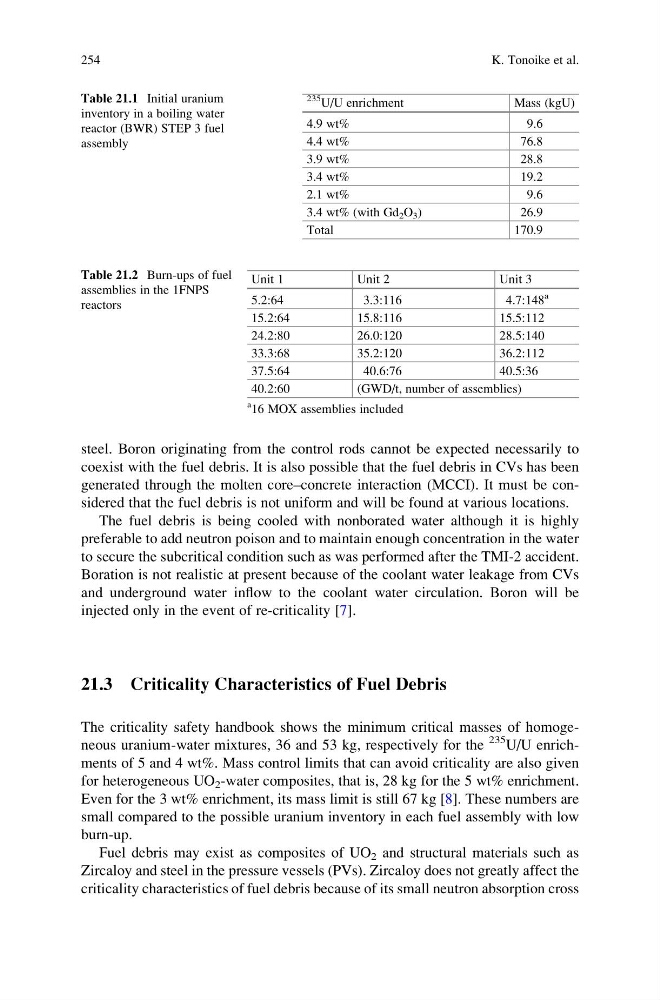
Even for the 3 wt% enrichment, its mass limit is still 67 kg [8]. These numbers are
small compared to the possible uranium inventory in each fuel assembly with low
burn-up.
Fuel debris may exist as composites of UO 2 and structural materials such as
Zircaloy and steel in the pressure vessels (PVs). Zircaloy does not greatly affect the
criticality characteristics of fuel debris because of its small neutron absorption cross
Table 21.1 Initial uranium
inventory in a boiling water
reactor (BWR) STEP 3 fuel
assembly
235
U/U enrichment
Mass (kgU)
4.9 wt%
9.6
4.4 wt%
76.8
3.9 wt%
28.8
3.4 wt%
19.2
2.1 wt%
9.6
3.4 wt% (with Gd 2 O 3 )
26.9
Total
170.9
Table 21.2 Burn-ups of fuel
assemblies in the 1FNPS
reactors
Unit 1
Unit 2
Unit 3
5.2:64
3.3:116
4.7:148
a
15.2:64
15.8:116
15.5:112
24.2:80
26.0:120
28.5:140
33.3:68
35.2:120
36.2:112
37.5:64
40.6:76
40.5:36
40.2:60
(GWD/t, number of assemblies)
a
16 MOX assemblies included
254
K. Tonoike et al.
coexist with the fuel debris. It is also possible that the fuel debris in CVs has been
generated through the molten core–concrete interaction (MCCI). It must be considered that the fuel debris is not uniform and will be found at various locations.
The fuel debris is being cooled with nonborated water although it is highly
preferable to add neutron poison and to maintain enough concentration in the water
to secure the subcritical condition such as was performed after the TMI-2 accident.
Boration is not realistic at present because of the coolant water leakage from CVs
and underground water inflow to the coolant water circulation. Boron will be
injected only in the event of re-criticality [7].
21.3 Criticality Characteristics of Fuel Debris
The criticality safety handbook shows the minimum critical masses of homogeneous uranium-water mixtures, 36 and 53 kg, respectively for the
235 U/U enrichments of 5 and 4 wt%. Mass control limits that can avoid criticality are also given
for heterogeneous UO 2 -water composites, that is, 28 kg for the 5 wt% enrichment.
Even for the 3 wt% enrichment, its mass limit is still 67 kg [8]. These numbers are
small compared to the possible uranium inventory in each fuel assembly with low
burn-up.
Fuel debris may exist as composites of UO 2 and structural materials such as
Zircaloy and steel in the pressure vessels (PVs). Zircaloy does not greatly affect the
criticality characteristics of fuel debris because of its small neutron absorption cross
Table 21.1 Initial uranium
inventory in a boiling water
reactor (BWR) STEP 3 fuel
assembly
235
U/U enrichment
Mass (kgU)
4.9 wt%
9.6
4.4 wt%
76.8
3.9 wt%
28.8
3.4 wt%
19.2
2.1 wt%
9.6
3.4 wt% (with Gd 2 O 3 )
26.9
Total
170.9
Table 21.2 Burn-ups of fuel
assemblies in the 1FNPS
reactors
Unit 1
Unit 2
Unit 3
5.2:64
3.3:116
4.7:148
a
15.2:64
15.8:116
15.5:112
24.2:80
26.0:120
28.5:140
33.3:68
35.2:120
36.2:112
37.5:64
40.6:76
40.5:36
40.2:60
(GWD/t, number of assemblies)
a
16 MOX assemblies included
254
K. Tonoike et al.