

determined to be 5 % of that at the center, based on flux distribution evaluated by
the one-dimensional neutron diffusion calculation.
20.3.2 Target Nuclides of Sensitivity Analyses
The representative radioactive nuclides in this study (Table 20.5) include not only
the important nuclides for various evaluations of radioactive wastes but also the
nuclides whose concentrations have been measured in the past, which will be useful
for the validation of numerical evaluations.
Target nuclides of sensitivity analyses were selected on the basis of two criteria.
The first was that the concentrations of activation products be larger than or
comparable to the concentration of fission products generated from impurity uranium in the materials. The contents of impurity uranium in Zircaloy-2 and SUS304
stainless steel were 0.00035 wt% and 0.0001 wt% [5], respectively. This value in
INCONEL alloy is unknown. The second criterion was that the concentrations of
activation products be comparatively large. In these analyses, activation products
with concentrations more than 1 Â 10
À9 g/t were chosen.
The concentrations of activation products larger than 1 Â 10
À9 g/t and fission
products generated from impurity uranium are shown in Table 20.6. The fission
products were calculated under the condition that the initial composition contains
only the uranium impurity. Table 20.6 also shows the selected target nuclides that
satisfy the foregoing criterion: 17 nuclides in Zircaloy-2 and Zircaloy-4, 8 nuclides
in SUS304 stainless steel, and 16 nuclides in INCONEL alloy were selected as the
target nuclides of sensitivity analyses.
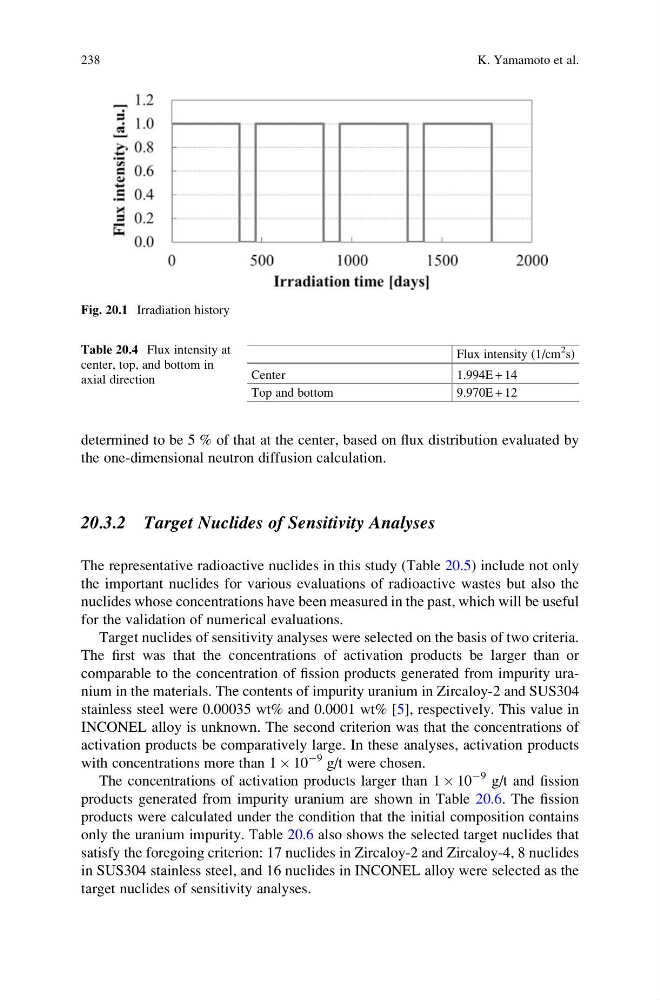
Fig. 20.1 Irradiation history
Table 20.4 Flux intensity at
center, top, and bottom in
axial direction
Flux intensity (1/cm
2
s)
Center
1.994E + 14
Top and bottom
9.970E + 12
238
K. Yamamoto et al.
the one-dimensional neutron diffusion calculation.
20.3.2 Target Nuclides of Sensitivity Analyses
The representative radioactive nuclides in this study (Table 20.5) include not only
the important nuclides for various evaluations of radioactive wastes but also the
nuclides whose concentrations have been measured in the past, which will be useful
for the validation of numerical evaluations.
Target nuclides of sensitivity analyses were selected on the basis of two criteria.
The first was that the concentrations of activation products be larger than or
comparable to the concentration of fission products generated from impurity uranium in the materials. The contents of impurity uranium in Zircaloy-2 and SUS304
stainless steel were 0.00035 wt% and 0.0001 wt% [5], respectively. This value in
INCONEL alloy is unknown. The second criterion was that the concentrations of
activation products be comparatively large. In these analyses, activation products
with concentrations more than 1 Â 10
À9 g/t were chosen.
The concentrations of activation products larger than 1 Â 10
À9 g/t and fission
products generated from impurity uranium are shown in Table 20.6. The fission
products were calculated under the condition that the initial composition contains
only the uranium impurity. Table 20.6 also shows the selected target nuclides that
satisfy the foregoing criterion: 17 nuclides in Zircaloy-2 and Zircaloy-4, 8 nuclides
in SUS304 stainless steel, and 16 nuclides in INCONEL alloy were selected as the
target nuclides of sensitivity analyses.
Fig. 20.1 Irradiation history
Table 20.4 Flux intensity at
center, top, and bottom in
axial direction
Flux intensity (1/cm
2
s)
Center
1.994E + 14
Top and bottom
9.970E + 12
238
K. Yamamoto et al.