

concentrations of the activation products. An effective first step to achieving this is
to identify the dominant generation pathways of activation products. Sensitivity
analyses of initial compositions and cross sections for activation products, which
involve understanding the effects of initial compositions and cross sections on the
concentrations of the target activation products, are powerful methods for quantitatively investigating the generation pathways. Thus, in the present study, sensitivity analyses focusing on the generation pathways for activation products were
conducted.
The ORIGEN2.2 [1] code was used in the analyses; this code has been widely
used for evaluating the concentrations of activation products. The one-group cross
sections made with the appropriate neutron spectrum are required for the accuracy
of the ORIGEN2.2 calculation. With respect to the activations of in-core structure
materials, the existing ORIGEN2.2 cross-section libraries made with the in-core
neutron spectrum are available. Thus, the target of the analyses in the present study
is the activation of such in-core structure materials.
This chapter presents the method, calculation conditions, and results of the
sensitivity analyses of initial compositions and cross sections for activation products in the materials of in-core structures, such as zirconium alloy, stainless steel,
and nickel-chromium-based alloy. The results of the sensitivity analyses identify
the elements and the nuclear reactions leading to the generation of activation
products. These results will be effective in improving the accuracy of numerical
evaluations of the concentrations of activation products.
20.2 Method of Calculating Sensitivity Coefficients
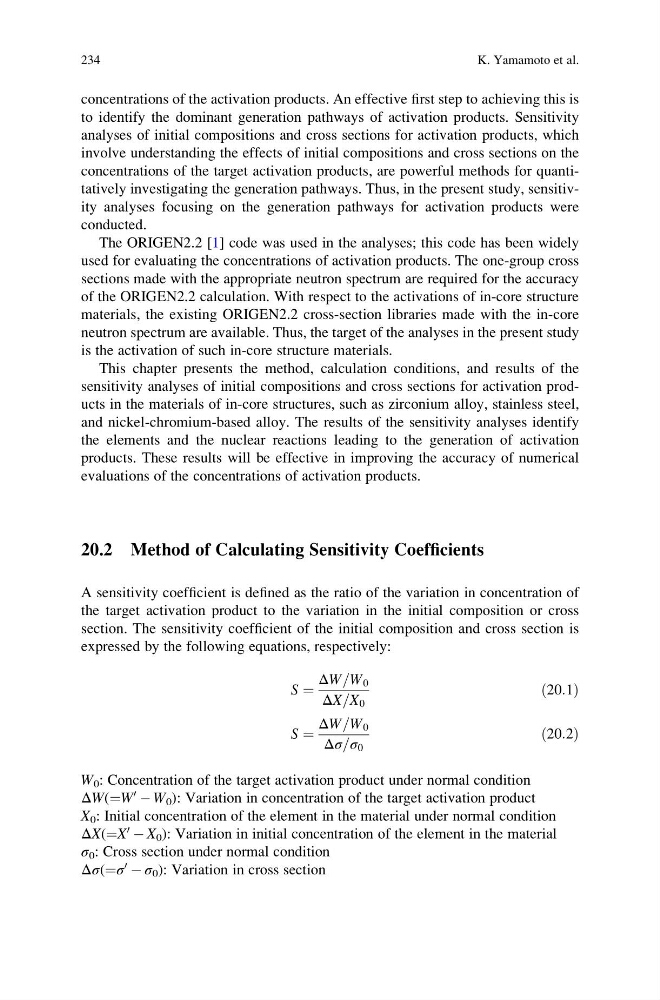
A sensitivity coefficient is defined as the ratio of the variation in concentration of
the target activation product to the variation in the initial composition or cross
section. The sensitivity coefficient of the initial composition and cross section is
expressed by the following equations, respectively:
S ¼
ΔW=W 0
ΔX=X 0
ð20:1Þ
S ¼
ΔW=W 0
Δσ=σ 0
ð20:2Þ
W 0 : Concentration of the target activation product under normal condition
ΔW(¼W
0
À W 0 ): Variation in concentration of the target activation product
X 0 : Initial concentration of the element in the material under normal condition
ΔX(¼X
0
À X 0 ): Variation in initial concentration of the element in the material
σ 0 : Cross section under normal condition
Δσ(¼σ
0
À σ 0 ): Variation in cross section
234
K. Yamamoto et al.
to identify the dominant generation pathways of activation products. Sensitivity
analyses of initial compositions and cross sections for activation products, which
involve understanding the effects of initial compositions and cross sections on the
concentrations of the target activation products, are powerful methods for quantitatively investigating the generation pathways. Thus, in the present study, sensitivity analyses focusing on the generation pathways for activation products were
conducted.
The ORIGEN2.2 [1] code was used in the analyses; this code has been widely
used for evaluating the concentrations of activation products. The one-group cross
sections made with the appropriate neutron spectrum are required for the accuracy
of the ORIGEN2.2 calculation. With respect to the activations of in-core structure
materials, the existing ORIGEN2.2 cross-section libraries made with the in-core
neutron spectrum are available. Thus, the target of the analyses in the present study
is the activation of such in-core structure materials.
This chapter presents the method, calculation conditions, and results of the
sensitivity analyses of initial compositions and cross sections for activation products in the materials of in-core structures, such as zirconium alloy, stainless steel,
and nickel-chromium-based alloy. The results of the sensitivity analyses identify
the elements and the nuclear reactions leading to the generation of activation
products. These results will be effective in improving the accuracy of numerical
evaluations of the concentrations of activation products.
20.2 Method of Calculating Sensitivity Coefficients
A sensitivity coefficient is defined as the ratio of the variation in concentration of
the target activation product to the variation in the initial composition or cross
section. The sensitivity coefficient of the initial composition and cross section is
expressed by the following equations, respectively:
S ¼
ΔW=W 0
ΔX=X 0
ð20:1Þ
S ¼
ΔW=W 0
Δσ=σ 0
ð20:2Þ
W 0 : Concentration of the target activation product under normal condition
ΔW(¼W
0
À W 0 ): Variation in concentration of the target activation product
X 0 : Initial concentration of the element in the material under normal condition
ΔX(¼X
0
À X 0 ): Variation in initial concentration of the element in the material
σ 0 : Cross section under normal condition
Δσ(¼σ
0
À σ 0 ): Variation in cross section
234
K. Yamamoto et al.