

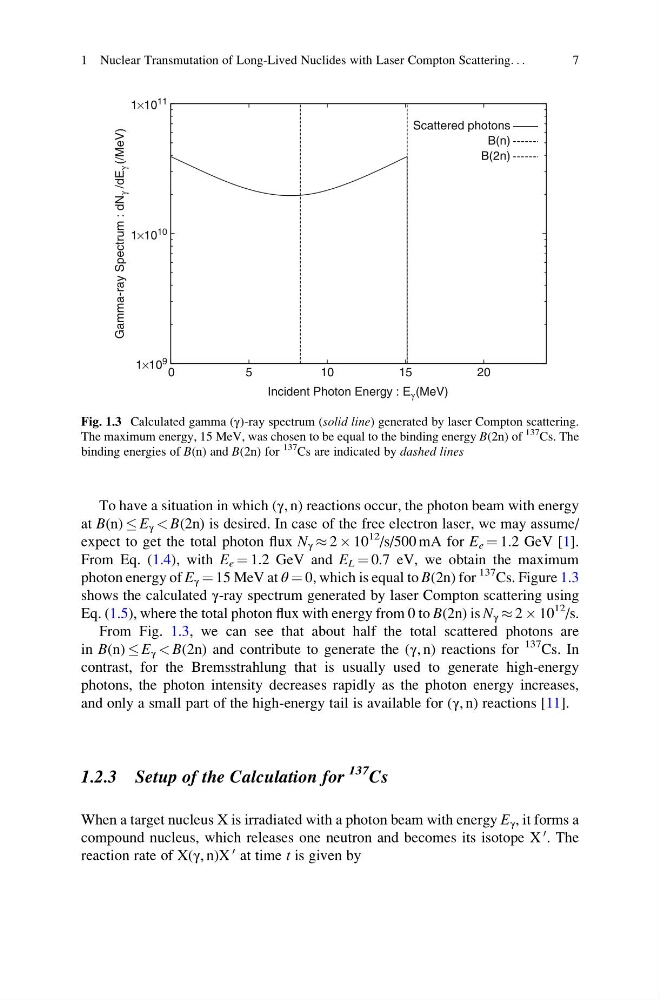
To have a situation in which (γ, n) reactions occur, the photon beam with energy
at B(n) E γ < B(2n) is desired. In case of the free electron laser, we may assume/
expect to get the total photon flux N γ % 2 Â 10
12 /s/500 mA for E e ¼ 1.2 GeV [1].
From Eq. (1.4), with E e ¼ 1.2 GeV and E L ¼ 0.7 eV, we obtain the maximum
photon energy of E γ ¼ 15 MeV at θ ¼ 0, which is equal to B(2n) for
137 Cs. Figure 1.3
shows the calculated γ-ray spectrum generated by laser Compton scattering using
Eq. (1.5), where the total photon flux with energy from 0 to B(2n) is N γ % 2 Â 10
12 /s.
From Fig. 1.3, we can see that about half the total scattered photons are
in B(n) E γ < B(2n) and contribute to generate the (γ, n) reactions for
137 Cs. In
contrast, for the Bremsstrahlung that is usually used to generate high-energy
photons, the photon intensity decreases rapidly as the photon energy increases,
and only a small part of the high-energy tail is available for (γ, n) reactions [11].
1.2.3 Setup of the Calculation for
137
Cs
When a target nucleus X is irradiated with a photon beam with energy E γ , it forms a
compound nucleus, which releases one neutron and becomes its isotope X
0 . The
reaction rate of X(γ, n)X
0 at time t is given by
1×10
9
1×10 10
1×10 11
0
5
10
15
20
Gamma-ray Spectrum : dN
γ /dE
γ (/MeV)
Incident Photon Energy : E γ (MeV)
Scattered photons
B(n)
B(2n)
Fig. 1.3 Calculated gamma (γ)-ray spectrum (solid line) generated by laser Compton scattering.
The maximum energy, 15 MeV, was chosen to be equal to the binding energy B(2n) of
137
Cs. The
binding energies of B(n) and B(2n) for
137
Cs are indicated by dashed lines
1 Nuclear Transmutation of Long-Lived Nuclides with Laser Compton Scattering. . .
7
at B(n) E γ < B(2n) is desired. In case of the free electron laser, we may assume/
expect to get the total photon flux N γ % 2 Â 10
12 /s/500 mA for E e ¼ 1.2 GeV [1].
From Eq. (1.4), with E e ¼ 1.2 GeV and E L ¼ 0.7 eV, we obtain the maximum
photon energy of E γ ¼ 15 MeV at θ ¼ 0, which is equal to B(2n) for
137 Cs. Figure 1.3
shows the calculated γ-ray spectrum generated by laser Compton scattering using
Eq. (1.5), where the total photon flux with energy from 0 to B(2n) is N γ % 2 Â 10
12 /s.
From Fig. 1.3, we can see that about half the total scattered photons are
in B(n) E γ < B(2n) and contribute to generate the (γ, n) reactions for
137 Cs. In
contrast, for the Bremsstrahlung that is usually used to generate high-energy
photons, the photon intensity decreases rapidly as the photon energy increases,
and only a small part of the high-energy tail is available for (γ, n) reactions [11].
1.2.3 Setup of the Calculation for
137
Cs
When a target nucleus X is irradiated with a photon beam with energy E γ , it forms a
compound nucleus, which releases one neutron and becomes its isotope X
0 . The
reaction rate of X(γ, n)X
0 at time t is given by
1×10
9
1×10 10
1×10 11
0
5
10
15
20
Gamma-ray Spectrum : dN
γ /dE
γ (/MeV)
Incident Photon Energy : E γ (MeV)
Scattered photons
B(n)
B(2n)
Fig. 1.3 Calculated gamma (γ)-ray spectrum (solid line) generated by laser Compton scattering.
The maximum energy, 15 MeV, was chosen to be equal to the binding energy B(2n) of
137
Cs. The
binding energies of B(n) and B(2n) for
137
Cs are indicated by dashed lines
1 Nuclear Transmutation of Long-Lived Nuclides with Laser Compton Scattering. . .
7