

17.3 MA Transmutation Rate
Let us first introduce a definition of transmutation rates of individual MA nuclides
fueled in a reactor core. The calculation method of the transmutation rate relative to
the nuclides is as follows. First, conventional burn-up calculations are carried out
and burn-up-dependent flux in each region is calculated, which is used in the second
step calculation. In the second step, we consider only the relevant MA in each
region and perform burn-up calculations using the flux obtained in the first step.
In this second step of calculation, nuclide k is produced from the original nuclide
l. There are many passes of reactions of transmutation of the initial nuclide (shown
by N ) and the production of N as is shown in Fig. 17.6. We can calculate the
production rate of nuclide k at time T from the initial nuclide l as
P lk ¼ e
N k T
ð Þ= e
N l 0
ð Þ
ð17:1Þ
where e
N l 0
ð Þ is number density of nuclide l at time 0 and e
N k T
ð Þ is number density of
nuclide k at time T, assuming nuclide l is present alone at t ¼ 0. Using e
N k T
ð Þ, the
overall fission (see Fig. 17.6) relative to the initial nuclide l is calculated as
OF
l
¼
X
k
Z T
0
σ
k
f t
ð Þ e
N k t
ð Þϕ t
ð Þdt
ð17:2Þ
where σ
k
f (t) is fission cross section of nuclide k at time t, ϕ(t) is neutron flux at time
t, and Σ is summation over all nuclides k resulting from initial nuclide l; this
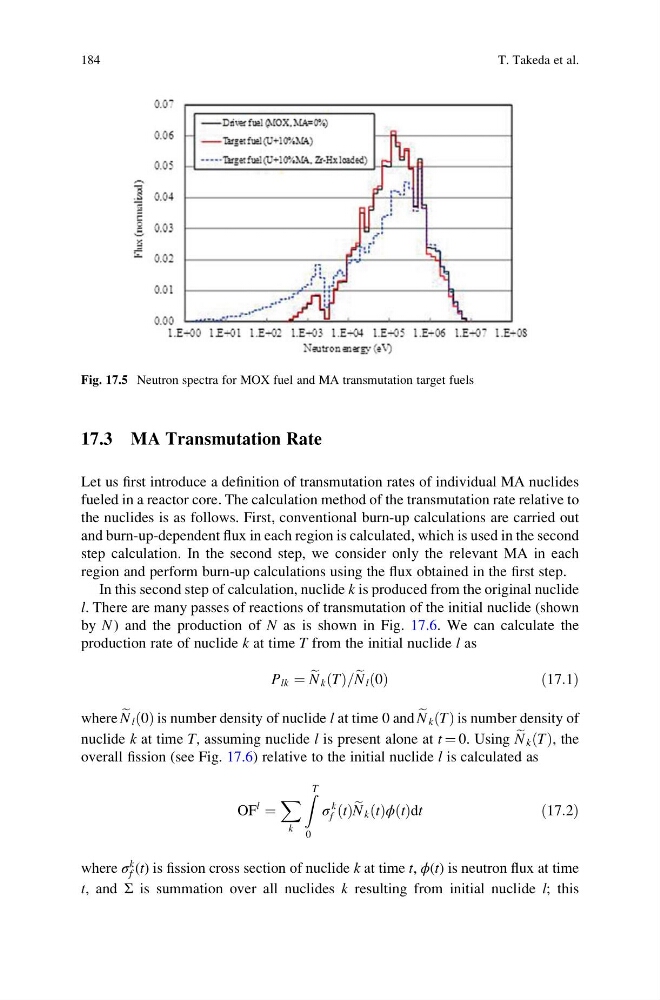
Fig. 17.5 Neutron spectra for MOX fuel and MA transmutation target fuels
184
T. Takeda et al.
Let us first introduce a definition of transmutation rates of individual MA nuclides
fueled in a reactor core. The calculation method of the transmutation rate relative to
the nuclides is as follows. First, conventional burn-up calculations are carried out
and burn-up-dependent flux in each region is calculated, which is used in the second
step calculation. In the second step, we consider only the relevant MA in each
region and perform burn-up calculations using the flux obtained in the first step.
In this second step of calculation, nuclide k is produced from the original nuclide
l. There are many passes of reactions of transmutation of the initial nuclide (shown
by N ) and the production of N as is shown in Fig. 17.6. We can calculate the
production rate of nuclide k at time T from the initial nuclide l as
P lk ¼ e
N k T
ð Þ= e
N l 0
ð Þ
ð17:1Þ
where e
N l 0
ð Þ is number density of nuclide l at time 0 and e
N k T
ð Þ is number density of
nuclide k at time T, assuming nuclide l is present alone at t ¼ 0. Using e
N k T
ð Þ, the
overall fission (see Fig. 17.6) relative to the initial nuclide l is calculated as
OF
l
¼
X
k
Z T
0
σ
k
f t
ð Þ e
N k t
ð Þϕ t
ð Þdt
ð17:2Þ
where σ
k
f (t) is fission cross section of nuclide k at time t, ϕ(t) is neutron flux at time
t, and Σ is summation over all nuclides k resulting from initial nuclide l; this
Fig. 17.5 Neutron spectra for MOX fuel and MA transmutation target fuels
184
T. Takeda et al.