

15.4.2 Performance of the Uranium-Free TRU Metallic Core
The core performance of the developed uranium-free core was evaluated as shown
in Table 15.4. The Zr content in the fuel alloy was determined to maintain criticality
during the operation cycle under the conditions of the upper limit of the melting
point, 1,200
C. According to the results, the uranium-free TRU metallic core is
viable in terms of core performance, safety performance, fuel fabrication, and TRU
burner.
The Doppler coefficient is similar to that of the conventional metallic fuel fast
reactor cores, and the burn-up reactivity swing is considered to be controllable by
conventional control rods and fixed absorbers. Moreover, core sodium void reactivity including the upper plenum region is negative because of neutron leakage at
the upper plenum region and neutron spectrum moderation from the presence of
BeO during sodium voiding. Although the restriction for sodium void reactivity
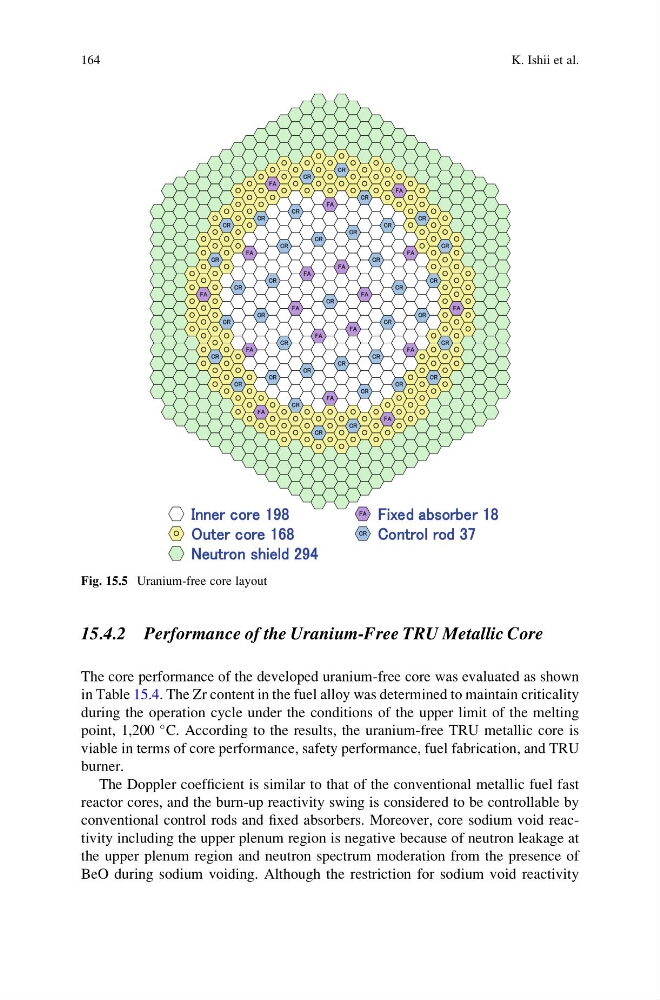
Fig. 15.5 Uranium-free core layout
164
K. Ishii et al.
The core performance of the developed uranium-free core was evaluated as shown
in Table 15.4. The Zr content in the fuel alloy was determined to maintain criticality
during the operation cycle under the conditions of the upper limit of the melting
point, 1,200
C. According to the results, the uranium-free TRU metallic core is
viable in terms of core performance, safety performance, fuel fabrication, and TRU
burner.
The Doppler coefficient is similar to that of the conventional metallic fuel fast
reactor cores, and the burn-up reactivity swing is considered to be controllable by
conventional control rods and fixed absorbers. Moreover, core sodium void reactivity including the upper plenum region is negative because of neutron leakage at
the upper plenum region and neutron spectrum moderation from the presence of
BeO during sodium voiding. Although the restriction for sodium void reactivity
Fig. 15.5 Uranium-free core layout
164
K. Ishii et al.