

complex processes. Therefore, we introduce a metal fuel alloy that can be simply
fabricated by injection casting and reprocessed by pyro-processing.
Additionally, in terms of reduction of nuclear waste burden, a metallic fuel fast
reactor cycle has the great potential to transmute long-lived fission products
(LLFPs) because of its excellent neutron economy [10, 11]. Moreover, it has an
advantage for long-term energy security because the basic technology of the
metallic fuel fast reactor cycle is also applicable to the future sustainable nuclear
energy supply system.
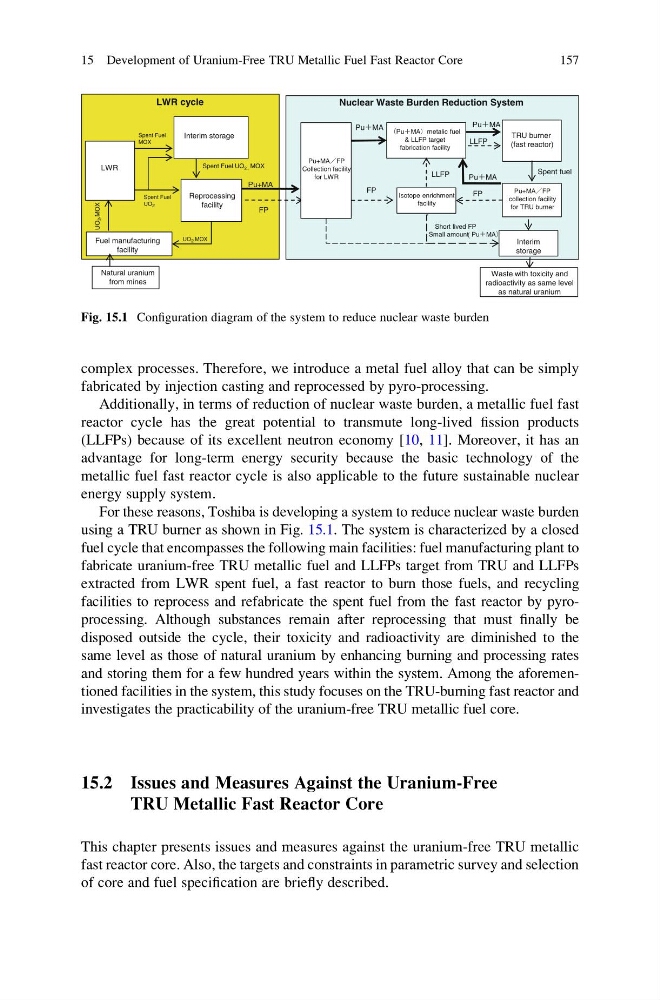
For these reasons, Toshiba is developing a system to reduce nuclear waste burden
using a TRU burner as shown in Fig. 15.1. The system is characterized by a closed
fuel cycle that encompasses the following main facilities: fuel manufacturing plant to
fabricate uranium-free TRU metallic fuel and LLFPs target from TRU and LLFPs
extracted from LWR spent fuel, a fast reactor to burn those fuels, and recycling
facilities to reprocess and refabricate the spent fuel from the fast reactor by pyroprocessing. Although substances remain after reprocessing that must finally be
disposed outside the cycle, their toxicity and radioactivity are diminished to the
same level as those of natural uranium by enhancing burning and processing rates
and storing them for a few hundred years within the system. Among the aforementioned facilities in the system, this study focuses on the TRU-burning fast reactor and
investigates the practicability of the uranium-free TRU metallic fuel core.
15.2 Issues and Measures Against the Uranium-Free
TRU Metallic Fast Reactor Core
This chapter presents issues and measures against the uranium-free TRU metallic
fast reactor core. Also, the targets and constraints in parametric survey and selection
of core and fuel specification are briefly described.
Nuclear Waste Burden Reduction System
LWR
Fuel manufacturing
facility
Natural uranium
from mines
Interim storage
Reprocessing
facility
Waste with toxicity and
radioactivity as same level
as natural uranium
Interim
storage
Pu+MA FP
Collection facility
for LWR
FP
Pu+MA
Isotope enrichment
facility
Pu MA metalic fuel
& LLFP target
fabrication facility
FP
FP
Pu+MA FP
collection facility
for TRU burner
LLFP
Pu MA
UO ,MOX
Spent Fuel
UO
Spent Fuel
MOX
LLFP
Pu MA
TRU burner
(fast reactor)
Spent fuel
Short lived FP
Small amount Pu MA
Pu MA
LWR cycle
UO ,MOX
Spent Fuel UO MOX
Fig. 15.1 Configuration diagram of the system to reduce nuclear waste burden
15 Development of Uranium-Free TRU Metallic Fuel Fast Reactor Core
157
fabricated by injection casting and reprocessed by pyro-processing.
Additionally, in terms of reduction of nuclear waste burden, a metallic fuel fast
reactor cycle has the great potential to transmute long-lived fission products
(LLFPs) because of its excellent neutron economy [10, 11]. Moreover, it has an
advantage for long-term energy security because the basic technology of the
metallic fuel fast reactor cycle is also applicable to the future sustainable nuclear
energy supply system.
For these reasons, Toshiba is developing a system to reduce nuclear waste burden
using a TRU burner as shown in Fig. 15.1. The system is characterized by a closed
fuel cycle that encompasses the following main facilities: fuel manufacturing plant to
fabricate uranium-free TRU metallic fuel and LLFPs target from TRU and LLFPs
extracted from LWR spent fuel, a fast reactor to burn those fuels, and recycling
facilities to reprocess and refabricate the spent fuel from the fast reactor by pyroprocessing. Although substances remain after reprocessing that must finally be
disposed outside the cycle, their toxicity and radioactivity are diminished to the
same level as those of natural uranium by enhancing burning and processing rates
and storing them for a few hundred years within the system. Among the aforementioned facilities in the system, this study focuses on the TRU-burning fast reactor and
investigates the practicability of the uranium-free TRU metallic fuel core.
15.2 Issues and Measures Against the Uranium-Free
TRU Metallic Fast Reactor Core
This chapter presents issues and measures against the uranium-free TRU metallic
fast reactor core. Also, the targets and constraints in parametric survey and selection
of core and fuel specification are briefly described.
Nuclear Waste Burden Reduction System
LWR
Fuel manufacturing
facility
Natural uranium
from mines
Interim storage
Reprocessing
facility
Waste with toxicity and
radioactivity as same level
as natural uranium
Interim
storage
Pu+MA FP
Collection facility
for LWR
FP
Pu+MA
Isotope enrichment
facility
Pu MA metalic fuel
& LLFP target
fabrication facility
FP
FP
Pu+MA FP
collection facility
for TRU burner
LLFP
Pu MA
UO ,MOX
Spent Fuel
UO
Spent Fuel
MOX
LLFP
Pu MA
TRU burner
(fast reactor)
Spent fuel
Short lived FP
Small amount Pu MA
Pu MA
LWR cycle
UO ,MOX
Spent Fuel UO MOX
Fig. 15.1 Configuration diagram of the system to reduce nuclear waste burden
15 Development of Uranium-Free TRU Metallic Fuel Fast Reactor Core
157