

supercritical state. However, the difference is expected to be not remarkable
compared to subcritical state, because excess reactivity is remarkably small compared to the subcriticality, as readily expected.
13.4 Conclusions
The neutron flux distribution evaluated in time-dependent mode changes with
elapsed time after the ignition of neutrons into the subcritical system, and the
neutron distribution in energy and space becomes almost stable in about 1 e
À4 s
after the ignition.
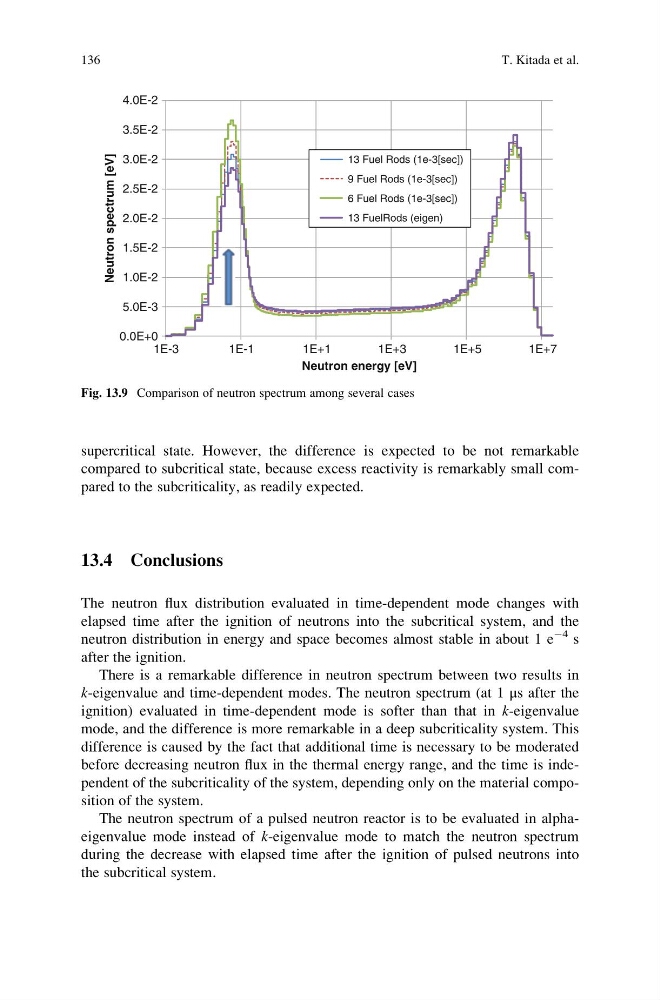
There is a remarkable difference in neutron spectrum between two results in
k-eigenvalue and time-dependent modes. The neutron spectrum (at 1 μs after the
ignition) evaluated in time-dependent mode is softer than that in k-eigenvalue
mode, and the difference is more remarkable in a deep subcriticality system. This
difference is caused by the fact that additional time is necessary to be moderated
before decreasing neutron flux in the thermal energy range, and the time is independent of the subcriticality of the system, depending only on the material composition of the system.
The neutron spectrum of a pulsed neutron reactor is to be evaluated in alphaeigenvalue mode instead of k-eigenvalue mode to match the neutron spectrum
during the decrease with elapsed time after the ignition of pulsed neutrons into
the subcritical system.
0.0E+0
5.0E-3
1.0E-2
1.5E-2
2.0E-2
2.5E-2
3.0E-2
3.5E-2
4.0E-2
1E-3
1E-1
1E+1
1E+3
1E+5
1E+7
Neutron spectrum [eV]
Neutron energy [eV]
13 Fuel Rods (1e-3[sec])
9 Fuel Rods (1e-3[sec])
6 Fuel Rods (1e-3[sec])
13 FuelRods (eigen)
Fig. 13.9 Comparison of neutron spectrum among several cases
136
T. Kitada et al.
compared to subcritical state, because excess reactivity is remarkably small compared to the subcriticality, as readily expected.
13.4 Conclusions
The neutron flux distribution evaluated in time-dependent mode changes with
elapsed time after the ignition of neutrons into the subcritical system, and the
neutron distribution in energy and space becomes almost stable in about 1 e
À4 s
after the ignition.
There is a remarkable difference in neutron spectrum between two results in
k-eigenvalue and time-dependent modes. The neutron spectrum (at 1 μs after the
ignition) evaluated in time-dependent mode is softer than that in k-eigenvalue
mode, and the difference is more remarkable in a deep subcriticality system. This
difference is caused by the fact that additional time is necessary to be moderated
before decreasing neutron flux in the thermal energy range, and the time is independent of the subcriticality of the system, depending only on the material composition of the system.
The neutron spectrum of a pulsed neutron reactor is to be evaluated in alphaeigenvalue mode instead of k-eigenvalue mode to match the neutron spectrum
during the decrease with elapsed time after the ignition of pulsed neutrons into
the subcritical system.
0.0E+0
5.0E-3
1.0E-2
1.5E-2
2.0E-2
2.5E-2
3.0E-2
3.5E-2
4.0E-2
1E-3
1E-1
1E+1
1E+3
1E+5
1E+7
Neutron spectrum [eV]
Neutron energy [eV]
13 Fuel Rods (1e-3[sec])
9 Fuel Rods (1e-3[sec])
6 Fuel Rods (1e-3[sec])
13 FuelRods (eigen)
Fig. 13.9 Comparison of neutron spectrum among several cases
136
T. Kitada et al.