

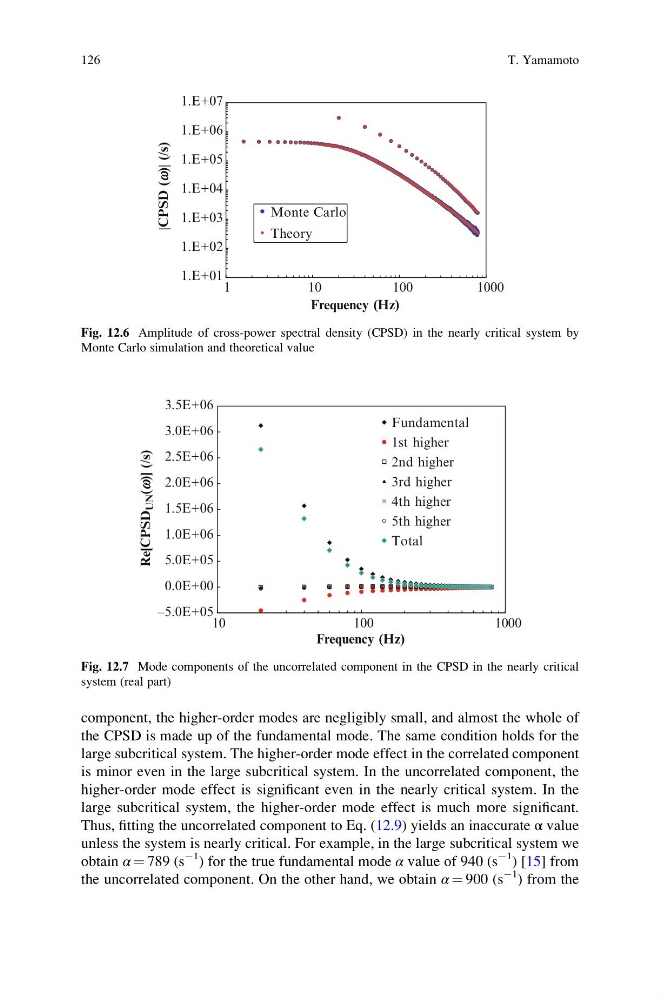
component, the higher-order modes are negligibly small, and almost the whole of
the CPSD is made up of the fundamental mode. The same condition holds for the
large subcritical system. The higher-order mode effect in the correlated component
is minor even in the large subcritical system. In the uncorrelated component, the
higher-order mode effect is significant even in the nearly critical system. In the
large subcritical system, the higher-order mode effect is much more significant.
Thus, fitting the uncorrelated component to Eq. (12.9) yields an inaccurate α value
unless the system is nearly critical. For example, in the large subcritical system we
obtain α ¼ 789 (s
À1 ) for the true fundamental mode α value of 940 (s
À1 ) [15] from
the uncorrelated component. On the other hand, we obtain α ¼ 900 (s
À1 ) from the
1.E+01
1.E+02
1.E+03
1.E+04
1.E+05
1.E+06
1.E+07
1
10
100
1000
|CPSD (w)| (/s)
Frequency (Hz)
Monte Carlo
Theory
Fig. 12.6 Amplitude of cross-power spectral density (CPSD) in the nearly critical system by
Monte Carlo simulation and theoretical value
–5.0E+05
0.0E+00
5.0E+05
1.0E+06
1.5E+06
2.0E+06
2.5E+06
3.0E+06
3.5E+06
10
100
1000
Frequency (Hz)
Fundamental
1st higher
2nd higher
3rd higher
4th higher
5th higher
Total
Re[CPSD
UN (w)] (/s)
Fig. 12.7 Mode components of the uncorrelated component in the CPSD in the nearly critical
system (real part)
126
T. Yamamoto
the CPSD is made up of the fundamental mode. The same condition holds for the
large subcritical system. The higher-order mode effect in the correlated component
is minor even in the large subcritical system. In the uncorrelated component, the
higher-order mode effect is significant even in the nearly critical system. In the
large subcritical system, the higher-order mode effect is much more significant.
Thus, fitting the uncorrelated component to Eq. (12.9) yields an inaccurate α value
unless the system is nearly critical. For example, in the large subcritical system we
obtain α ¼ 789 (s
À1 ) for the true fundamental mode α value of 940 (s
À1 ) [15] from
the uncorrelated component. On the other hand, we obtain α ¼ 900 (s
À1 ) from the
1.E+01
1.E+02
1.E+03
1.E+04
1.E+05
1.E+06
1.E+07
1
10
100
1000
|CPSD (w)| (/s)
Frequency (Hz)
Monte Carlo
Theory
Fig. 12.6 Amplitude of cross-power spectral density (CPSD) in the nearly critical system by
Monte Carlo simulation and theoretical value
–5.0E+05
0.0E+00
5.0E+05
1.0E+06
1.5E+06
2.0E+06
2.5E+06
3.0E+06
3.5E+06
10
100
1000
Frequency (Hz)
Fundamental
1st higher
2nd higher
3rd higher
4th higher
5th higher
Total
Re[CPSD
UN (w)] (/s)
Fig. 12.7 Mode components of the uncorrelated component in the CPSD in the nearly critical
system (real part)
126
T. Yamamoto