

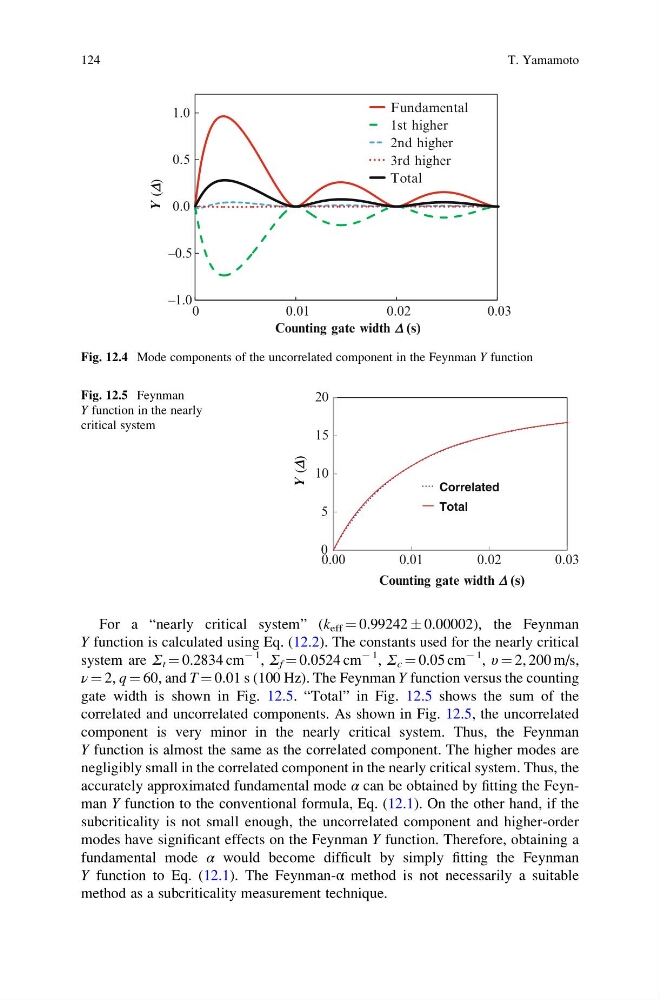
For a “nearly critical system” (k eff ¼ 0.99242 Æ 0.00002), the Feynman
Y function is calculated using Eq. (12.2). The constants used for the nearly critical
system are Σ t ¼ 0.2834 cm
À 1 , Σ f ¼ 0.0524 cm
À 1 , Σ c ¼ 0.05 cm
À 1 , υ ¼ 2, 200 m/s,
ν ¼ 2, q ¼ 60, and T ¼ 0.01 s (100 Hz). The Feynman Y function versus the counting
gate width is shown in Fig. 12.5. “Total” in Fig. 12.5 shows the sum of the
correlated and uncorrelated components. As shown in Fig. 12.5, the uncorrelated
component is very minor in the nearly critical system. Thus, the Feynman
Y function is almost the same as the correlated component. The higher modes are
negligibly small in the correlated component in the nearly critical system. Thus, the
accurately approximated fundamental mode α can be obtained by fitting the Feynman Y function to the conventional formula, Eq. (12.1). On the other hand, if the
subcriticality is not small enough, the uncorrelated component and higher-order
modes have significant effects on the Feynman Y function. Therefore, obtaining a
fundamental mode α would become difficult by simply fitting the Feynman
Y function to Eq. (12.1). The Feynman-α method is not necessarily a suitable
method as a subcriticality measurement technique.
–1.0
–0.5
0.0
0.5
1.0
0
0.01
0.02
0.03
Fundamental
1st higher
2nd higher
3rd higher
Total
Y (D)
Counting gate width D (s)
Fig. 12.4 Mode components of the uncorrelated component in the Feynman Y function
0
5
10
15
20
0.00
0.01
0.02
0.03
Correlated
Total
Y (D)
Counting gate width D (s)
Fig. 12.5 Feynman
Y function in the nearly
critical system
124
T. Yamamoto
Y function is calculated using Eq. (12.2). The constants used for the nearly critical
system are Σ t ¼ 0.2834 cm
À 1 , Σ f ¼ 0.0524 cm
À 1 , Σ c ¼ 0.05 cm
À 1 , υ ¼ 2, 200 m/s,
ν ¼ 2, q ¼ 60, and T ¼ 0.01 s (100 Hz). The Feynman Y function versus the counting
gate width is shown in Fig. 12.5. “Total” in Fig. 12.5 shows the sum of the
correlated and uncorrelated components. As shown in Fig. 12.5, the uncorrelated
component is very minor in the nearly critical system. Thus, the Feynman
Y function is almost the same as the correlated component. The higher modes are
negligibly small in the correlated component in the nearly critical system. Thus, the
accurately approximated fundamental mode α can be obtained by fitting the Feynman Y function to the conventional formula, Eq. (12.1). On the other hand, if the
subcriticality is not small enough, the uncorrelated component and higher-order
modes have significant effects on the Feynman Y function. Therefore, obtaining a
fundamental mode α would become difficult by simply fitting the Feynman
Y function to Eq. (12.1). The Feynman-α method is not necessarily a suitable
method as a subcriticality measurement technique.
–1.0
–0.5
0.0
0.5
1.0
0
0.01
0.02
0.03
Fundamental
1st higher
2nd higher
3rd higher
Total
Y (D)
Counting gate width D (s)
Fig. 12.4 Mode components of the uncorrelated component in the Feynman Y function
0
5
10
15
20
0.00
0.01
0.02
0.03
Correlated
Total
Y (D)
Counting gate width D (s)
Fig. 12.5 Feynman
Y function in the nearly
critical system
124
T. Yamamoto