

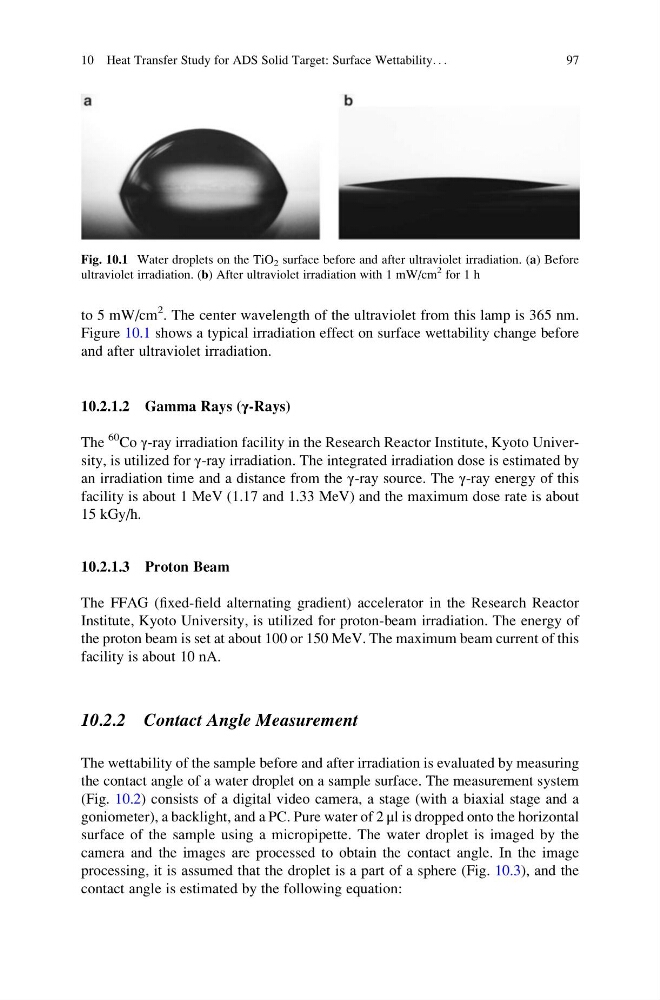
to 5 mW/cm
2 . The center wavelength of the ultraviolet from this lamp is 365 nm.
Figure 10.1 shows a typical irradiation effect on surface wettability change before
and after ultraviolet irradiation.
10.2.1.2 Gamma Rays (γ-Rays)
The
60 Co γ-ray irradiation facility in the Research Reactor Institute, Kyoto University, is utilized for γ-ray irradiation. The integrated irradiation dose is estimated by
an irradiation time and a distance from the γ-ray source. The γ-ray energy of this
facility is about 1 MeV (1.17 and 1.33 MeV) and the maximum dose rate is about
15 kGy/h.
10.2.1.3 Proton Beam
The FFAG (fixed-field alternating gradient) accelerator in the Research Reactor
Institute, Kyoto University, is utilized for proton-beam irradiation. The energy of
the proton beam is set at about 100 or 150 MeV. The maximum beam current of this
facility is about 10 nA.
10.2.2 Contact Angle Measurement
The wettability of the sample before and after irradiation is evaluated by measuring
the contact angle of a water droplet on a sample surface. The measurement system
(Fig. 10.2) consists of a digital video camera, a stage (with a biaxial stage and a
goniometer), a backlight, and a PC. Pure water of 2 μl is dropped onto the horizontal
surface of the sample using a micropipette. The water droplet is imaged by the
camera and the images are processed to obtain the contact angle. In the image
processing, it is assumed that the droplet is a part of a sphere (Fig. 10.3), and the
contact angle is estimated by the following equation:
Fig. 10.1 Water droplets on the TiO 2 surface before and after ultraviolet irradiation. (a) Before
ultraviolet irradiation. (b) After ultraviolet irradiation with 1 mW/cm
2 for 1 h
10 Heat Transfer Study for ADS Solid Target: Surface Wettability. . .
97
2 . The center wavelength of the ultraviolet from this lamp is 365 nm.
Figure 10.1 shows a typical irradiation effect on surface wettability change before
and after ultraviolet irradiation.
10.2.1.2 Gamma Rays (γ-Rays)
The
60 Co γ-ray irradiation facility in the Research Reactor Institute, Kyoto University, is utilized for γ-ray irradiation. The integrated irradiation dose is estimated by
an irradiation time and a distance from the γ-ray source. The γ-ray energy of this
facility is about 1 MeV (1.17 and 1.33 MeV) and the maximum dose rate is about
15 kGy/h.
10.2.1.3 Proton Beam
The FFAG (fixed-field alternating gradient) accelerator in the Research Reactor
Institute, Kyoto University, is utilized for proton-beam irradiation. The energy of
the proton beam is set at about 100 or 150 MeV. The maximum beam current of this
facility is about 10 nA.
10.2.2 Contact Angle Measurement
The wettability of the sample before and after irradiation is evaluated by measuring
the contact angle of a water droplet on a sample surface. The measurement system
(Fig. 10.2) consists of a digital video camera, a stage (with a biaxial stage and a
goniometer), a backlight, and a PC. Pure water of 2 μl is dropped onto the horizontal
surface of the sample using a micropipette. The water droplet is imaged by the
camera and the images are processed to obtain the contact angle. In the image
processing, it is assumed that the droplet is a part of a sphere (Fig. 10.3), and the
contact angle is estimated by the following equation:
Fig. 10.1 Water droplets on the TiO 2 surface before and after ultraviolet irradiation. (a) Before
ultraviolet irradiation. (b) After ultraviolet irradiation with 1 mW/cm
2 for 1 h
10 Heat Transfer Study for ADS Solid Target: Surface Wettability. . .
97