

86
The fi rst step for the maturity assessment is the sampling phase. Considering the
mapping of actors (throughout the supply chains) and the structure of the sector
(small, medium and big companies) a sample of the actors is selected. The sample
covers different product/material groups within a given sector (e.g., food, meat,
fruits, vegetables, drinks, etc. or the recycling of plastics, metals, wood etc.) to the
extent possible within the region. In most cases, a sample covering 20–40 % of the
actors is suffi ciently representative to formulate conclusions. Table 7.1 provides
the key fi gures of sampling done for the textile, packaging, seafood and mechanical
sectors.
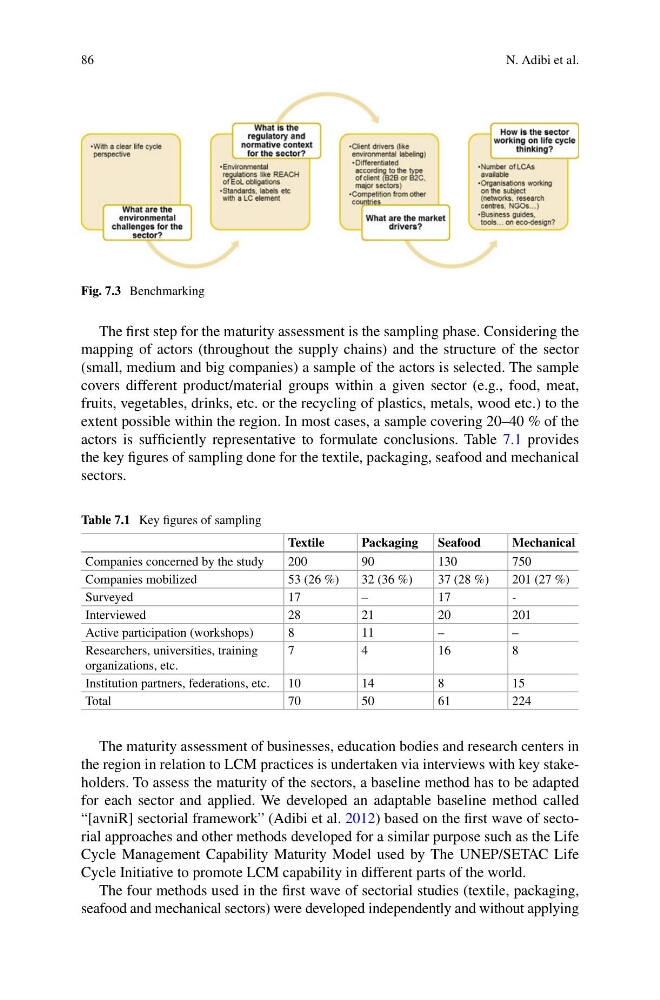
Fig. 7.3 Benchmarking
Table 7.1 Key fi gures of sampling
Textile
Packaging
Seafood
Mechanical
Companies concerned by the study
200
90
130
750
Companies mobilized
53 (26 %)
32 (36 %)
37 (28 %)
201 (27 %)
Surveyed
17
–
17
-
Interviewed
28
21
20
201
Active participation (workshops)
8
11
–
–
Researchers, universities, training
organizations, etc.
7
4
16
8
Institution partners, federations, etc. 10
14
8
15
Total
70
50
61
224
The maturity assessment of businesses, education bodies and research centers in
the region in relation to LCM practices is undertaken via interviews with key stakeholders. To assess the maturity of the sectors, a baseline method has to be adapted
for each sector and applied. We developed an adaptable baseline method called
“[avniR] sectorial framework” (Adibi et al. 2012 ) based on the fi rst wave of sectorial approaches and other methods developed for a similar purpose such as the Life
Cycle Management Capability Maturity Model used by The UNEP/SETAC Life
Cycle Initiative to promote LCM capability in different parts of the world.
The four methods used in the fi rst wave of sectorial studies (textile, packaging,
seafood and mechanical sectors) were developed independently and without applying
N. Adibi et al.
The fi rst step for the maturity assessment is the sampling phase. Considering the
mapping of actors (throughout the supply chains) and the structure of the sector
(small, medium and big companies) a sample of the actors is selected. The sample
covers different product/material groups within a given sector (e.g., food, meat,
fruits, vegetables, drinks, etc. or the recycling of plastics, metals, wood etc.) to the
extent possible within the region. In most cases, a sample covering 20–40 % of the
actors is suffi ciently representative to formulate conclusions. Table 7.1 provides
the key fi gures of sampling done for the textile, packaging, seafood and mechanical
sectors.
Fig. 7.3 Benchmarking
Table 7.1 Key fi gures of sampling
Textile
Packaging
Seafood
Mechanical
Companies concerned by the study
200
90
130
750
Companies mobilized
53 (26 %)
32 (36 %)
37 (28 %)
201 (27 %)
Surveyed
17
–
17
-
Interviewed
28
21
20
201
Active participation (workshops)
8
11
–
–
Researchers, universities, training
organizations, etc.
7
4
16
8
Institution partners, federations, etc. 10
14
8
15
Total
70
50
61
224
The maturity assessment of businesses, education bodies and research centers in
the region in relation to LCM practices is undertaken via interviews with key stakeholders. To assess the maturity of the sectors, a baseline method has to be adapted
for each sector and applied. We developed an adaptable baseline method called
“[avniR] sectorial framework” (Adibi et al. 2012 ) based on the fi rst wave of sectorial approaches and other methods developed for a similar purpose such as the Life
Cycle Management Capability Maturity Model used by The UNEP/SETAC Life
Cycle Initiative to promote LCM capability in different parts of the world.
The four methods used in the fi rst wave of sectorial studies (textile, packaging,
seafood and mechanical sectors) were developed independently and without applying
N. Adibi et al.