

84
For the sectors, existing support organizations are identifi ed in a second step. We
selected competitivity and excellence clusters, as they include innovation in their
scope to help emerging new and innovative products and markets based on the
implementation of LCM approaches. Once these organizations are identifi ed, one
reference person is designated for each sector. The different reference persons from
the sectors, called “Life Cycle Champions”, are creating an active network.
Champions are fi rst trained on LCA and then on LCM approaches. A specifi c
training of two days has been developed and delivered by the [avniR] platform. The
training covers an advanced introduction to LCA, a detailed presentation of sectorial approaches and different steps and critical points to better integrate LCM within
sectors based on the fi rst sectorial experiences.
Based on [avniR] experience, it is strongly recommended to assure the presence
of the same persons during the entire process through the implementation phase.
When a change of person occurs, the step-by-step capitalization of the results
becomes essential and the hierarchy within the structure (e.g., the president of the
cluster) has to be extremely motivated to assure the continuation of the process.
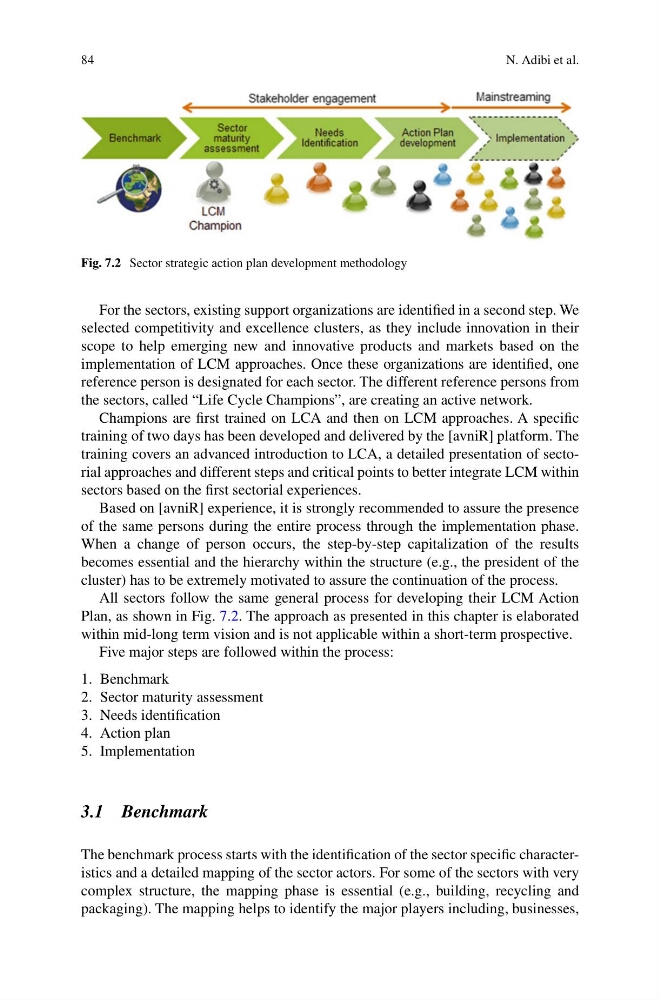
All sectors follow the same general process for developing their LCM Action
Plan, as shown in Fig. 7.2 . The approach as presented in this chapter is elaborated
within mid-long term vision and is not applicable within a short-term prospective.
Five major steps are followed within the process:
1. Benchmark
2. Sector maturity assessment
3. Needs identifi cation
4. Action plan
5. Implementation
3.1 Benchmark
The benchmark process starts with the identifi cation of the sector specifi c characteristics and a detailed mapping of the sector actors. For some of the sectors with very
complex structure, the mapping phase is essential (e.g., building, recycling and
packaging). The mapping helps to identify the major players including, businesses,
Fig. 7.2 Sector strategic action plan development methodology
N. Adibi et al.
For the sectors, existing support organizations are identifi ed in a second step. We
selected competitivity and excellence clusters, as they include innovation in their
scope to help emerging new and innovative products and markets based on the
implementation of LCM approaches. Once these organizations are identifi ed, one
reference person is designated for each sector. The different reference persons from
the sectors, called “Life Cycle Champions”, are creating an active network.
Champions are fi rst trained on LCA and then on LCM approaches. A specifi c
training of two days has been developed and delivered by the [avniR] platform. The
training covers an advanced introduction to LCA, a detailed presentation of sectorial approaches and different steps and critical points to better integrate LCM within
sectors based on the fi rst sectorial experiences.
Based on [avniR] experience, it is strongly recommended to assure the presence
of the same persons during the entire process through the implementation phase.
When a change of person occurs, the step-by-step capitalization of the results
becomes essential and the hierarchy within the structure (e.g., the president of the
cluster) has to be extremely motivated to assure the continuation of the process.
All sectors follow the same general process for developing their LCM Action
Plan, as shown in Fig. 7.2 . The approach as presented in this chapter is elaborated
within mid-long term vision and is not applicable within a short-term prospective.
Five major steps are followed within the process:
1. Benchmark
2. Sector maturity assessment
3. Needs identifi cation
4. Action plan
5. Implementation
3.1 Benchmark
The benchmark process starts with the identifi cation of the sector specifi c characteristics and a detailed mapping of the sector actors. For some of the sectors with very
complex structure, the mapping phase is essential (e.g., building, recycling and
packaging). The mapping helps to identify the major players including, businesses,
Fig. 7.2 Sector strategic action plan development methodology
N. Adibi et al.