

58
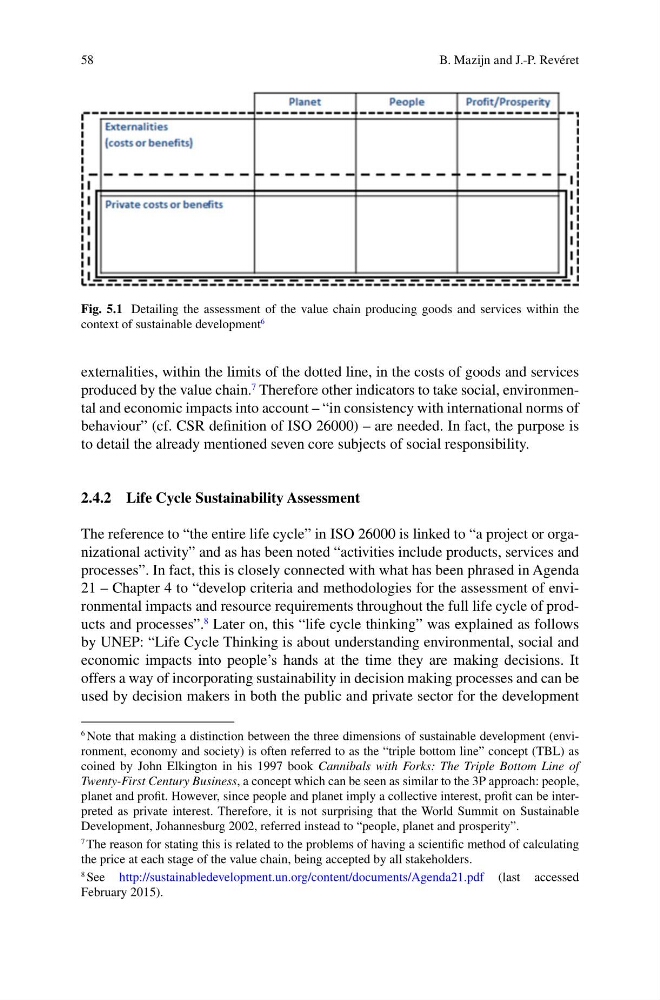
externalities, within the limits of the dotted line, in the costs of goods and services
produced by the value chain.
7 Therefore other indicators to take social, environmental and economic impacts into account – “in consistency with international norms of
behaviour” (cf. CSR defi nition of ISO 26000) – are needed. In fact, the purpose is
to detail the already mentioned seven core subjects of social responsibility.
2.4.2 Life Cycle Sustainability Assessment
The reference to “the entire life cycle” in ISO 26000 is linked to “a project or organizational activity” and as has been noted “activities include products, services and
processes”. In fact, this is closely connected with what has been phrased in Agenda
21 – Chapter 4 to “develop criteria and methodologies for the assessment of environmental impacts and resource requirements throughout the full life cycle of products and processes”.
8 Later on, this “life cycle thinking” was explained as follows
by UNEP: “Life Cycle Thinking is about understanding environmental, social and
economic impacts into people’s hands at the time they are making decisions. It
offers a way of incorporating sustainability in decision making processes and can be
used by decision makers in both the public and private sector for the development
6 Note that making a distinction between the three dimensions of sustainable development (environment, economy and society) is often referred to as the “triple bottom line” concept (TBL) as
coined by John Elkington in his 1997 book Cannibals with Forks: The Triple Bottom Line of
Twenty-First Century Business , a concept which can be seen as similar to the 3P approach: people,
planet and profi t. However, since people and planet imply a collective interest, profi t can be interpreted as private interest. Therefore, it is not surprising that the World Summit on Sustainable
Development, Johannesburg 2002, referred instead to “people, planet and prosperity”.
7 The reason for stating this is related to the problems of having a scientifi c method of calculating
the price at each stage of the value chain, being accepted by all stakeholders.
8 See http://sustainabledevelopment.un.org/content/documents/Agenda21.pdf (last accessed
February 2015).
Fig. 5.1 Detailing the assessment of the value chain producing goods and services within the
context of sustainable development
6
B. Mazijn and J.-P. Revéret
externalities, within the limits of the dotted line, in the costs of goods and services
produced by the value chain.
7 Therefore other indicators to take social, environmental and economic impacts into account – “in consistency with international norms of
behaviour” (cf. CSR defi nition of ISO 26000) – are needed. In fact, the purpose is
to detail the already mentioned seven core subjects of social responsibility.
2.4.2 Life Cycle Sustainability Assessment
The reference to “the entire life cycle” in ISO 26000 is linked to “a project or organizational activity” and as has been noted “activities include products, services and
processes”. In fact, this is closely connected with what has been phrased in Agenda
21 – Chapter 4 to “develop criteria and methodologies for the assessment of environmental impacts and resource requirements throughout the full life cycle of products and processes”.
8 Later on, this “life cycle thinking” was explained as follows
by UNEP: “Life Cycle Thinking is about understanding environmental, social and
economic impacts into people’s hands at the time they are making decisions. It
offers a way of incorporating sustainability in decision making processes and can be
used by decision makers in both the public and private sector for the development
6 Note that making a distinction between the three dimensions of sustainable development (environment, economy and society) is often referred to as the “triple bottom line” concept (TBL) as
coined by John Elkington in his 1997 book Cannibals with Forks: The Triple Bottom Line of
Twenty-First Century Business , a concept which can be seen as similar to the 3P approach: people,
planet and profi t. However, since people and planet imply a collective interest, profi t can be interpreted as private interest. Therefore, it is not surprising that the World Summit on Sustainable
Development, Johannesburg 2002, referred instead to “people, planet and prosperity”.
7 The reason for stating this is related to the problems of having a scientifi c method of calculating
the price at each stage of the value chain, being accepted by all stakeholders.
8 See http://sustainabledevelopment.un.org/content/documents/Agenda21.pdf (last accessed
February 2015).
Fig. 5.1 Detailing the assessment of the value chain producing goods and services within the
context of sustainable development
6
B. Mazijn and J.-P. Revéret