

47
• Conducting internal audits to determine and provide information to management
on whether LCM conforms to plans has been properly implemented as well as to
identify improvement options.
Once the “Check” stage of the cycle is performed, the next step will be
followed.
2.4 Act
Answers for the questions raised in the “Check” stages determine the possible
actions in the “Act” stages of the PDCA cycle. If the target is met, then a new target
for further sustainability improvement will be established or if the objectives are
over ambitious and do not consider the potential of the company’s resources, then a
new target with less ambition level could be set. Therefore, the “Act” stage in any
case ends the previous cycle and begins a new cycle with a new target. Whether the
LCM initiatives were successful or not, the annual cycle needs to be accompanied
with a top management review and setting directions (ISO 2004 ; Remmen et al.
2007 ). The top management review basically addresses if there is any need to
change or modify the policies, objectives and other elements of the system in the
light of audits, evaluations, changing circumstances provides management with the
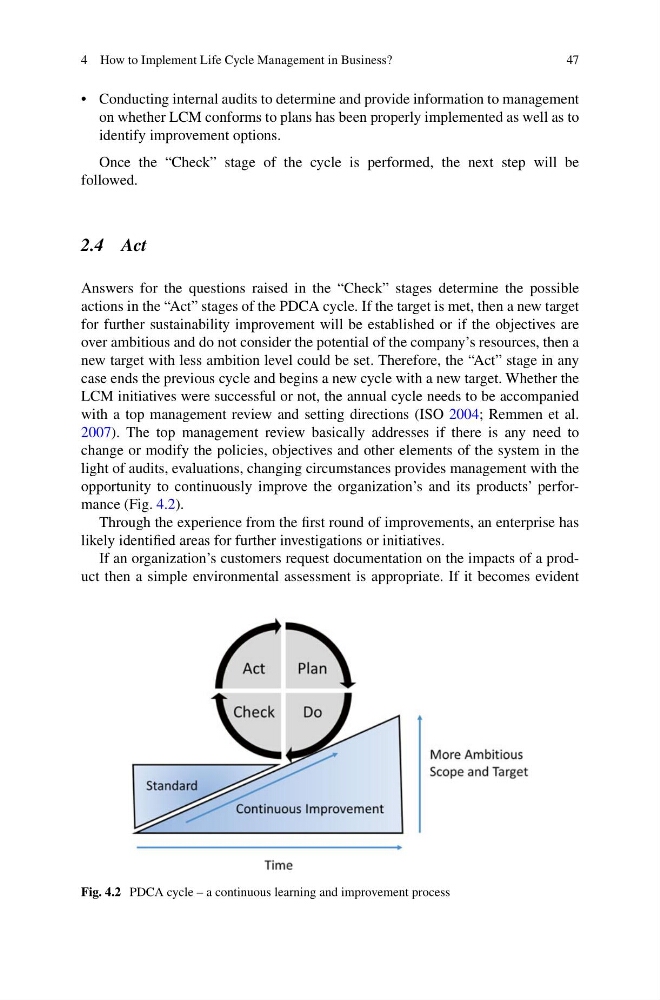
opportunity to continuously improve the organization’s and its products’ performance (Fig. 4.2 ).
Through the experience from the fi rst round of improvements, an enterprise has
likely identifi ed areas for further investigations or initiatives.
If an organization’s customers request documentation on the impacts of a product then a simple environmental assessment is appropriate. If it becomes evident
Fig. 4.2 PDCA cycle – a continuous learning and improvement process
4 How to Implement Life Cycle Management in Business?
• Conducting internal audits to determine and provide information to management
on whether LCM conforms to plans has been properly implemented as well as to
identify improvement options.
Once the “Check” stage of the cycle is performed, the next step will be
followed.
2.4 Act
Answers for the questions raised in the “Check” stages determine the possible
actions in the “Act” stages of the PDCA cycle. If the target is met, then a new target
for further sustainability improvement will be established or if the objectives are
over ambitious and do not consider the potential of the company’s resources, then a
new target with less ambition level could be set. Therefore, the “Act” stage in any
case ends the previous cycle and begins a new cycle with a new target. Whether the
LCM initiatives were successful or not, the annual cycle needs to be accompanied
with a top management review and setting directions (ISO 2004 ; Remmen et al.
2007 ). The top management review basically addresses if there is any need to
change or modify the policies, objectives and other elements of the system in the
light of audits, evaluations, changing circumstances provides management with the
opportunity to continuously improve the organization’s and its products’ performance (Fig. 4.2 ).
Through the experience from the fi rst round of improvements, an enterprise has
likely identifi ed areas for further investigations or initiatives.
If an organization’s customers request documentation on the impacts of a product then a simple environmental assessment is appropriate. If it becomes evident
Fig. 4.2 PDCA cycle – a continuous learning and improvement process
4 How to Implement Life Cycle Management in Business?