

43
In addition to information on environmental and social impacts of their products
or processes, a better understanding is necessary of both internal and external stakeholders, the current market conditions and the future opportunities linked with sustainability achievements. Discussion with all relevant stakeholders helps to get
information on the legal and other requirements including environmental and social
concerns. In addition, such discussion is also important when setting up objectives
and targets. Goals to improve products’ environmental and social performance will
also have an effect on customers’ expectations and responses.
Once the status overview is performed, then the next step will be to set objectives
and targets. The criteria to select possible areas of product improvement are based
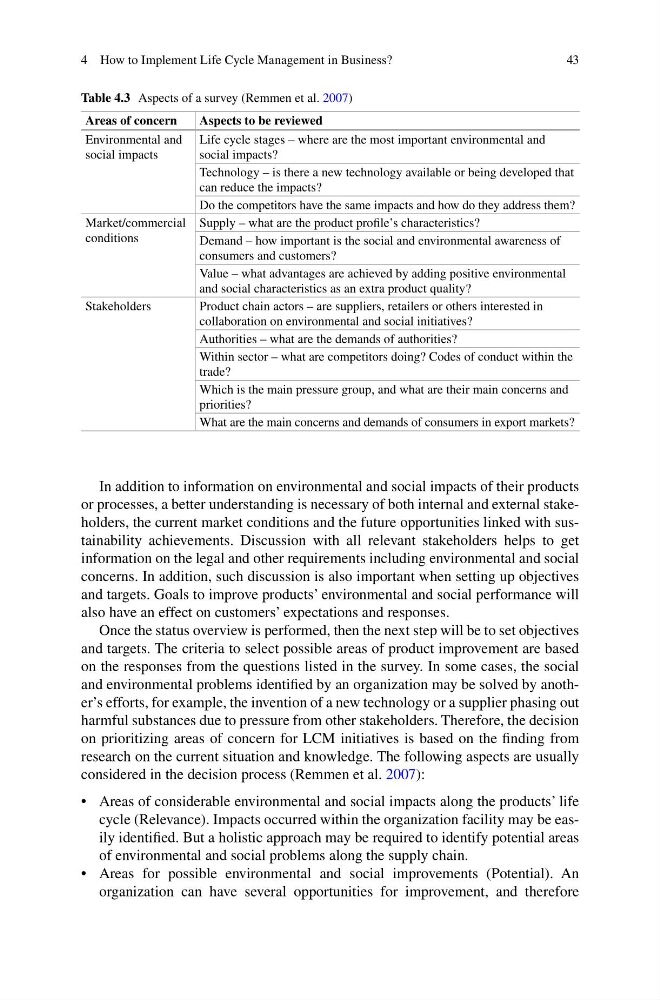
on the responses from the questions listed in the survey. In some cases, the social
and environmental problems identifi ed by an organization may be solved by another’s efforts, for example, the invention of a new technology or a supplier phasing out
harmful substances due to pressure from other stakeholders. Therefore, the decision
on prioritizing areas of concern for LCM initiatives is based on the fi nding from
research on the current situation and knowledge. The following aspects are usually
considered in the decision process (Remmen et al. 2007 ):
• Areas of considerable environmental and social impacts along the products’ life
cycle (Relevance). Impacts occurred within the organization facility may be easily identifi ed. But a holistic approach may be required to identify potential areas
of environmental and social problems along the supply chain.
• Areas for possible environmental and social improvements (Potential). An
organization can have several opportunities for improvement, and therefore
Table 4.3 Aspects of a survey (Remmen et al. 2007 )
Areas of concern
Aspects to be reviewed
Environmental and
social impacts
Life cycle stages – where are the most important environmental and
social impacts?
Technology – is there a new technology available or being developed that
can reduce the impacts?
Do the competitors have the same impacts and how do they address them?
Market/commercial
conditions
Supply – what are the product profi le’s characteristics?
Demand – how important is the social and environmental awareness of
consumers and customers?
Value – what advantages are achieved by adding positive environmental
and social characteristics as an extra product quality?
Stakeholders
Product chain actors – are suppliers, retailers or others interested in
collaboration on environmental and social initiatives?
Authorities – what are the demands of authorities?
Within sector – what are competitors doing? Codes of conduct within the
trade?
Which is the main pressure group, and what are their main concerns and
priorities?
What are the main concerns and demands of consumers in export markets?
4 How to Implement Life Cycle Management in Business?
In addition to information on environmental and social impacts of their products
or processes, a better understanding is necessary of both internal and external stakeholders, the current market conditions and the future opportunities linked with sustainability achievements. Discussion with all relevant stakeholders helps to get
information on the legal and other requirements including environmental and social
concerns. In addition, such discussion is also important when setting up objectives
and targets. Goals to improve products’ environmental and social performance will
also have an effect on customers’ expectations and responses.
Once the status overview is performed, then the next step will be to set objectives
and targets. The criteria to select possible areas of product improvement are based
on the responses from the questions listed in the survey. In some cases, the social
and environmental problems identifi ed by an organization may be solved by another’s efforts, for example, the invention of a new technology or a supplier phasing out
harmful substances due to pressure from other stakeholders. Therefore, the decision
on prioritizing areas of concern for LCM initiatives is based on the fi nding from
research on the current situation and knowledge. The following aspects are usually
considered in the decision process (Remmen et al. 2007 ):
• Areas of considerable environmental and social impacts along the products’ life
cycle (Relevance). Impacts occurred within the organization facility may be easily identifi ed. But a holistic approach may be required to identify potential areas
of environmental and social problems along the supply chain.
• Areas for possible environmental and social improvements (Potential). An
organization can have several opportunities for improvement, and therefore
Table 4.3 Aspects of a survey (Remmen et al. 2007 )
Areas of concern
Aspects to be reviewed
Environmental and
social impacts
Life cycle stages – where are the most important environmental and
social impacts?
Technology – is there a new technology available or being developed that
can reduce the impacts?
Do the competitors have the same impacts and how do they address them?
Market/commercial
conditions
Supply – what are the product profi le’s characteristics?
Demand – how important is the social and environmental awareness of
consumers and customers?
Value – what advantages are achieved by adding positive environmental
and social characteristics as an extra product quality?
Stakeholders
Product chain actors – are suppliers, retailers or others interested in
collaboration on environmental and social initiatives?
Authorities – what are the demands of authorities?
Within sector – what are competitors doing? Codes of conduct within the
trade?
Which is the main pressure group, and what are their main concerns and
priorities?
What are the main concerns and demands of consumers in export markets?
4 How to Implement Life Cycle Management in Business?