

19
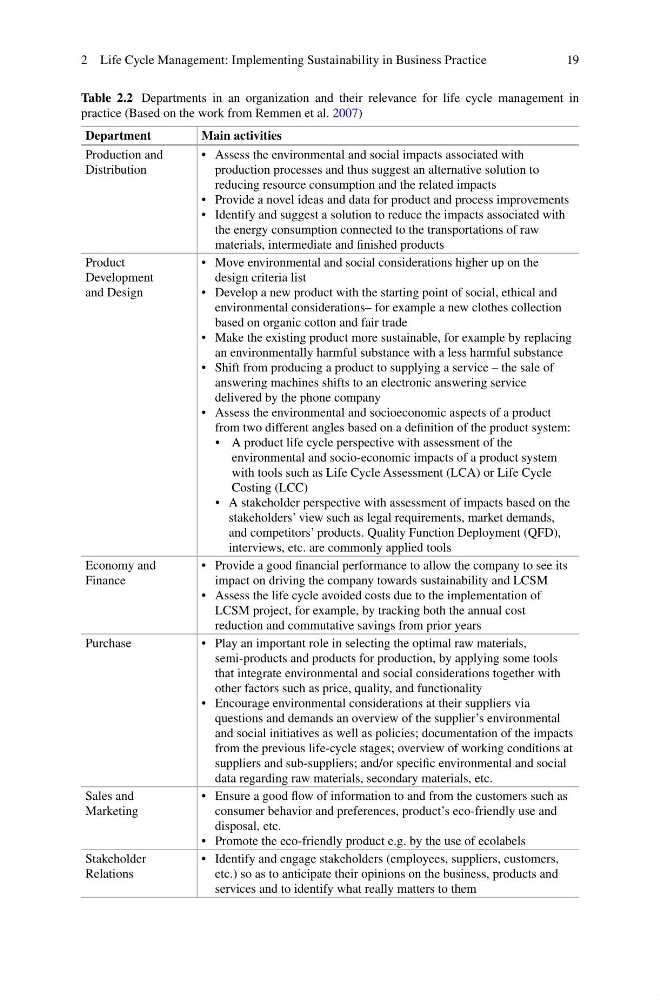
Table 2.2 Departments in an organization and their relevance for life cycle management in
practice (Based on the work from Remmen et al. 2007 )
Department
Main activities
Production and
Distribution
• Assess the environmental and social impacts associated with
production processes and thus suggest an alternative solution to
reducing resource consumption and the related impacts
• Provide a novel ideas and data for product and process improvements
• Identify and suggest a solution to reduce the impacts associated with
the energy consumption connected to the transportations of raw
materials, intermediate and fi nished products
Product
Development
and Design
• Move environmental and social considerations higher up on the
design criteria list
• Develop a new product with the starting point of social, ethical and
environmental considerations– for example a new clothes collection
based on organic cotton and fair trade
• Make the existing product more sustainable, for example by replacing
an environmentally harmful substance with a less harmful substance
• Shift from producing a product to supplying a service – the sale of
answering machines shifts to an electronic answering service
delivered by the phone company
• Assess the environmental and socioeconomic aspects of a product
from two different angles based on a defi nition of the product system:
• A product life cycle perspective with assessment of the
environmental and socio-economic impacts of a product system
with tools such as Life Cycle Assessment (LCA) or Life Cycle
Costing (LCC)
• A stakeholder perspective with assessment of impacts based on the
stakeholders’ view such as legal requirements, market demands,
and competitors’ products. Quality Function Deployment (QFD),
interviews, etc. are commonly applied tools
Economy and
Finance
• Provide a good fi nancial performance to allow the company to see its
impact on driving the company towards sustainability and LCSM
• Assess the life cycle avoided costs due to the implementation of
LCSM project, for example, by tracking both the annual cost
reduction and commutative savings from prior years
Purchase
• Play an important role in selecting the optimal raw materials,
semi- products and products for production, by applying some tools
that integrate environmental and social considerations together with
other factors such as price, quality, and functionality
• Encourage environmental considerations at their suppliers via
questions and demands an overview of the supplier’s environmental
and social initiatives as well as policies; documentation of the impacts
from the previous life-cycle stages; overview of working conditions at
suppliers and sub-suppliers; and/or specifi c environmental and social
data regarding raw materials, secondary materials, etc.
Sales and
Marketing
• Ensure a good fl ow of information to and from the customers such as
consumer behavior and preferences, product’s eco-friendly use and
disposal, etc.
• Promote the eco-friendly product e.g. by the use of ecolabels
Stakeholder
Relations
• Identify and engage stakeholders (employees, suppliers, customers,
etc.) so as to anticipate their opinions on the business, products and
services and to identify what really matters to them
2 Life Cycle Management: Implementing Sustainability in Business Practice
Table 2.2 Departments in an organization and their relevance for life cycle management in
practice (Based on the work from Remmen et al. 2007 )
Department
Main activities
Production and
Distribution
• Assess the environmental and social impacts associated with
production processes and thus suggest an alternative solution to
reducing resource consumption and the related impacts
• Provide a novel ideas and data for product and process improvements
• Identify and suggest a solution to reduce the impacts associated with
the energy consumption connected to the transportations of raw
materials, intermediate and fi nished products
Product
Development
and Design
• Move environmental and social considerations higher up on the
design criteria list
• Develop a new product with the starting point of social, ethical and
environmental considerations– for example a new clothes collection
based on organic cotton and fair trade
• Make the existing product more sustainable, for example by replacing
an environmentally harmful substance with a less harmful substance
• Shift from producing a product to supplying a service – the sale of
answering machines shifts to an electronic answering service
delivered by the phone company
• Assess the environmental and socioeconomic aspects of a product
from two different angles based on a defi nition of the product system:
• A product life cycle perspective with assessment of the
environmental and socio-economic impacts of a product system
with tools such as Life Cycle Assessment (LCA) or Life Cycle
Costing (LCC)
• A stakeholder perspective with assessment of impacts based on the
stakeholders’ view such as legal requirements, market demands,
and competitors’ products. Quality Function Deployment (QFD),
interviews, etc. are commonly applied tools
Economy and
Finance
• Provide a good fi nancial performance to allow the company to see its
impact on driving the company towards sustainability and LCSM
• Assess the life cycle avoided costs due to the implementation of
LCSM project, for example, by tracking both the annual cost
reduction and commutative savings from prior years
Purchase
• Play an important role in selecting the optimal raw materials,
semi- products and products for production, by applying some tools
that integrate environmental and social considerations together with
other factors such as price, quality, and functionality
• Encourage environmental considerations at their suppliers via
questions and demands an overview of the supplier’s environmental
and social initiatives as well as policies; documentation of the impacts
from the previous life-cycle stages; overview of working conditions at
suppliers and sub-suppliers; and/or specifi c environmental and social
data regarding raw materials, secondary materials, etc.
Sales and
Marketing
• Ensure a good fl ow of information to and from the customers such as
consumer behavior and preferences, product’s eco-friendly use and
disposal, etc.
• Promote the eco-friendly product e.g. by the use of ecolabels
Stakeholder
Relations
• Identify and engage stakeholders (employees, suppliers, customers,
etc.) so as to anticipate their opinions on the business, products and
services and to identify what really matters to them
2 Life Cycle Management: Implementing Sustainability in Business Practice