

333
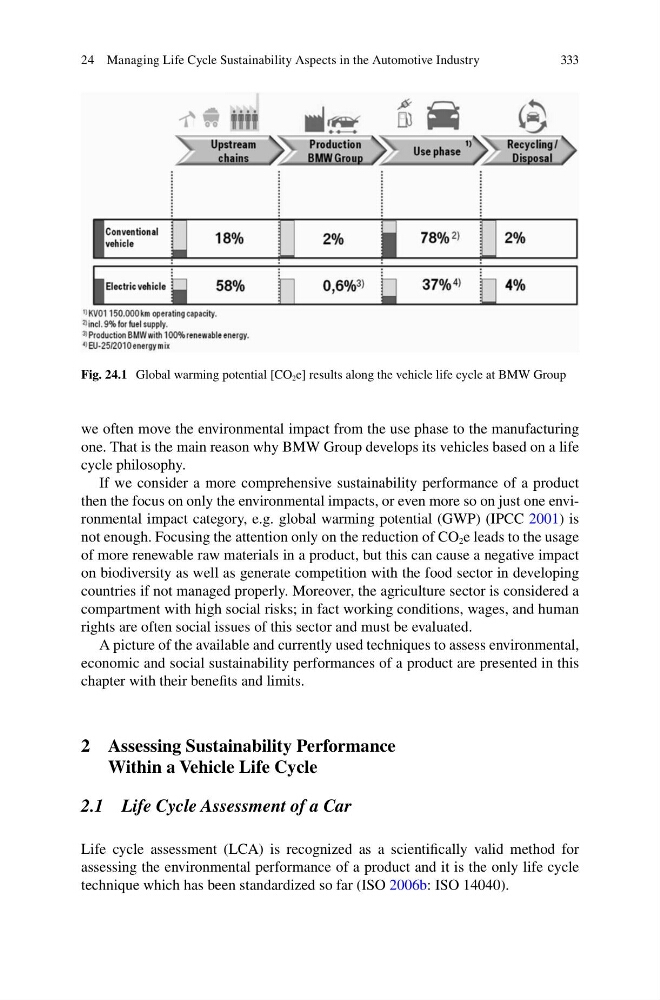
we often move the environmental impact from the use phase to the manufacturing
one. That is the main reason why BMW Group develops its vehicles based on a life
cycle philosophy.
If we consider a more comprehensive sustainability performance of a product
then the focus on only the environmental impacts, or even more so on just one environmental impact category, e.g. global warming potential (GWP) (IPCC 2001 ) is
not enough. Focusing the attention only on the reduction of CO 2 e leads to the usage
of more renewable raw materials in a product, but this can cause a negative impact
on biodiversity as well as generate competition with the food sector in developing
countries if not managed properly. Moreover, the agriculture sector is considered a
compartment with high social risks; in fact working conditions, wages, and human
rights are often social issues of this sector and must be evaluated.
A picture of the available and currently used techniques to assess environmental,
economic and social sustainability performances of a product are presented in this
chapter with their benefi ts and limits.
2 Assessing Sustainability Performance
Within a Vehicle Life Cycle
2.1 Life Cycle Assessment of a Car
Life cycle assessment (LCA) is recognized as a scientifi cally valid method for
assessing the environmental performance of a product and it is the only life cycle
technique which has been standardized so far (ISO 2006b : ISO 14040).
Fig. 24.1 Global warming potential [CO 2 e] results along the vehicle life cycle at BMW Group
24 Managing Life Cycle Sustainability Aspects in the Automotive Industry
we often move the environmental impact from the use phase to the manufacturing
one. That is the main reason why BMW Group develops its vehicles based on a life
cycle philosophy.
If we consider a more comprehensive sustainability performance of a product
then the focus on only the environmental impacts, or even more so on just one environmental impact category, e.g. global warming potential (GWP) (IPCC 2001 ) is
not enough. Focusing the attention only on the reduction of CO 2 e leads to the usage
of more renewable raw materials in a product, but this can cause a negative impact
on biodiversity as well as generate competition with the food sector in developing
countries if not managed properly. Moreover, the agriculture sector is considered a
compartment with high social risks; in fact working conditions, wages, and human
rights are often social issues of this sector and must be evaluated.
A picture of the available and currently used techniques to assess environmental,
economic and social sustainability performances of a product are presented in this
chapter with their benefi ts and limits.
2 Assessing Sustainability Performance
Within a Vehicle Life Cycle
2.1 Life Cycle Assessment of a Car
Life cycle assessment (LCA) is recognized as a scientifi cally valid method for
assessing the environmental performance of a product and it is the only life cycle
technique which has been standardized so far (ISO 2006b : ISO 14040).
Fig. 24.1 Global warming potential [CO 2 e] results along the vehicle life cycle at BMW Group
24 Managing Life Cycle Sustainability Aspects in the Automotive Industry