

320
entire life cycle of a product (Remmen et al. 2007). The mobility sector is a key
branch for the development of technologies that help to minimize environmental
impacts. For the Volkswagen Group, the motivation for this is not only driven by
external factors like environmental regulations, financial markets, customer requirements, competitors’ behavior and the volatility of energy and resource prices, but
also because, as a major automobile manufacturer, the Volkswagen Group takes seriously its responsibility for the sustainable development of the economy, the environment and the society. Based on this, the Volkswagen Group set itself the goal to
become the world’s most sustainable automobile manufacturer by 2018. In order to
achieve this, a set of ambitious environmental targets has been elaborated to be pursued continuously in different business units like technical development, production,
and sales division. The environmental strategy applies not only to all brands of the
Volkswagen Group in all regions, but also to the whole value chain.
1.1 Life Cycle Management at Volkswagen
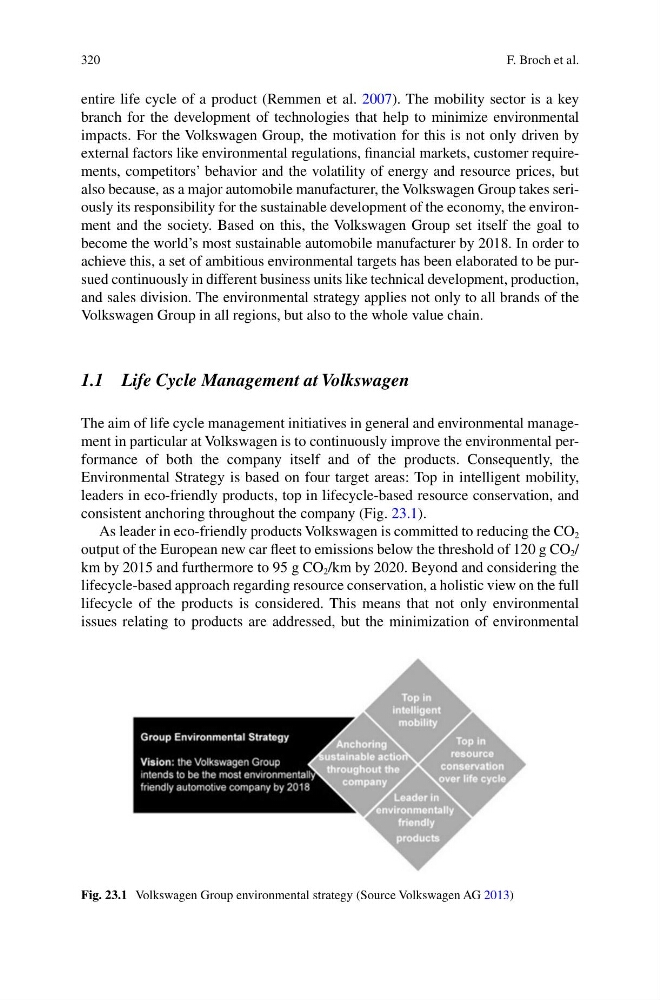
The aim of life cycle management initiatives in general and environmental management in particular at Volkswagen is to continuously improve the environmental performance of both the company itself and of the products. Consequently, the
Environmental Strategy is based on four target areas: Top in intelligent mobility,
leaders in eco-friendly products, top in lifecycle-based resource conservation, and
consistent anchoring throughout the company (Fig. 23.1).
As leader in eco-friendly products Volkswagen is committed to reducing the CO 2
output of the European new car fleet to emissions below the threshold of 120 g CO 2 /
km by 2015 and furthermore to 95 g CO 2 /km by 2020. Beyond and considering the
lifecycle-based approach regarding resource conservation, a holistic view on the full
lifecycle of the products is considered. This means that not only environmental
issues relating to products are addressed, but the minimization of environmental
Fig. 23.1 Volkswagen Group environmental strategy (Source Volkswagen AG 2013)
F. Broch et al.
entire life cycle of a product (Remmen et al. 2007). The mobility sector is a key
branch for the development of technologies that help to minimize environmental
impacts. For the Volkswagen Group, the motivation for this is not only driven by
external factors like environmental regulations, financial markets, customer requirements, competitors’ behavior and the volatility of energy and resource prices, but
also because, as a major automobile manufacturer, the Volkswagen Group takes seriously its responsibility for the sustainable development of the economy, the environment and the society. Based on this, the Volkswagen Group set itself the goal to
become the world’s most sustainable automobile manufacturer by 2018. In order to
achieve this, a set of ambitious environmental targets has been elaborated to be pursued continuously in different business units like technical development, production,
and sales division. The environmental strategy applies not only to all brands of the
Volkswagen Group in all regions, but also to the whole value chain.
1.1 Life Cycle Management at Volkswagen
The aim of life cycle management initiatives in general and environmental management in particular at Volkswagen is to continuously improve the environmental performance of both the company itself and of the products. Consequently, the
Environmental Strategy is based on four target areas: Top in intelligent mobility,
leaders in eco-friendly products, top in lifecycle-based resource conservation, and
consistent anchoring throughout the company (Fig. 23.1).
As leader in eco-friendly products Volkswagen is committed to reducing the CO 2
output of the European new car fleet to emissions below the threshold of 120 g CO 2 /
km by 2015 and furthermore to 95 g CO 2 /km by 2020. Beyond and considering the
lifecycle-based approach regarding resource conservation, a holistic view on the full
lifecycle of the products is considered. This means that not only environmental
issues relating to products are addressed, but the minimization of environmental
Fig. 23.1 Volkswagen Group environmental strategy (Source Volkswagen AG 2013)
F. Broch et al.