

251
Peteraf 2003 ; Sanchez 2004 ). The targeted capabilities need to be tailored to the
specifi c competitive environment facing the company, linked directly to shareholder
value and supported by organizational design (Hart and Milstein 2003 ; Heraty 2004 ;
Sanchez 2004 ). The LCM CMM was designed to build the capability to measure
and report a company’s environmental performance, with an emphasis on LCA. It is
possible that too much emphasis was placed on LCA to the detriment of mainstreaming LCM or LC thinking.
The training resources did cover the evaluation of a company’s competitive context, but clearly were insuffi cient to meet the needs of the coaches. In part, this can
be attributed to the dominance of environmental or LCA practitioners acting as
coaches. However, it should be acknowledged that strong management leadership
and cross-functional teams helped many companies identify appropriate projects
that delivered business value as well as environmental benefi ts. The coach need not
be the strategic expert, but does need suffi cient understanding to tap the right people
within the company. The guidance provided by the GE Ecoassessment CoE is a
good model for supporting the LCM champions. In particular, the various weighting
schemes available in the LCM tool and the interactive tool showing how LCM can
add business value would help address this gap. These examples also demonstrate
the importance of management vision – a clear expectation that LCM will add business value – that is supported with resources and enabling infrastructure (the environmental portal). The Renault initiative to deploy eco-design across its supply
chain and the role played by SDA and FICCI in supporting the pilot studies are
further evidence of the importance of strong leadership and focus on adding value.
Another common feedback from the coaches was that the maturity assessment
tended to be somewhat abstract and diffi cult to translate into specifi c actions. The
customized maturity assessments FICCI and Renault developed are noteworthy.
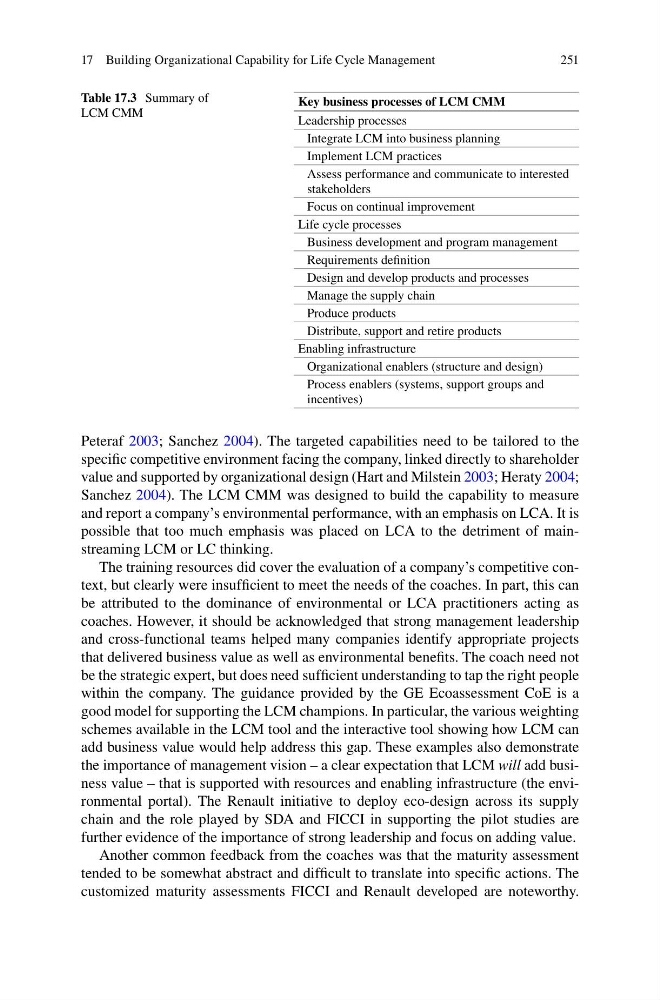
Table 17.3 Summary of
LCM CMM
Key business processes of LCM CMM
Leadership processes
Integrate LCM into business planning
Implement LCM practices
Assess performance and communicate to interested
stakeholders
Focus on continual improvement
Life cycle processes
Business development and program management
Requirements defi nition
Design and develop products and processes
Manage the supply chain
Produce products
Distribute, support and retire products
Enabling infrastructure
Organizational enablers (structure and design)
Process enablers (systems, support groups and
incentives)
17 Building Organizational Capability for Life Cycle Management
Peteraf 2003 ; Sanchez 2004 ). The targeted capabilities need to be tailored to the
specifi c competitive environment facing the company, linked directly to shareholder
value and supported by organizational design (Hart and Milstein 2003 ; Heraty 2004 ;
Sanchez 2004 ). The LCM CMM was designed to build the capability to measure
and report a company’s environmental performance, with an emphasis on LCA. It is
possible that too much emphasis was placed on LCA to the detriment of mainstreaming LCM or LC thinking.
The training resources did cover the evaluation of a company’s competitive context, but clearly were insuffi cient to meet the needs of the coaches. In part, this can
be attributed to the dominance of environmental or LCA practitioners acting as
coaches. However, it should be acknowledged that strong management leadership
and cross-functional teams helped many companies identify appropriate projects
that delivered business value as well as environmental benefi ts. The coach need not
be the strategic expert, but does need suffi cient understanding to tap the right people
within the company. The guidance provided by the GE Ecoassessment CoE is a
good model for supporting the LCM champions. In particular, the various weighting
schemes available in the LCM tool and the interactive tool showing how LCM can
add business value would help address this gap. These examples also demonstrate
the importance of management vision – a clear expectation that LCM will add business value – that is supported with resources and enabling infrastructure (the environmental portal). The Renault initiative to deploy eco-design across its supply
chain and the role played by SDA and FICCI in supporting the pilot studies are
further evidence of the importance of strong leadership and focus on adding value.
Another common feedback from the coaches was that the maturity assessment
tended to be somewhat abstract and diffi cult to translate into specifi c actions. The
customized maturity assessments FICCI and Renault developed are noteworthy.
Table 17.3 Summary of
LCM CMM
Key business processes of LCM CMM
Leadership processes
Integrate LCM into business planning
Implement LCM practices
Assess performance and communicate to interested
stakeholders
Focus on continual improvement
Life cycle processes
Business development and program management
Requirements defi nition
Design and develop products and processes
Manage the supply chain
Produce products
Distribute, support and retire products
Enabling infrastructure
Organizational enablers (structure and design)
Process enablers (systems, support groups and
incentives)
17 Building Organizational Capability for Life Cycle Management