

248
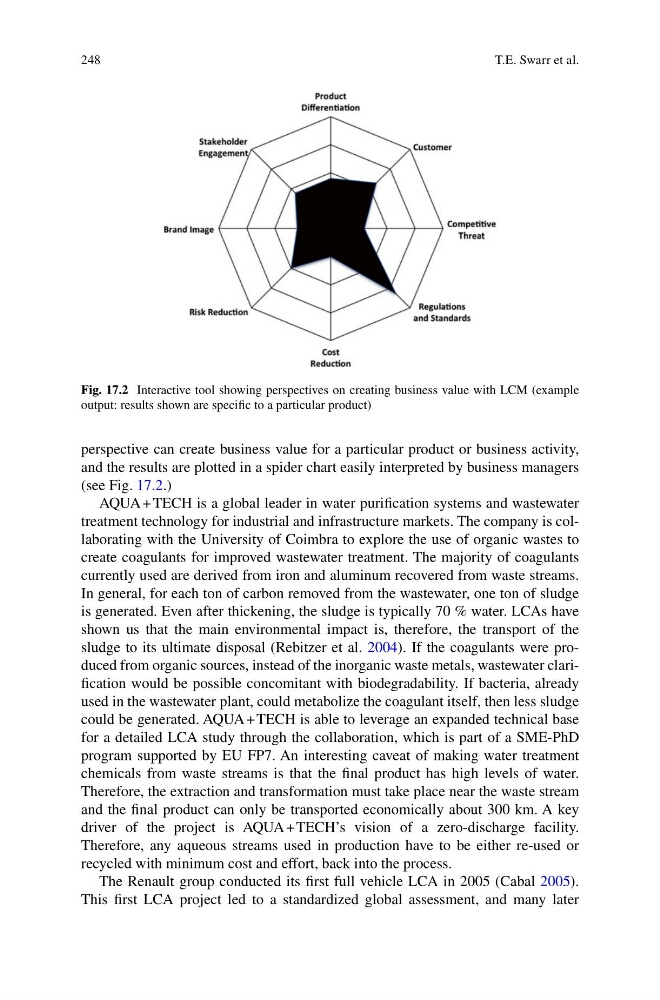
perspective can create business value for a particular product or business activity,
and the results are plotted in a spider chart easily interpreted by business managers
(see Fig. 17.2 .)
AQUA + TECH is a global leader in water purifi cation systems and wastewater
treatment technology for industrial and infrastructure markets. The company is collaborating with the University of Coimbra to explore the use of organic wastes to
create coagulants for improved wastewater treatment. The majority of coagulants
currently used are derived from iron and aluminum recovered from waste streams.
In general, for each ton of carbon removed from the wastewater, one ton of sludge
is generated. Even after thickening, the sludge is typically 70 % water. LCAs have
shown us that the main environmental impact is, therefore, the transport of the
sludge to its ultimate disposal (Rebitzer et al. 2004 ). If the coagulants were produced from organic sources, instead of the inorganic waste metals, wastewater clarifi cation would be possible concomitant with biodegradability. If bacteria, already
used in the wastewater plant, could metabolize the coagulant itself, then less sludge
could be generated. AQUA + TECH is able to leverage an expanded technical base
for a detailed LCA study through the collaboration, which is part of a SME-PhD
program supported by EU FP7. An interesting caveat of making water treatment
chemicals from waste streams is that the fi nal product has high levels of water.
Therefore, the extraction and transformation must take place near the waste stream
and the fi nal product can only be transported economically about 300 km. A key
driver of the project is AQUA + TECH’s vision of a zero-discharge facility.
Therefore, any aqueous streams used in production have to be either re-used or
recycled with minimum cost and effort, back into the process.
The Renault group conducted its fi rst full vehicle LCA in 2005 (Cabal 2005 ).
This fi rst LCA project led to a standardized global assessment, and many later
Fig. 17.2 Interactive tool showing perspectives on creating business value with LCM (example
output: results shown are specifi c to a particular product)
T.E. Swarr et al.
perspective can create business value for a particular product or business activity,
and the results are plotted in a spider chart easily interpreted by business managers
(see Fig. 17.2 .)
AQUA + TECH is a global leader in water purifi cation systems and wastewater
treatment technology for industrial and infrastructure markets. The company is collaborating with the University of Coimbra to explore the use of organic wastes to
create coagulants for improved wastewater treatment. The majority of coagulants
currently used are derived from iron and aluminum recovered from waste streams.
In general, for each ton of carbon removed from the wastewater, one ton of sludge
is generated. Even after thickening, the sludge is typically 70 % water. LCAs have
shown us that the main environmental impact is, therefore, the transport of the
sludge to its ultimate disposal (Rebitzer et al. 2004 ). If the coagulants were produced from organic sources, instead of the inorganic waste metals, wastewater clarifi cation would be possible concomitant with biodegradability. If bacteria, already
used in the wastewater plant, could metabolize the coagulant itself, then less sludge
could be generated. AQUA + TECH is able to leverage an expanded technical base
for a detailed LCA study through the collaboration, which is part of a SME-PhD
program supported by EU FP7. An interesting caveat of making water treatment
chemicals from waste streams is that the fi nal product has high levels of water.
Therefore, the extraction and transformation must take place near the waste stream
and the fi nal product can only be transported economically about 300 km. A key
driver of the project is AQUA + TECH’s vision of a zero-discharge facility.
Therefore, any aqueous streams used in production have to be either re-used or
recycled with minimum cost and effort, back into the process.
The Renault group conducted its fi rst full vehicle LCA in 2005 (Cabal 2005 ).
This fi rst LCA project led to a standardized global assessment, and many later
Fig. 17.2 Interactive tool showing perspectives on creating business value with LCM (example
output: results shown are specifi c to a particular product)
T.E. Swarr et al.