

242
2 Methods
2.1 Development of the Life Cycle Management Capability
Maturity Model
The life cycle management capability maturity model (LCM CMM) was based on a
model developed at the Massachusetts Institute of Technology to guide enterprises
implementing lean production practices (Nightingale and Mize 2002 ). Researchers,
academics, consultants and business managers had developed a broad vision of the
values, behaviors and practices that constituted a lean enterprise (Womak and Jones
2003 ). However, practitioners were faced with a confusing array of principles, tools
and practices, but no help on the order or precedence to implementing various best
practices in a cohesive management system. These same considerations describe the
current challenge of deploying sustainability across global supply chains.
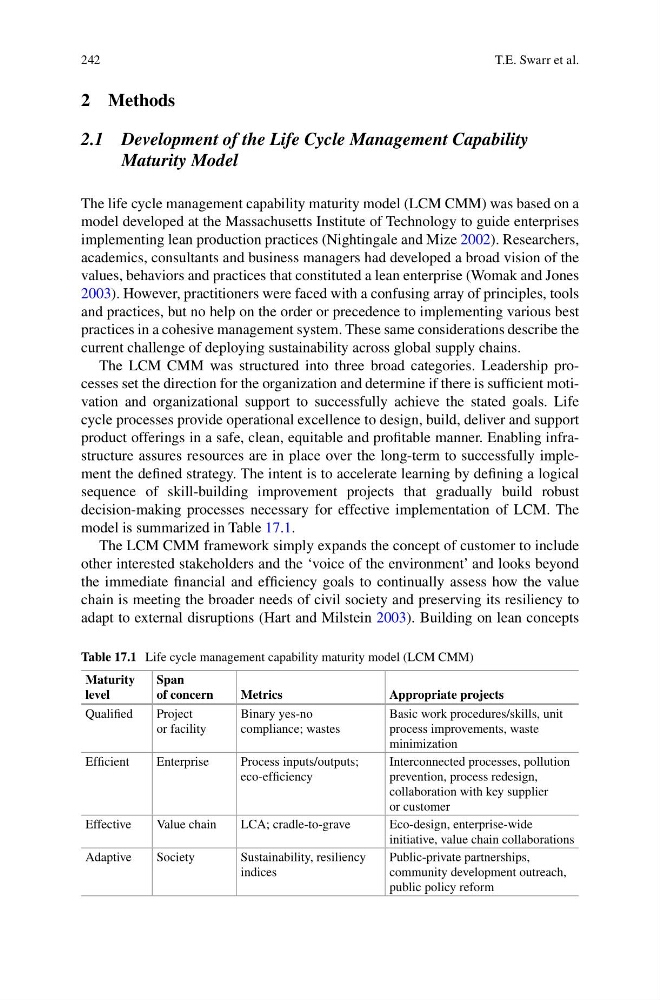
The LCM CMM was structured into three broad categories. Leadership processes set the direction for the organization and determine if there is suffi cient motivation and organizational support to successfully achieve the stated goals. Life
cycle processes provide operational excellence to design, build, deliver and support
product offerings in a safe, clean, equitable and profi table manner. Enabling infrastructure assures resources are in place over the long-term to successfully implement the defi ned strategy. The intent is to accelerate learning by defi ning a logical
sequence of skill-building improvement projects that gradually build robust
decision- making processes necessary for effective implementation of LCM. The
model is summarized in Table 17.1 .
The LCM CMM framework simply expands the concept of customer to include
other interested stakeholders and the ‘voice of the environment’ and looks beyond
the immediate fi nancial and effi ciency goals to continually assess how the value
chain is meeting the broader needs of civil society and preserving its resiliency to
adapt to external disruptions (Hart and Milstein 2003 ). Building on lean concepts
Table 17.1 Life cycle management capability maturity model (LCM CMM)
Maturity
level
Span
of concern
Metrics
Appropriate projects
Qualifi ed
Project
or facility
Binary yes-no
compliance; wastes
Basic work procedures/skills, unit
process improvements, waste
minimization
Effi cient
Enterprise
Process inputs/outputs;
eco-effi ciency
Interconnected processes, pollution
prevention, process redesign,
collaboration with key supplier
or customer
Effective
Value chain
LCA; cradle-to-grave
Eco-design, enterprise-wide
initiative, value chain collaborations
Adaptive
Society
Sustainability, resiliency
indices
Public-private partnerships,
community development outreach,
public policy reform
T.E. Swarr et al.
2 Methods
2.1 Development of the Life Cycle Management Capability
Maturity Model
The life cycle management capability maturity model (LCM CMM) was based on a
model developed at the Massachusetts Institute of Technology to guide enterprises
implementing lean production practices (Nightingale and Mize 2002 ). Researchers,
academics, consultants and business managers had developed a broad vision of the
values, behaviors and practices that constituted a lean enterprise (Womak and Jones
2003 ). However, practitioners were faced with a confusing array of principles, tools
and practices, but no help on the order or precedence to implementing various best
practices in a cohesive management system. These same considerations describe the
current challenge of deploying sustainability across global supply chains.
The LCM CMM was structured into three broad categories. Leadership processes set the direction for the organization and determine if there is suffi cient motivation and organizational support to successfully achieve the stated goals. Life
cycle processes provide operational excellence to design, build, deliver and support
product offerings in a safe, clean, equitable and profi table manner. Enabling infrastructure assures resources are in place over the long-term to successfully implement the defi ned strategy. The intent is to accelerate learning by defi ning a logical
sequence of skill-building improvement projects that gradually build robust
decision- making processes necessary for effective implementation of LCM. The
model is summarized in Table 17.1 .
The LCM CMM framework simply expands the concept of customer to include
other interested stakeholders and the ‘voice of the environment’ and looks beyond
the immediate fi nancial and effi ciency goals to continually assess how the value
chain is meeting the broader needs of civil society and preserving its resiliency to
adapt to external disruptions (Hart and Milstein 2003 ). Building on lean concepts
Table 17.1 Life cycle management capability maturity model (LCM CMM)
Maturity
level
Span
of concern
Metrics
Appropriate projects
Qualifi ed
Project
or facility
Binary yes-no
compliance; wastes
Basic work procedures/skills, unit
process improvements, waste
minimization
Effi cient
Enterprise
Process inputs/outputs;
eco-effi ciency
Interconnected processes, pollution
prevention, process redesign,
collaboration with key supplier
or customer
Effective
Value chain
LCA; cradle-to-grave
Eco-design, enterprise-wide
initiative, value chain collaborations
Adaptive
Society
Sustainability, resiliency
indices
Public-private partnerships,
community development outreach,
public policy reform
T.E. Swarr et al.