

152
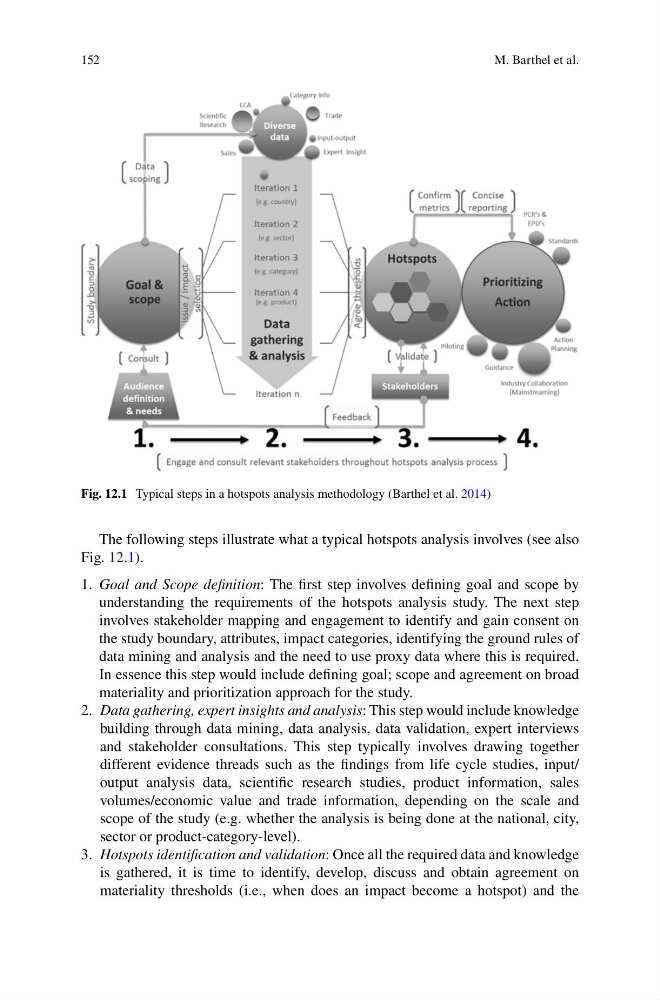
The following steps illustrate what a typical hotspots analysis involves (see also
Fig. 12.1 ).
1. Goal and Scope defi nition : The fi rst step involves defi ning goal and scope by
understanding the requirements of the hotspots analysis study. The next step
involves stakeholder mapping and engagement to identify and gain consent on
the study boundary, attributes, impact categories, identifying the ground rules of
data mining and analysis and the need to use proxy data where this is required.
In essence this step would include defi ning goal; scope and agreement on broad
materiality and prioritization approach for the study.
2. Data gathering, expert insights and analysis : This step would include knowledge
building through data mining, data analysis, data validation, expert interviews
and stakeholder consultations. This step typically involves drawing together
different evidence threads such as the fi ndings from life cycle studies, input/
output analysis data, scientifi c research studies, product information, sales
volumes/economic value and trade information, depending on the scale and
scope of the study (e.g. whether the analysis is being done at the national, city,
sector or product-category-level).
3. Hotspots identifi cation and validation : Once all the required data and knowledge
is gathered, it is time to identify, develop, discuss and obtain agreement on
materiality thresholds (i.e., when does an impact become a hotspot) and the
Fig. 12.1 Typical steps in a hotspots analysis methodology (Barthel et al. 2014 )
M. Barthel et al.
The following steps illustrate what a typical hotspots analysis involves (see also
Fig. 12.1 ).
1. Goal and Scope defi nition : The fi rst step involves defi ning goal and scope by
understanding the requirements of the hotspots analysis study. The next step
involves stakeholder mapping and engagement to identify and gain consent on
the study boundary, attributes, impact categories, identifying the ground rules of
data mining and analysis and the need to use proxy data where this is required.
In essence this step would include defi ning goal; scope and agreement on broad
materiality and prioritization approach for the study.
2. Data gathering, expert insights and analysis : This step would include knowledge
building through data mining, data analysis, data validation, expert interviews
and stakeholder consultations. This step typically involves drawing together
different evidence threads such as the fi ndings from life cycle studies, input/
output analysis data, scientifi c research studies, product information, sales
volumes/economic value and trade information, depending on the scale and
scope of the study (e.g. whether the analysis is being done at the national, city,
sector or product-category-level).
3. Hotspots identifi cation and validation : Once all the required data and knowledge
is gathered, it is time to identify, develop, discuss and obtain agreement on
materiality thresholds (i.e., when does an impact become a hotspot) and the
Fig. 12.1 Typical steps in a hotspots analysis methodology (Barthel et al. 2014 )
M. Barthel et al.