

143
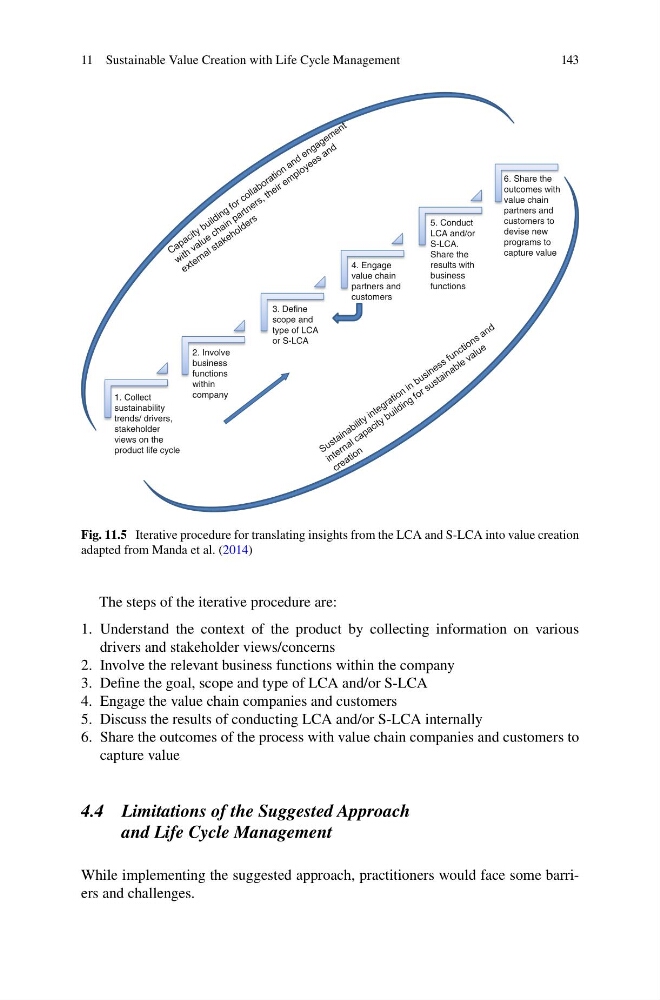
The steps of the iterative procedure are:
1. Understand the context of the product by collecting information on various
drivers and stakeholder views/concerns
2. Involve the relevant business functions within the company
3. Defi ne the goal, scope and type of LCA and/or S-LCA
4. Engage the value chain companies and customers
5. Discuss the results of conducting LCA and/or S-LCA internally
6. Share the outcomes of the process with value chain companies and customers to
capture value
4.4 Limitations of the Suggested Approach
and Life Cycle Management
While implementing the suggested approach, practitioners would face some barriers and challenges.
1. Collect
sustainability
trends/ drivers,
stakeholder
views on the
product life cycle
2. Involve
business
functions
within
company
3. Define
scope and
type of LCA
or S-LCA
4. Engage
value chain
partners and
customers
5. Conduct
LCA and/or
S-LCA.
Share the
results with
business
functions
6. Share the
outcomes with
value chain
partners and
customers to
devise new
programs to
capture value
Fig. 11.5 Iterative procedure for translating insights from the LCA and S-LCA into value creation
adapted from Manda et al. ( 2014 )
11 Sustainable Value Creation with Life Cycle Management
The steps of the iterative procedure are:
1. Understand the context of the product by collecting information on various
drivers and stakeholder views/concerns
2. Involve the relevant business functions within the company
3. Defi ne the goal, scope and type of LCA and/or S-LCA
4. Engage the value chain companies and customers
5. Discuss the results of conducting LCA and/or S-LCA internally
6. Share the outcomes of the process with value chain companies and customers to
capture value
4.4 Limitations of the Suggested Approach
and Life Cycle Management
While implementing the suggested approach, practitioners would face some barriers and challenges.
1. Collect
sustainability
trends/ drivers,
stakeholder
views on the
product life cycle
2. Involve
business
functions
within
company
3. Define
scope and
type of LCA
or S-LCA
4. Engage
value chain
partners and
customers
5. Conduct
LCA and/or
S-LCA.
Share the
results with
business
functions
6. Share the
outcomes with
value chain
partners and
customers to
devise new
programs to
capture value
Fig. 11.5 Iterative procedure for translating insights from the LCA and S-LCA into value creation
adapted from Manda et al. ( 2014 )
11 Sustainable Value Creation with Life Cycle Management