

133
development of new business models. In some companies business development is
part of innovation.
Procurement/sourcing is involved in fi nding the right suppliers who can provide
quality inputs at the right time. It also negotiates pricing and keeps track of the
production timeline. Sourcing also conducts supplier environmental and social audits
and deals with supplier certifi cations. Sourcing is responsible for avoiding any risks
arising from supplier practices, including compliance with local laws and child labor.
It can go further by not only looking at sustainability performance of suppliers but also
at the infl uence of purchased items in the fi nal product life cycle of customers. This
would help close the information cycle between suppliers and fi nal customers and may
bring collaborative opportunities for future sustainable business development.
Marketing and sales is responsible for communicating the product attributes and
differentiating their products against those of their competitors. It conducts market
research to fi nd opportunities for market growth and expansion to new markets.
For Business to Consumers (B2C) companies, it also handles communication with
consumers. Marketing conducts research to acquire the consumer intelligence
related to how customers/consumers make trade-offs between price, environmental
performance and other quality parameters.
To improve sustainability performance of processes and products, all these
business functions need concrete guidance and insights on the product’s impacts
throughout its life cycle. This calls for sound tools to support business functions in
decision-making.
Support activities/functions
Primary activities/functions
Operations
• Reduce
emissions and
waste
• Reduce energy
and water use
• Improve health
and safety
standards
Marketing and
sales
• Communicate
environmental
attributes
• Understand
customer needs
and preferences
• Promote
corporate image
• Gauge new
opportunities
for sustainable
products
Inbound and
outbound logistics
• Reduce
transportation
impacts
• Reduce
packaging
impacts
After-sale service
• Customer
support for
better
performance
• Take-back
• Recycling
Technology and Innovation (RD&D)
• Redesign processes and products for superior sustainable performance
• Design new products from sustainable feedstocks and waste (product service systems, closing the loop)
Procurement
• Choose environmentally and socially responsible suppliers
• Collaborate and develop suppliers for better practices
Human resources
• Training in principles of sustainability
• Develop awareness, culture and reward mechanisms for sustainability integration
Firm infrastructure (EHS, financing, planning, legal, communications)
• Maintain databases of firm resource use and emissions
• Financial and sustainability reporting, transparency, government regulations
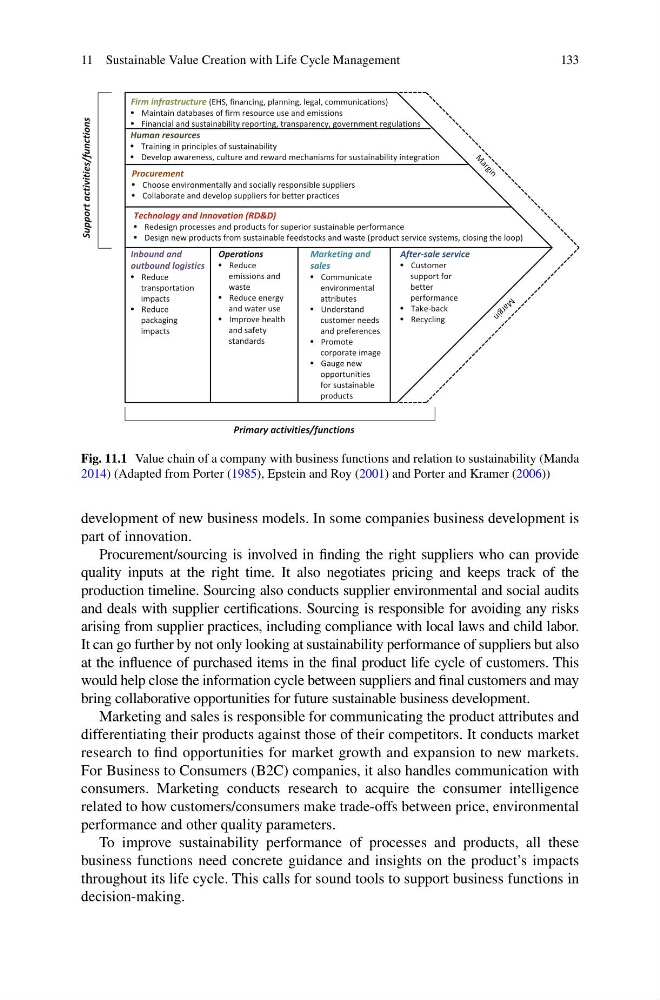
Fig. 11.1 Value chain of a company with business functions and relation to sustainability (Manda
2014 ) (Adapted from Porter ( 1985 ), Epstein and Roy ( 2001 ) and Porter and Kramer ( 2006 ))
11 Sustainable Value Creation with Life Cycle Management
development of new business models. In some companies business development is
part of innovation.
Procurement/sourcing is involved in fi nding the right suppliers who can provide
quality inputs at the right time. It also negotiates pricing and keeps track of the
production timeline. Sourcing also conducts supplier environmental and social audits
and deals with supplier certifi cations. Sourcing is responsible for avoiding any risks
arising from supplier practices, including compliance with local laws and child labor.
It can go further by not only looking at sustainability performance of suppliers but also
at the infl uence of purchased items in the fi nal product life cycle of customers. This
would help close the information cycle between suppliers and fi nal customers and may
bring collaborative opportunities for future sustainable business development.
Marketing and sales is responsible for communicating the product attributes and
differentiating their products against those of their competitors. It conducts market
research to fi nd opportunities for market growth and expansion to new markets.
For Business to Consumers (B2C) companies, it also handles communication with
consumers. Marketing conducts research to acquire the consumer intelligence
related to how customers/consumers make trade-offs between price, environmental
performance and other quality parameters.
To improve sustainability performance of processes and products, all these
business functions need concrete guidance and insights on the product’s impacts
throughout its life cycle. This calls for sound tools to support business functions in
decision-making.
Support activities/functions
Primary activities/functions
Operations
• Reduce
emissions and
waste
• Reduce energy
and water use
• Improve health
and safety
standards
Marketing and
sales
• Communicate
environmental
attributes
• Understand
customer needs
and preferences
• Promote
corporate image
• Gauge new
opportunities
for sustainable
products
Inbound and
outbound logistics
• Reduce
transportation
impacts
• Reduce
packaging
impacts
After-sale service
• Customer
support for
better
performance
• Take-back
• Recycling
Technology and Innovation (RD&D)
• Redesign processes and products for superior sustainable performance
• Design new products from sustainable feedstocks and waste (product service systems, closing the loop)
Procurement
• Choose environmentally and socially responsible suppliers
• Collaborate and develop suppliers for better practices
Human resources
• Training in principles of sustainability
• Develop awareness, culture and reward mechanisms for sustainability integration
Firm infrastructure (EHS, financing, planning, legal, communications)
• Maintain databases of firm resource use and emissions
• Financial and sustainability reporting, transparency, government regulations
Fig. 11.1 Value chain of a company with business functions and relation to sustainability (Manda
2014 ) (Adapted from Porter ( 1985 ), Epstein and Roy ( 2001 ) and Porter and Kramer ( 2006 ))
11 Sustainable Value Creation with Life Cycle Management