

114
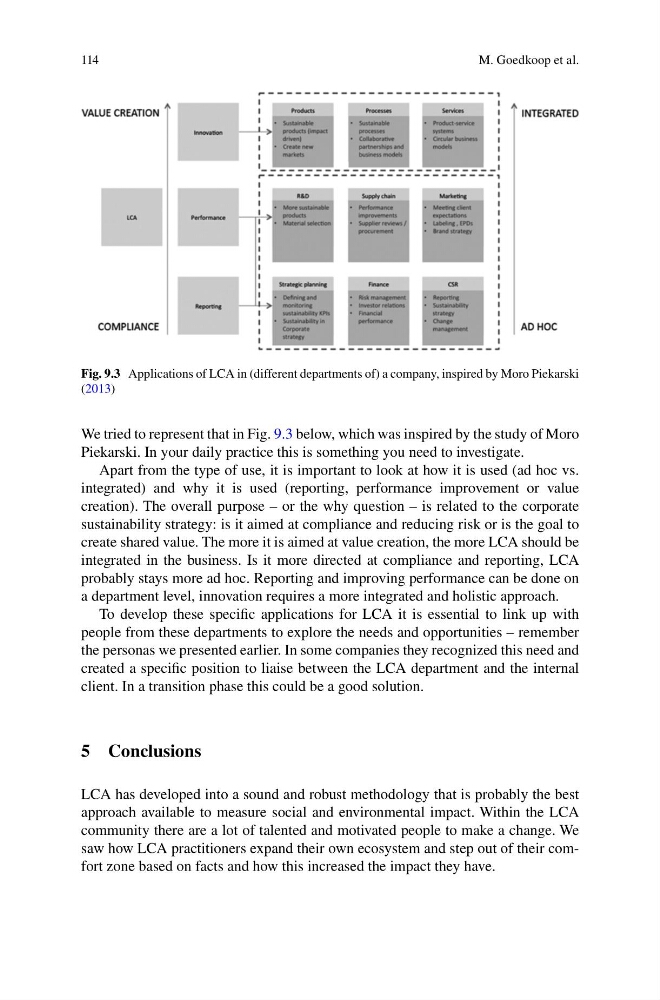
We tried to represent that in Fig. 9.3 below, which was inspired by the study of Moro
Piekarski. In your daily practice this is something you need to investigate.
Apart from the type of use, it is important to look at how it is used (ad hoc vs.
integrated) and why it is used (reporting, performance improvement or value
creation). The overall purpose – or the why question – is related to the corporate
sustainability strategy: is it aimed at compliance and reducing risk or is the goal to
create shared value. The more it is aimed at value creation, the more LCA should be
integrated in the business. Is it more directed at compliance and reporting, LCA
probably stays more ad hoc. Reporting and improving performance can be done on
a department level, innovation requires a more integrated and holistic approach.
To develop these specifi c applications for LCA it is essential to link up with
people from these departments to explore the needs and opportunities – remember
the personas we presented earlier. In some companies they recognized this need and
created a specifi c position to liaise between the LCA department and the internal
client. In a transition phase this could be a good solution.
5 Conclusions
LCA has developed into a sound and robust methodology that is probably the best
approach available to measure social and environmental impact. Within the LCA
community there are a lot of talented and motivated people to make a change. We
saw how LCA practitioners expand their own ecosystem and step out of their comfort zone based on facts and how this increased the impact they have.
Fig. 9.3 Applications of LCA in (different departments of) a company, inspired by Moro Piekarski
( 2013 )
M. Goedkoop et al.
We tried to represent that in Fig. 9.3 below, which was inspired by the study of Moro
Piekarski. In your daily practice this is something you need to investigate.
Apart from the type of use, it is important to look at how it is used (ad hoc vs.
integrated) and why it is used (reporting, performance improvement or value
creation). The overall purpose – or the why question – is related to the corporate
sustainability strategy: is it aimed at compliance and reducing risk or is the goal to
create shared value. The more it is aimed at value creation, the more LCA should be
integrated in the business. Is it more directed at compliance and reporting, LCA
probably stays more ad hoc. Reporting and improving performance can be done on
a department level, innovation requires a more integrated and holistic approach.
To develop these specifi c applications for LCA it is essential to link up with
people from these departments to explore the needs and opportunities – remember
the personas we presented earlier. In some companies they recognized this need and
created a specifi c position to liaise between the LCA department and the internal
client. In a transition phase this could be a good solution.
5 Conclusions
LCA has developed into a sound and robust methodology that is probably the best
approach available to measure social and environmental impact. Within the LCA
community there are a lot of talented and motivated people to make a change. We
saw how LCA practitioners expand their own ecosystem and step out of their comfort zone based on facts and how this increased the impact they have.
Fig. 9.3 Applications of LCA in (different departments of) a company, inspired by Moro Piekarski
( 2013 )
M. Goedkoop et al.