

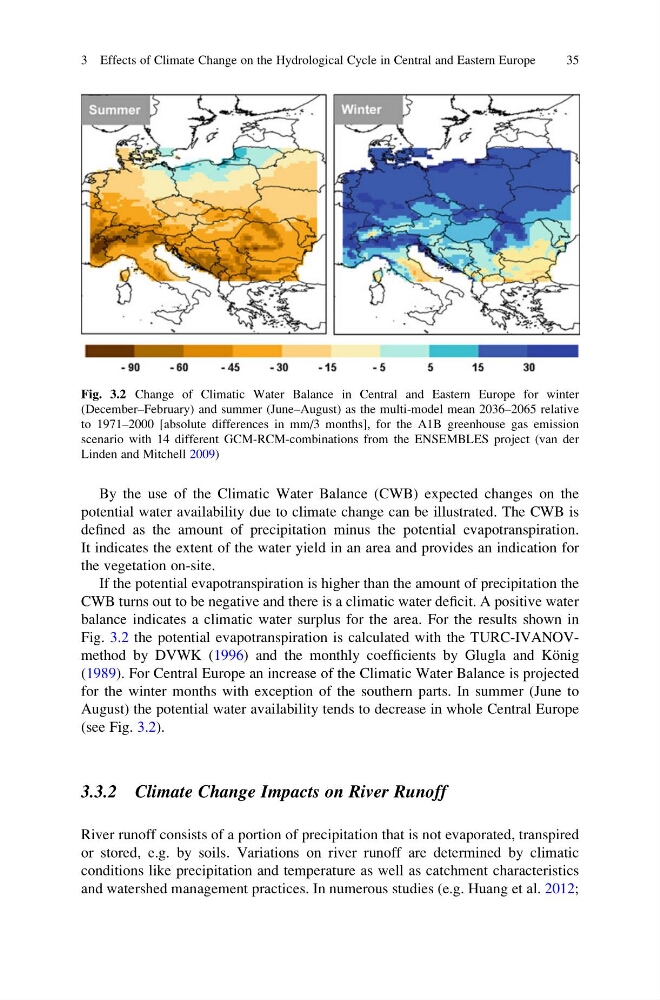
By the use of the Climatic Water Balance (CWB) expected changes on the
potential water availability due to climate change can be illustrated. The CWB is
defined as the amount of precipitation minus the potential evapotranspiration.
It indicates the extent of the water yield in an area and provides an indication for
the vegetation on-site.
If the potential evapotranspiration is higher than the amount of precipitation the
CWB turns out to be negative and there is a climatic water deficit. A positive water
balance indicates a climatic water surplus for the area. For the results shown in
Fig. 3.2 the potential evapotranspiration is calculated with the TURC-IVANOVmethod by DVWK (1996) and the monthly coefficients by Glugla and Ko ¨nig
(1989). For Central Europe an increase of the Climatic Water Balance is projected
for the winter months with exception of the southern parts. In summer (June to
August) the potential water availability tends to decrease in whole Central Europe
(see Fig. 3.2).
3.3.2 Climate Change Impacts on River Runoff
River runoff consists of a portion of precipitation that is not evaporated, transpired
or stored, e.g. by soils. Variations on river runoff are determined by climatic
conditions like precipitation and temperature as well as catchment characteristics
and watershed management practices. In numerous studies (e.g. Huang et al. 2012;
Fig. 3.2 Change of Climatic Water Balance in Central and Eastern Europe for winter
(December–February) and summer (June–August) as the multi-model mean 2036–2065 relative
to 1971–2000 [absolute differences in mm/3 months], for the A1B greenhouse gas emission
scenario with 14 different GCM-RCM-combinations from the ENSEMBLES project (van der
Linden and Mitchell 2009)
3 Effects of Climate Change on the Hydrological Cycle in Central and Eastern Europe
35
potential water availability due to climate change can be illustrated. The CWB is
defined as the amount of precipitation minus the potential evapotranspiration.
It indicates the extent of the water yield in an area and provides an indication for
the vegetation on-site.
If the potential evapotranspiration is higher than the amount of precipitation the
CWB turns out to be negative and there is a climatic water deficit. A positive water
balance indicates a climatic water surplus for the area. For the results shown in
Fig. 3.2 the potential evapotranspiration is calculated with the TURC-IVANOVmethod by DVWK (1996) and the monthly coefficients by Glugla and Ko ¨nig
(1989). For Central Europe an increase of the Climatic Water Balance is projected
for the winter months with exception of the southern parts. In summer (June to
August) the potential water availability tends to decrease in whole Central Europe
(see Fig. 3.2).
3.3.2 Climate Change Impacts on River Runoff
River runoff consists of a portion of precipitation that is not evaporated, transpired
or stored, e.g. by soils. Variations on river runoff are determined by climatic
conditions like precipitation and temperature as well as catchment characteristics
and watershed management practices. In numerous studies (e.g. Huang et al. 2012;
Fig. 3.2 Change of Climatic Water Balance in Central and Eastern Europe for winter
(December–February) and summer (June–August) as the multi-model mean 2036–2065 relative
to 1971–2000 [absolute differences in mm/3 months], for the A1B greenhouse gas emission
scenario with 14 different GCM-RCM-combinations from the ENSEMBLES project (van der
Linden and Mitchell 2009)
3 Effects of Climate Change on the Hydrological Cycle in Central and Eastern Europe
35