

compact to form glaciers and ice caps. In case of ice and snow, the water stored
is released to the cycle with delay as a function of temperature. Rainfall type,
volume and intensity are a decisive factor for further processes in the catchment.
Factors controlling evaporation are the amount of incident solar radiation, the
vapour pressure of the air relative to saturation, air temperature, wind circulation
and atmospheric pressure. About 600 calories of energy per gram of water is
exchanged during the change from a liquid to a gaseous state. Transpiration
accounts for loss of water vapour through plant stomata. Besides in snow and
ice covers, water can be held on the canopy surface, which includes plant foliage,
branches and stems. From this so called interception store, it eventually evaporates
to the atmosphere without reaching the soil surface. If rainfall intensity exceeds
the soil’s infiltration capacity, surface runoff occurs. The respective infiltration
rate depends mainly on the texture and structure as well as the initial moisture
content of the soil. Water infiltrated can be held in the unsaturated soil dependent
on the amount lost by plant uptake, evaporation, groundwater recharge, or interflow
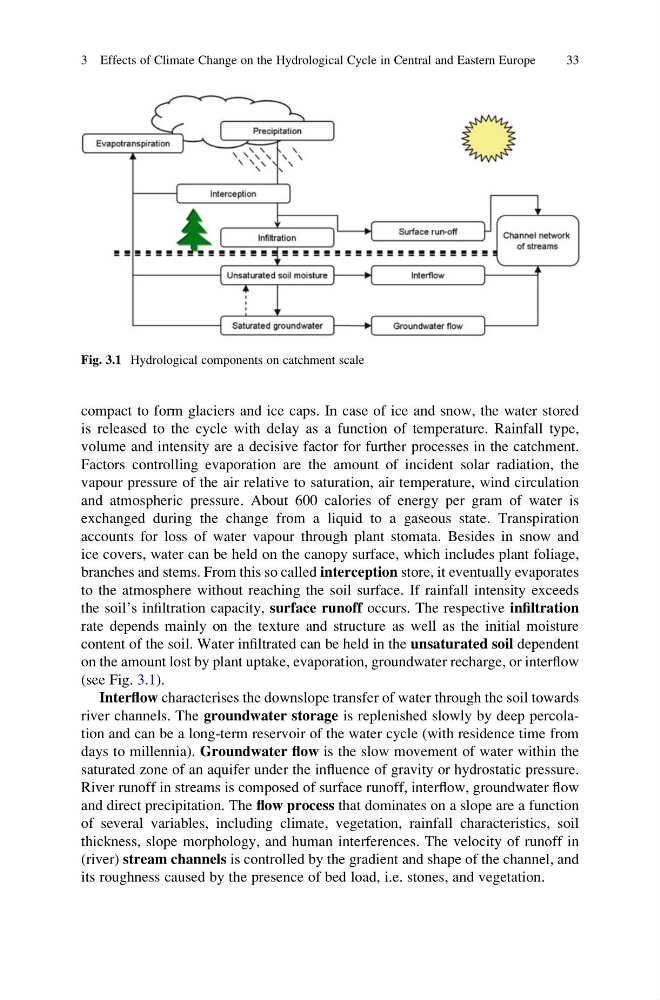
(see Fig. 3.1).
Interflow characterises the downslope transfer of water through the soil towards
river channels. The groundwater storage is replenished slowly by deep percolation and can be a long-term reservoir of the water cycle (with residence time from
days to millennia). Groundwater flow is the slow movement of water within the
saturated zone of an aquifer under the influence of gravity or hydrostatic pressure.
River runoff in streams is composed of surface runoff, interflow, groundwater flow
and direct precipitation. The flow process that dominates on a slope are a function
of several variables, including climate, vegetation, rainfall characteristics, soil
thickness, slope morphology, and human interferences. The velocity of runoff in
(river) stream channels is controlled by the gradient and shape of the channel, and
its roughness caused by the presence of bed load, i.e. stones, and vegetation.
Fig. 3.1 Hydrological components on catchment scale
3 Effects of Climate Change on the Hydrological Cycle in Central and Eastern Europe
33
is released to the cycle with delay as a function of temperature. Rainfall type,
volume and intensity are a decisive factor for further processes in the catchment.
Factors controlling evaporation are the amount of incident solar radiation, the
vapour pressure of the air relative to saturation, air temperature, wind circulation
and atmospheric pressure. About 600 calories of energy per gram of water is
exchanged during the change from a liquid to a gaseous state. Transpiration
accounts for loss of water vapour through plant stomata. Besides in snow and
ice covers, water can be held on the canopy surface, which includes plant foliage,
branches and stems. From this so called interception store, it eventually evaporates
to the atmosphere without reaching the soil surface. If rainfall intensity exceeds
the soil’s infiltration capacity, surface runoff occurs. The respective infiltration
rate depends mainly on the texture and structure as well as the initial moisture
content of the soil. Water infiltrated can be held in the unsaturated soil dependent
on the amount lost by plant uptake, evaporation, groundwater recharge, or interflow
(see Fig. 3.1).
Interflow characterises the downslope transfer of water through the soil towards
river channels. The groundwater storage is replenished slowly by deep percolation and can be a long-term reservoir of the water cycle (with residence time from
days to millennia). Groundwater flow is the slow movement of water within the
saturated zone of an aquifer under the influence of gravity or hydrostatic pressure.
River runoff in streams is composed of surface runoff, interflow, groundwater flow
and direct precipitation. The flow process that dominates on a slope are a function
of several variables, including climate, vegetation, rainfall characteristics, soil
thickness, slope morphology, and human interferences. The velocity of runoff in
(river) stream channels is controlled by the gradient and shape of the channel, and
its roughness caused by the presence of bed load, i.e. stones, and vegetation.
Fig. 3.1 Hydrological components on catchment scale
3 Effects of Climate Change on the Hydrological Cycle in Central and Eastern Europe
33