

dataset and the HABIT-CHANGE-database 2012). Even though models predict a
slight increase in precipitation (about 20 mm/day), the number of dry days
(<1 mm/day) per vegetation season is expected to increase by 4–5 days. When
combining these models the predicted beginning of the vegetation period will shift
from 22nd February (1971–2000) to 27th January (2036–2065). Additionally, the
predicted water balance, calculated as the mean precipitation minus the potential
evapotranspiration, is expected to decrease slightly in autumn.
Global-warming-related effects on biodiversity can be mitigated in the short
term by designing an appropriate nature reserve (Botkin et al. 2007). However, the
challenges of biodiversity loss are daunting, since biodiversity is decreasing even in
protected areas. For this reason, alien invasive species found in the Mediterranean,
even if not highly invasive, like A. squamatus, might nevertheless potentially
become so. In Fig. 19.3 we can recognise the distribution of A. squamatus in
areas adjacent to both protected areas of Sec ˇovlje Salina and S ˇ kocjanski Inlet.
As previously noted, in some years like in 2008 the abundance of A. squamatus
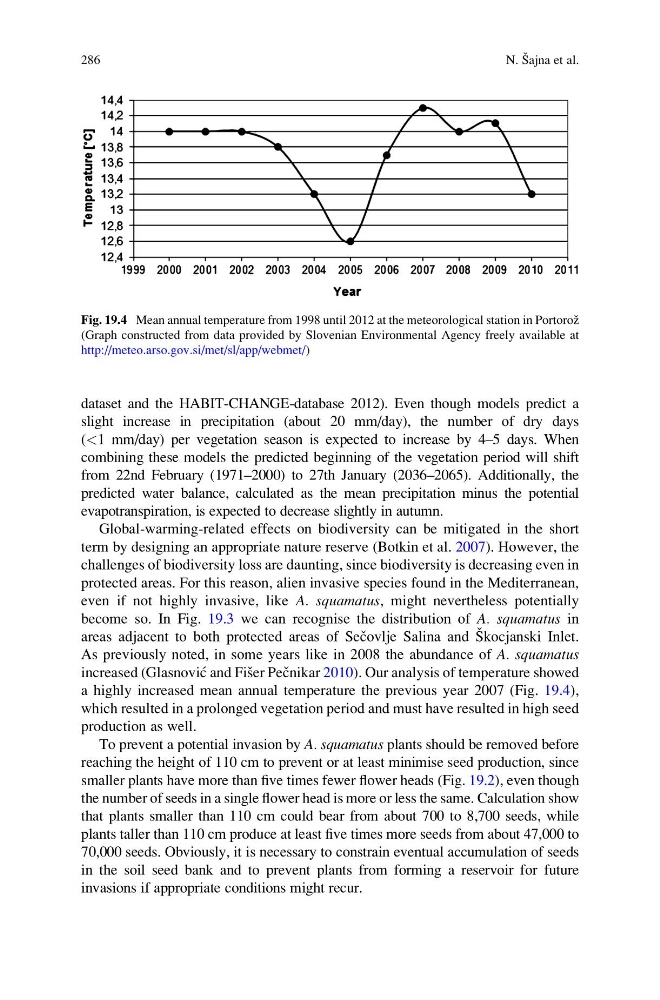
increased (Glasnovic ´ and Fis ˇer Pec ˇnikar 2010). Our analysis of temperature showed
a highly increased mean annual temperature the previous year 2007 (Fig. 19.4),
which resulted in a prolonged vegetation period and must have resulted in high seed
production as well.
To prevent a potential invasion by A. squamatus plants should be removed before
reaching the height of 110 cm to prevent or at least minimise seed production, since
smaller plants have more than five times fewer flower heads (Fig. 19.2), even though
the number of seeds in a single flower head is more or less the same. Calculation show
that plants smaller than 110 cm could bear from about 700 to 8,700 seeds, while
plants taller than 110 cm produce at least five times more seeds from about 47,000 to
70,000 seeds. Obviously, it is necessary to constrain eventual accumulation of seeds
in the soil seed bank and to prevent plants from forming a reservoir for future
invasions if appropriate conditions might recur.
Fig. 19.4 Mean annual temperature from 1998 until 2012 at the meteorological station in Portoroz ˇ
(Graph constructed from data provided by Slovenian Environmental Agency freely available at
http://meteo.arso.gov.si/met/sl/app/webmet/)
286
N. S ˇ ajna et al.
slight increase in precipitation (about 20 mm/day), the number of dry days
(<1 mm/day) per vegetation season is expected to increase by 4–5 days. When
combining these models the predicted beginning of the vegetation period will shift
from 22nd February (1971–2000) to 27th January (2036–2065). Additionally, the
predicted water balance, calculated as the mean precipitation minus the potential
evapotranspiration, is expected to decrease slightly in autumn.
Global-warming-related effects on biodiversity can be mitigated in the short
term by designing an appropriate nature reserve (Botkin et al. 2007). However, the
challenges of biodiversity loss are daunting, since biodiversity is decreasing even in
protected areas. For this reason, alien invasive species found in the Mediterranean,
even if not highly invasive, like A. squamatus, might nevertheless potentially
become so. In Fig. 19.3 we can recognise the distribution of A. squamatus in
areas adjacent to both protected areas of Sec ˇovlje Salina and S ˇ kocjanski Inlet.
As previously noted, in some years like in 2008 the abundance of A. squamatus
increased (Glasnovic ´ and Fis ˇer Pec ˇnikar 2010). Our analysis of temperature showed
a highly increased mean annual temperature the previous year 2007 (Fig. 19.4),
which resulted in a prolonged vegetation period and must have resulted in high seed
production as well.
To prevent a potential invasion by A. squamatus plants should be removed before
reaching the height of 110 cm to prevent or at least minimise seed production, since
smaller plants have more than five times fewer flower heads (Fig. 19.2), even though
the number of seeds in a single flower head is more or less the same. Calculation show
that plants smaller than 110 cm could bear from about 700 to 8,700 seeds, while
plants taller than 110 cm produce at least five times more seeds from about 47,000 to
70,000 seeds. Obviously, it is necessary to constrain eventual accumulation of seeds
in the soil seed bank and to prevent plants from forming a reservoir for future
invasions if appropriate conditions might recur.
Fig. 19.4 Mean annual temperature from 1998 until 2012 at the meteorological station in Portoroz ˇ
(Graph constructed from data provided by Slovenian Environmental Agency freely available at
http://meteo.arso.gov.si/met/sl/app/webmet/)
286
N. S ˇ ajna et al.